






 Portuguese
  Spanish


Change in the operation of supermarkets in Goiás reorganizes shifts on Sundays and holidays, sets a limit for the use of workers, provides for union inspection, and creates fines for companies that violate the rules defined in the collective bargaining agreement of the category.
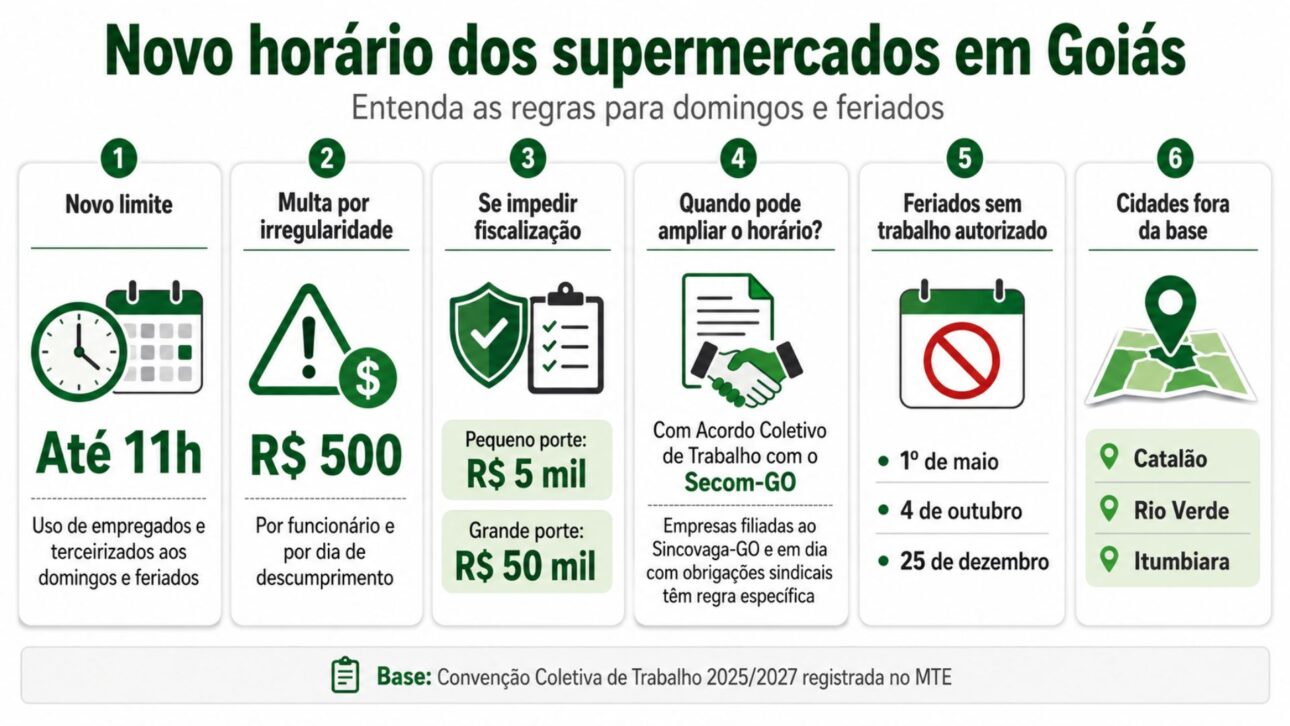
Supermarkets, hypermarkets, wholesale clubs, grocery stores, and retail establishments of food products in Goiás are authorized to use the labor of employees and contractors only until 11 am on Sundays and holidays, according to the Collective Labor Agreement 2025/2027 registered with the Ministry of Labor and Employment.
The rule applies to the territorial base represented by the Union of Employees in Retail Supermarkets, Hypermarkets in the Municipality of Goiânia and Macro Region, Secom-GO, in negotiation with the Union of Retail Food Products in the State of Goiás, Sincovaga-GO.
Registered with the MTE this Tuesday (02), the document is valid until March 31, 2027, and includes rules on working hours, inspection, fines, time banks, and operation on specific dates.
-
São Paulo Expands Healthcare and Housing in Southern Region with New Health Center, 374 Apartments, and Over 2,300 Property Titles

-
Rescue Teams Use Flashlights to Find 47 Dogs in Abandoned, Powerless U.S. Home, Offering Them a Fresh Start Through Responsible Adoption

-
Siblings Discover 1939 Superman Comic in Late Mother’s Attic, Sets Record at $9.12 Million Auction
-
12-Year-Old Discovers 80-Million-Year-Old Marine Tylosaurus Fossil During Kansas Field Trip




Supermarkets in Goiás will have a work limit on Sundays
According to the agreement, work on Sundays and holidays is allowed until 11 am for direct and contracted employees working in the core activities of the food retail trade, such as supermarkets, hypermarkets, wholesale clubs, warehouses, and grocery stores.
To extend this limit, companies need to sign a Collective Labor Agreement with Secom-GO, provided that the instrument includes benefits, conditions aimed at improving work, and compliance with health and safety standards required by the MTE.
In practice, establishments intending to keep employees beyond 11 am on Sundays or holidays must comply with the union requirement stipulated in the agreement, except in situations of waiver expressly described by the collective document itself.
Although it does not necessarily address the physical opening of stores in all cases, the measure restricts the use of workers in the category after the set time, a point that serves as a basis for applying the penalties provided.
Fines for supermarkets that violate the agreement
In case of non-compliance, the company may receive a fine of R$ 500 per worker and per day of Sunday or holiday worked irregularly, when employees are used without a valid collective agreement with Secom-GO.
In the part of the convention regarding 2026/2027, the amount collected from this penalty is divided into 50% for the affected worker and 50% for Secom-GO, according to the clause that regulates work on Sundays and holidays.
The participation of union agents in inspecting companies operating on these dates is also foreseen, with the aim of verifying if the rules agreed upon between the labor and employer entities are being followed.
If the inspection is obstructed, the stipulated fine reaches R$ 5,000 for small establishments, defined as those with up to seven check-outs, and R$ 50,000 for large companies, with more than seven check-outs.
This penalty for obstructing the inspection is reverted to the benefit of Secom-GO and can be proven by means admitted in law, including photographic records and filming, as provided in the collective agreement.
Companies affiliated with Sincovaga-GO have specific rules
Companies affiliated or associated with Sincovaga-GO that are up to date with their union obligations, such as social fee, confederative contribution, assistance contribution, and employer negotiation contribution, are exempt from signing a specific collective agreement.
Under these conditions, establishments are no longer required to sign the agreement mentioned in the caput to extend the time limit on Sundays and holidays, provided they meet the other requirements set forth in the collective instrument.
Even so, all signatory companies must prepare a rotation schedule, according to the legislation that regulates work in commerce on Sundays and holidays and in accordance with the conditions agreed upon in the convention.
With this organization, the norm creates a common parameter for supermarkets and companies in the sector, while preserving the need to observe any applicable municipal rules.
Rio Verde, Itumbiara, and Catalão are excluded from the base
Although the convention covers a wide list of municipalities in Goiás, Catalão, Rio Verde, and Itumbiara are not included in the covered base, as they have their own union representation or negotiation conducted by local and regional entities.
In these three cities, the rules on working hours in supermarkets, work on Sundays, holidays, and any penalties depend on the conventions or collective agreements made by the entities responsible for each territorial base.
This exclusion prevents the automatic application of the conditions agreed between Secom-GO and Sincovaga-GO in these locations, even if the companies engage in the same economic activity and operate in the retail trade of foodstuffs.
For workers and consumers in these cities, the operating routine must be verified based on local union rules, and not just based on the convention registered for Goiânia and the macro region.
Holidays with closure provided by the convention
In addition to the general limit until 11 am, the convention establishes dates on which work is not authorized in the category in 2026: May 1st, Labor Day; October 4th, anticipation of Retail Workers’ Day; and December 25th, Christmas.
On these specific holidays, the clause wording indicates that work is not authorized, even if the general rule allows operation with employees until 11 am on other holidays covered by the convention.
To g1, Secom-GO’s prosecutor, José Nilton Carvalho, stated, in indirect speech, that the agreement seeks to improve the quality of life for workers by reducing hours on Sundays, without completely disrupting the sector’s operation during the week.
According to the understanding presented by the union representative, the limitation of Sunday working hours is linked to the preservation of rest periods, while the convention maintains room for negotiation in cases where companies intend to extend the working hours.
Bank of hours in supermarkets depends on agreement
Another point provided in the Collective Labor Agreement 2025/2027 deals with the creation of a bank of hours, whose implementation depends on a collective agreement made with Secom-GO, except in specific cases of exemption provided in the document.
The compensation of working hours must follow the rules of the Consolidation of Labor Laws and the convention itself, under penalty of nullity of the act and payment of the amounts due according to the applicable salary clauses.
As with the extension of hours on Sundays and holidays, companies affiliated or associated with Sincovaga-GO and up to date with their union obligations receive specific treatment and are exempt from the agreement provided for this point.
Also covered by the convention are outsourced companies that provide services in the core activities of the food retail trade, with a provision for inclusion in the union representativeness plan of the convening entities.
Change affects schedules of workers and companies
For the workers covered by the base, the main practical change is the limitation of service on Sundays and holidays until 11 am, unless there is a valid collective agreement or exemption provided for companies associated with the employer’s union.
On the side of the companies, the central point is the need to adjust schedules, shifts, and any extensions of working hours to the convention rules, especially because the fine for irregular workers can be repeated each day of non-compliance.
Union inspection functions as a control mechanism for the agreement and can result in a high penalty when there is resistance to inspection, especially for networks and establishments classified as larger.
The rules remain valid within the period of the collective agreement and affect the category represented in the municipalities listed in the document registered with the MTE, except for the locations served by their own unions.


