Portuguese
  Spanish



Cement-Based Rechargeable Batteries Will Revolutionize Renewable Energy Generation in the Civil Construction World. Imagine Entire Buildings Capable of Storing Energy in the Very Concrete They’re Made Of!
Imagine an entire twenty-story concrete building that can store energy like a giant battery? The first global concept for cement-based rechargeable batteries emerges, thanks to unique research from the Chalmers University of Technology in Sweden. This vision could become a reality and change the world of renewable energy in civil construction.
Read Also
- Ethanol Made from Coconut Husks, Developed by a Brazilian University, Could Change the World of Renewable Energy
- Robot That Plants and Weeds Promises to Revolutionize the World of Renewable Energy in Agriculture
- The Most Powerful Tidal Turbine in the World Is Ready and Will Revolutionize the World of Renewable Energy
- Giant Offshore Turbines Will Reduce the Price of Wind Energy, Allowing Wind to Play a Larger Role in Renewable Energy Worldwide
The growing demand for sustainable construction materials presents major challenges for researchers. Dr. Emma Zhang, formerly from Chalmers University of Technology in Sweden, joined Professor Luping Tang’s research group several years ago to seek the building materials of the future. Together, they have now succeeded in developing a global concept for a cement-based rechargeable battery.
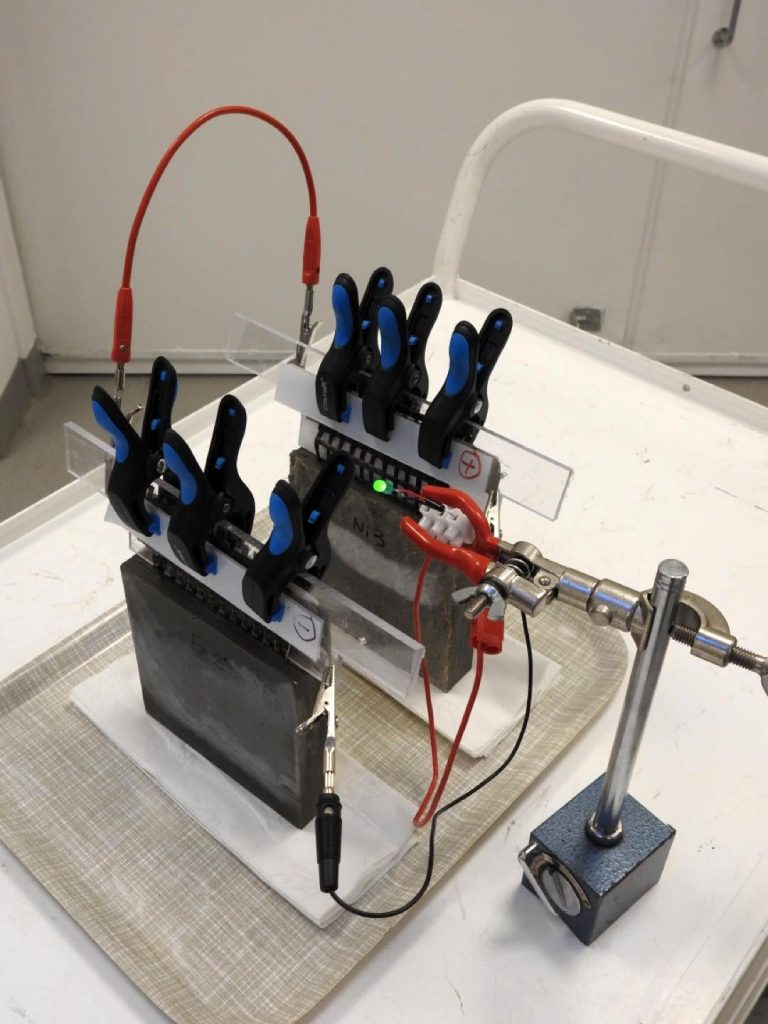
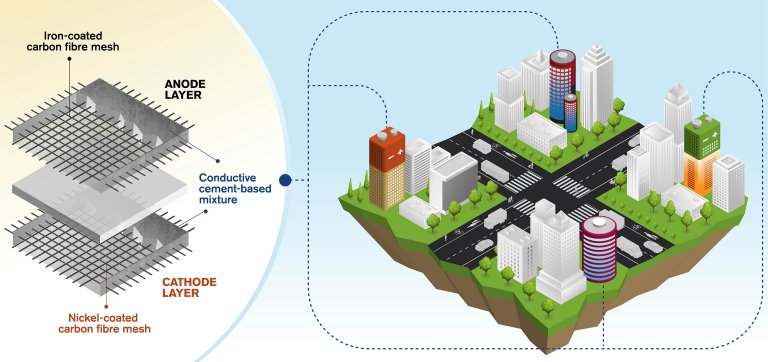
The concept, which promises to revolutionize the construction industry, first involves a cement-based mixture, with small amounts of short carbon fibers added to increase conductivity and flexural strength. Next, embedded within the mixture is a mesh of metal-coated carbon fiber – iron for the anode and nickel for the cathode. After much experimentation, this is the prototype that the researchers are now presenting.
-
Brazil’s Offshore Wind Energy Potential Worth $1 Trillion Stalled by Long-Delayed Agreement

-
World’s Largest Engie Solar Plant in Brazil Highlights Billion-Dollar Energy Waste Issue: Company Considers Batteries and Bitcoin Mining to Avoid Wasting Production

-
Air Products Cancels $2.9 Billion Clean Hydrogen Megaproject in Louisiana, Shuts Down Arizona Unit, Highlighting High Costs of U.S. Energy Transition
-
Over 60 Tractors Take to the Streets in Lopera as Solar Parks Compete with Olive Groves, Affecting 13,000 to 100,000 Trees According to Conflicting Reports


“Results from previous studies investigating concrete battery technology showed very low performance, so we realized we had to think outside the box to come up with another way to produce the electrode. This particular idea we developed – which is also rechargeable – has never been explored before. Now we have a proof of concept at a laboratory scale”, explains Emma Zhang.
Research by Luping Tang and Emma Zhang has produced a cement-based rechargeable battery with an average energy density of 7 Watt-hours per square meter (or 0.8 Watt-hours per liter). Energy density is used to express battery capacity, and a conservative estimate is that the performance of the new Chalmers battery could be more than ten times greater than previous attempts at concrete batteries. The energy density is still low compared to commercial batteries, but this limitation could be overcome thanks to the enormous volume in which the battery could be built when used in buildings.
Cement-Based Rechargeable Battery Becomes a Potential Key in Civil Construction to Solve Energy Storage Issues and Can Be Coupled with Solar Panels
The fact that the battery is rechargeable is its most important quality, and the possibilities for its use if the concept is further developed and commercialized are almost astonishing. Energy storage is an obvious possibility, monitoring is another. The researchers see applications that can range from powering LEDs to providing 4G connections in remote areas or cathodic protection against corrosion in concrete infrastructure.
“It could also be coupled with solar cell panels, for example, to provide electricity and become the power source for monitoring systems on highways or bridges, where sensors operated by a concrete battery could detect cracks or corrosion”, suggests Emma Zhang.
The concept of using structures and buildings in this way could be revolutionary, as it would offer an alternative solution to the energy crisis, providing a large volume of energy storage. Concrete, formed by mixing cement with other ingredients, is the most widely used building material in the world. From a sustainability perspective, it is far from ideal, but the potential to add functionality to it could offer a new dimension. Emma Zhang comments:
“We envision that in the future this technology could allow entire sections of multi-story buildings to be made of functional concrete. Given that any concrete surface could have a layer of this embedded electrode, we are talking about enormous volumes of functional concrete”.
Portable Blade-less Wind Turbine for Urban Spaces Can Revolutionize Renewable Energy Generation Worldwide
Wind Energy: Portable Blade-less (or Propeller-less) Turbine Is the Most Powerful and Safe in History and Suitable for Urban Environments, Safe for Children, Pets, Wildlife, and Birds.
An American startup from Salt Lake City, Halcium, has a project that could revolutionize renewable energy generation for homes. The portable blade-less (or propeller-less) mini wind turbine, called PowerPod, was developed to operate in urban spaces. According to its creators, it is the most powerful and safest wind turbine in history, promising to be cheaper than solar panels.
The 1 kW PowerPod has the potential to produce three times more energy than a conventional turbine. The extra power is due to an advanced blade system in the chainstay that increases wind speed by 40%.
There is also the possibility of connecting the mini wind turbine to solar systems, adding a diversified energy source that can be important on days with less sun.