






 Portuguese
  Spanish
  3 min of reading
  0 comments


The Innovation That Will Change The Future: How Suzuki’s Hydrogen-Powered Motorcycle And Its New Patents Are Shocking The Automotive World
In a twist that shook the automotive world, Suzuki surprised everyone by revealing its latest innovation: a hydrogen-powered motorcycle. In a landscape where most automakers are focused on developing electric vehicles, Suzuki’s initiative to explore hydrogen as an alternative shows its commitment to diversification and innovation in mobility.
Suzuki’s Diversification In Fuel Use
Suzuki’s choice to invest in hydrogen technology marks a significant strategic shift. While many companies are betting all their chips on electric vehicles, Suzuki opts for a broader approach, developing alternatives that go beyond pure electrification. This move allows the company to remain versatile and capable of meeting various market demands while adapting to different global regulations.
Suzuki’s focus on multiple technologies ensures that it is not restricted to a single solution, which can be a significant differentiator in an increasingly competitive market. The ability to adapt to different types of fuel and changes in global energy policies puts Suzuki in a advantageous position for the future.
-
Intense cold arrives with winter on Sunday, threatens frost from the South to the Southeast, and could leave Rio Grande do Sul with negative temperatures starting this weekend.

-
Astronomers find a “fossil” of the Milky Way that survived for 12.5 billion years, remained hidden near the center of the galaxy, and now reveals four different generations of stars.

-
Researchers develop a revolutionary solution capable of cooling chips with up to 10 times greater efficiency, overcoming thermal limits that hindered the advancement of modern computing and enabling faster, more compact, and energy-efficient equipment.

-
Scientists pumped seawater to the surface of the Arctic during the third warmest winter ever recorded in the region and thickened the ice by up to 32 centimeters in the tested areas, a gain comparable to the thickness lost in 50 years.




Design Innovations For Hydrogen Energy
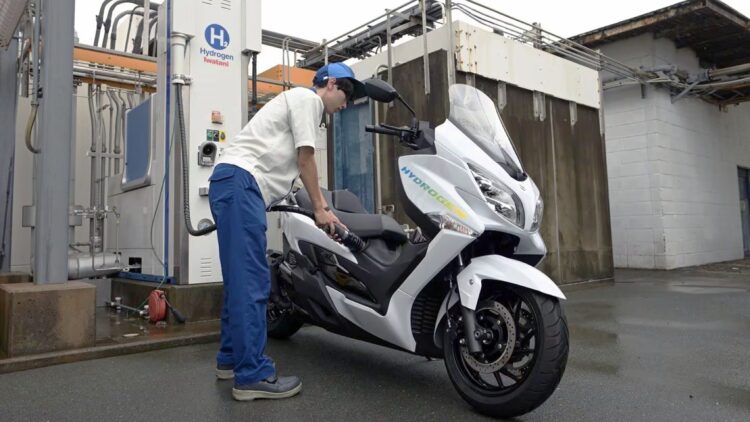
The latest patent applications from Suzuki reveal a creative and ingenious effort to adapt hydrogen technology to its existing lineup, such as the Burgman 400 model. The innovative design integrates two hydrogen tanks, one located in front of the engine and the other under the passenger seat, efficiently utilizing space without compromising the traditional scooter design.
Additionally, Suzuki has adjusted the engines to operate with hydrogen, implementing a sophisticated direct injection system that ensures efficient combustion. This adaptation demonstrates Suzuki’s willingness to overcome technical challenges and explore the limits of engineering in search of sustainable and efficient solutions.
Hydrogen Versus Electricity
Suzuki’s investment in hydrogen technology highlights several significant advantages over battery electric motors, especially for larger motorcycles. The quick refueling of hydrogen fuel cells, compared to the recharge time of batteries, is an important advantage in alleviating user range anxiety.
Moreover, hydrogen allows for the continuous development of internal combustion (IC) engines, offering a more affordable alternative in terms of research and development (R&D) costs. This approach can be particularly advantageous for high-performance touring motorcycles, where weight and range are critical factors.
The Future Of Motorcycles
Suzuki’s bet on hydrogen-powered motorcycles reveals a future vision that goes beyond total electrification. By exploring different types of fuels, the company positions itself as a progressive leader, willing to innovate and provide diverse solutions for an uncertain future.
The challenges of decarbonizing the automotive industry are vast, but the launch of a hydrogen-powered motorcycle, such as the Suzuki Burgman, could mark a new chapter in sustainable mobility, addressing performance and sustainability issues that might otherwise go unnoticed. Suzuki’s recent patents indicate a commitment to innovation that could transform the motorcycle market in the coming years.





Be the first to react!