Portuguese
  Spanish


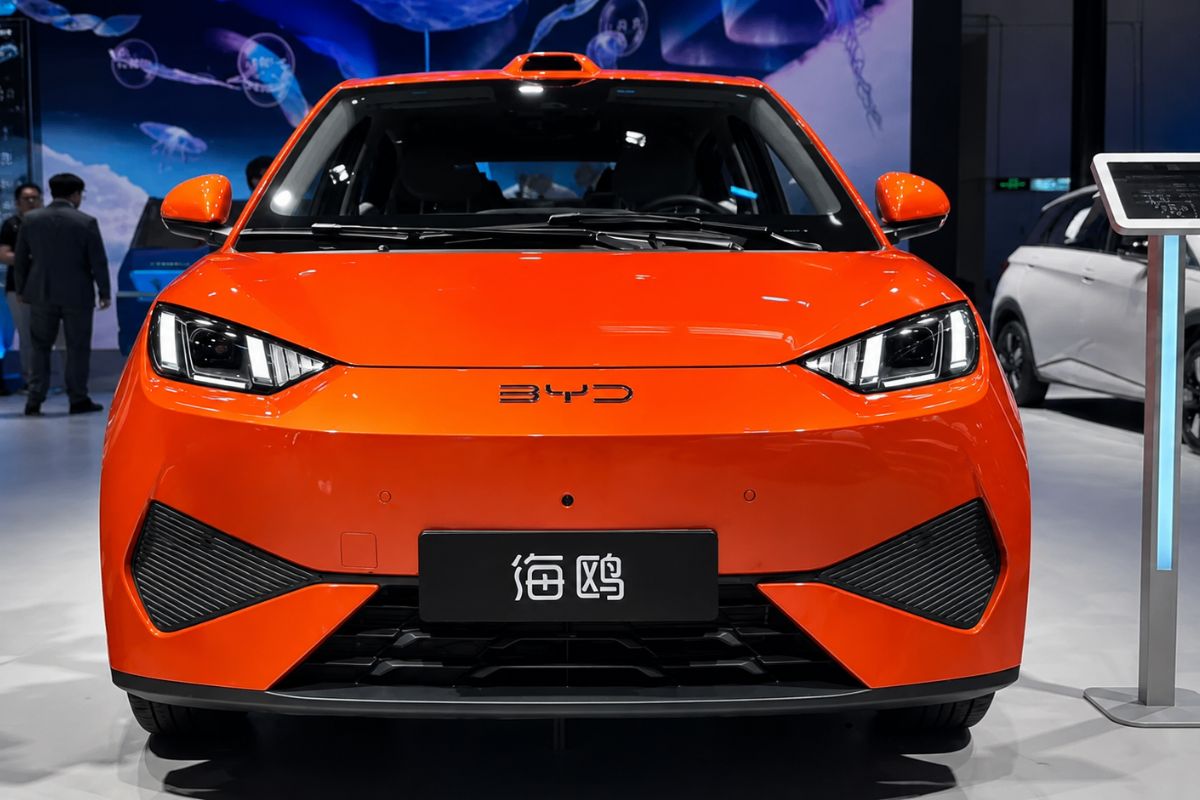


The BYD Dolphin Mini appeared at the Beijing Motor Show 2026 with a discreet visual update, but much more ambitious on the technical side, combining a possible LiDAR sensor on the roof, power gain, internal reorganization, and a range that can reach 500 km in the Chinese cycle, changing the game among affordable electric compacts
The BYD Dolphin Mini emerged at the Beijing Motor Show 2026 as a strategic update to the model known in China as the Seagull, revealing a clear move by BYD to push its entry-level car to a new technical level. The brand presented the compact with less focus on appearance and more on content evolution, preserving the project’s foundation but adding features that typically don’t easily appear in this market segment.
According to the portal Inside EVs, what put the BYD Dolphin Mini in the spotlight was precisely this combination of advancements. The model appeared with possible use of a LiDAR sensor on the roof, an enlarged motor to about 60 kW, or 81 hp, and indications that the range could reach approximately 500 km in the CLTC standard, still without official confirmation. In practice, BYD sent a clear message to the market: the electric compact no longer wants to be seen merely as an entry point, but as a product that is starting to raise the bar in the segment.
The electric compact changed without fanfare

The update of the BYD Dolphin Mini was not designed as a visual rupture. The design remains practically the same, with minor external revisions, new color options, and specific adjustments to the wheels. This shows that BYD preferred not to tamper too much with an already consolidated base.
-
Rolls-Royce Turns Heads with 30-Inch Floating Wheels, 6.6-Liter V12 Engine, and 563 Horsepower

-
2019 Kia Sportage EX: A Spacious and Cost-Effective SUV with 2.0 Flex Engine and Panoramic Roof
-
Fiat Strada Becomes Top Seller in June, Surpassing Onix, Polo, Hilux, and T-Cross with 107 HP Engine and 732 km Range.

-
Suitcase-sized hydrogen engine spins at 25,000 rpm, nearly doubling the efficiency of conventional cars and replacing exhaust smoke with water vapor


This type of choice says a lot about the brand’s strategy. Instead of reinventing the car’s exterior, BYD decided to focus on areas where the impact on the consumer can be greater: technology, efficiency, usability, and perceived value. It’s a product evolution, not an identity change.
The LiDAR is the most striking detail on the roof
The most symbolic point of the update is the possibility of using a LiDAR sensor on the roof, associated with BYD’s most advanced driving assistance package. In entry-level cars, this type of equipment is still rare, which makes the move particularly relevant.
By bringing this feature to the BYD Dolphin Mini, the brand signals that it is trying to push technologies previously restricted to more expensive models to higher-volume products. It is precisely this type of movement that shakes up the market, because it transforms what was premium into something that starts to trickle down to the base.
The motor got stronger and reinforces the package’s evolution
The update also affects the mechanical part. The BYD Dolphin Mini goes from 55 kW, or 75 hp, to about 60 kW, or 81 hp. It may seem like a small leap on paper, but it helps reinforce the idea of a more mature car, better adjusted for broader use.
When this change appears alongside more technology and more range, the gain is no longer isolated. The stronger motor is not just a better number; it is part of a package that tries to move the model away from the image of a basic electric car and closer to a more complete standard.
Range might be the point that most impacts the market
Today, the Seagull offers up to 405 km in the Chinese cycle. The new configuration displayed in Beijing indicates that the range could reach approximately 500 km in the CLTC standard, although this number has not yet been officially confirmed.
This data is crucial because range is still one of the biggest psychological and practical barriers for those considering entering the world of electric vehicles. If the BYD Dolphin Mini truly approaches 500 km, it will no longer be treated merely as an urban car and will begin to occupy a much broader space in the consumer’s mind.
The interior changed little, but it changed where it mattered


Inside, the BYD Dolphin Mini also followed the logic of evolution without rupture. The changes were discreet but focused on usability. The brand reorganized the center console, simplified the steering wheel controls, and included a new armrest with a compartment.
Another important point was wireless charging, which now has a power of up to 50 W with a cooling system. These details don’t transform the interior into a different car, but they improve the daily experience, which is precisely where an electric compact needs to convince.
The BYD Dolphin Mini wants to remain accessible without looking too simple
The basis shows that BYD is trying to preserve the car’s original proposal, accessibility and scale, without making it seem technically limited. This is a delicate equation. The more technology enters, the greater the risk of the product moving away from the idea of an entry-level car.
So far, however, what appears is another intention. The brand wants to keep the BYD Dolphin Mini as a high-volume model, but with a level of content that makes rivals seem older, more basic, and less prepared for the new phase of electric vehicles.
What was shown in Beijing pressures entry-level rivals
Even without a radical generational change, the package presented in Beijing has the weight to change the segment’s benchmark. This happens because the BYD Dolphin Mini already occupies an unusual position, competing for space with compact combustion hatchbacks in price and volume.
When a car like this gains more power, possible LiDAR, and potentially much superior range, it changes market expectations. The message is simple and strong: the entry-level electric car can start to demand fewer concessions from the buyer and more reaction from competitors.
Brazil still has no confirmation, but the impact already exists

The base itself highlights that there is no confirmation that these changes will reach Brazil. This is especially true given BYD’s local strategy and production in Camaçari. Therefore, for now, what was seen in Beijing cannot be treated as a confirmed update for the Brazilian market.
Even so, the impact already exists because the BYD Dolphin Mini sold here is part of the same product logic. When China receives more range, more power, and more driving assistance in an entry-level model, the inevitable reflection is to increase pressure on what consumers and rivals also come to expect in other markets.
What BYD seems to be doing behind this update
The brand’s move suggests a well-calculated strategy. Instead of reserving more advanced features only for larger and more expensive cars, BYD is starting to spread some of this content across entry-level models. This strengthens its image of technological leadership and, at the same time, expands its competitive advantage in volume.
In the case of the BYD Dolphin Mini, this choice is even more relevant because it occupies precisely the step where many consumers begin to consider an electric car for the first time. If this car becomes more complete without losing its essence, the brand manages to tackle a crucial point in the market transition.
The electric compact is no longer just basic
For a long time, the logic of the entry-level electric car was simple: more competitive price, but also more limitations, especially in performance, range, and technological sophistication. The BYD Dolphin Mini that appeared in Beijing suggests that this logic may be changing.
By incorporating possible LiDAR, a stronger motor, and a range that can reach 500 km, the model shows that the electric compact no longer wants to be just acceptable. It wants to start being desirable, competitive, and technically respected. That’s where the story really gets interesting.
Beijing showed a more ambitious BYD Dolphin Mini
In the end, what appeared at the show was not a visual revolution, but a change in stance. The BYD Dolphin Mini remains recognizable, continues to be compact, and maintains its entry-level position, but emerges with clearly greater ambitions.
The feeling is that BYD decided to test how far it can take a small car without removing its mass-market appeal. If this package truly advances, the electric compact could cease to be just the cheapest model in the lineup and become one of the most troublesome products for competitors.
If the BYD Dolphin Mini really gains possible LiDAR, a stronger motor, and a range close to 500 km, will entry-level electric cars truly level up, or will the market still resist accepting so much technology descending so quickly to the base?