Portuguese
  Spanish



Emergency measure seeks to relieve costs for the population, reduce protests, and incentivize sustainable urban mobility amid skyrocketing gasoline and diesel prices
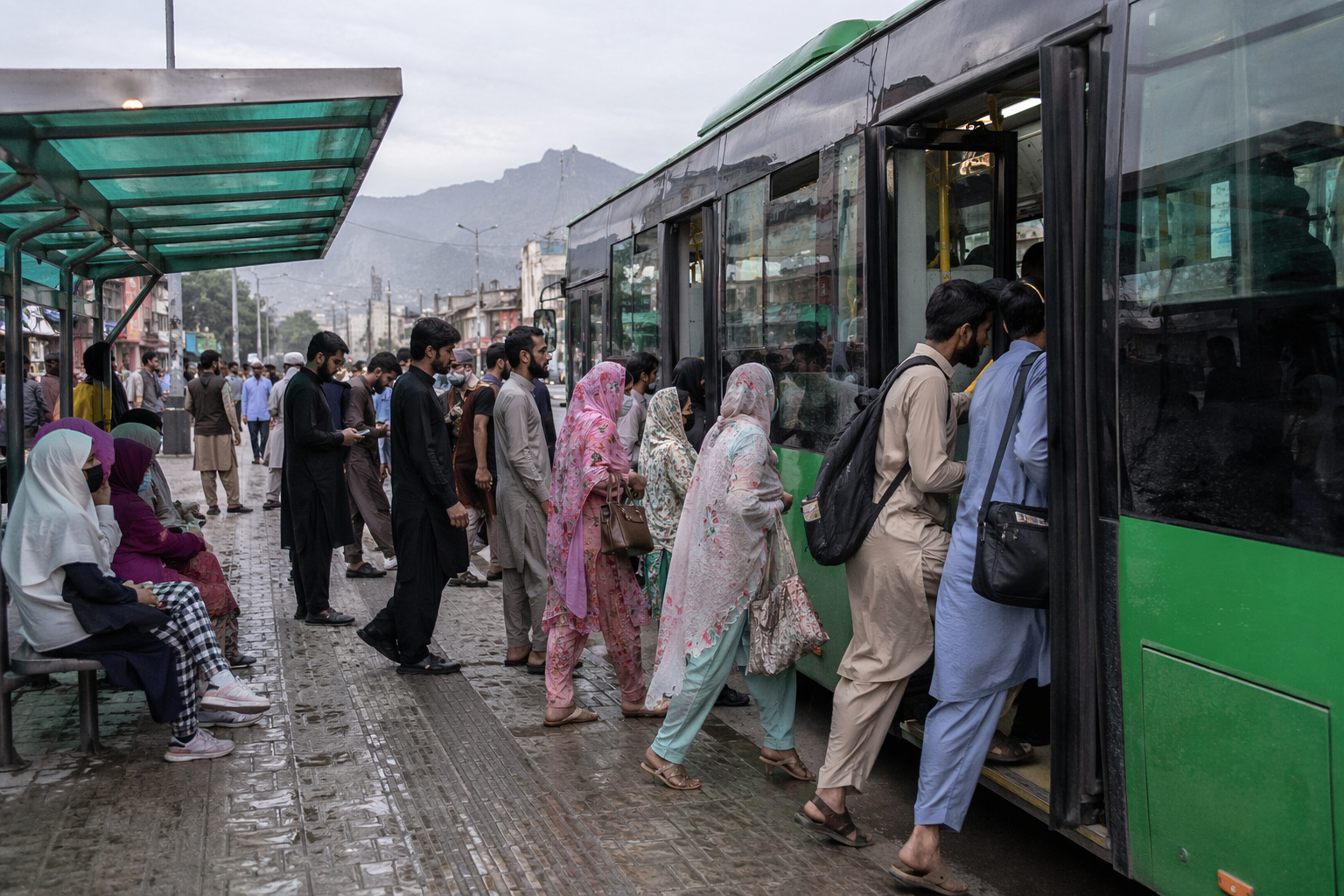
A decision of great social impact was announced by the government of Pakistan in early April 2026, after weeks of economic tension and popular pressure.
The free public transport began to be implemented on April 4, 2026, covering Islamabad and other strategic provinces of the country.
The measure was adopted as a direct response to the significant rise in fuel prices, driven by the war in the Middle East.
This scenario led to an increase in the cost of living and intensified protests in urban centers.
Thus, the government sought an immediate solution to contain the effects of the energy crisis.
Implementation of free public transport
The decision was confirmed by the Interior Minister, Mohsin Naqvi, who detailed the scope of the public policy.
According to the government, all buses and subways have been included in the initiative, which expands the reach of the benefit.
Additionally, the measure was structured to last one month, allowing for an initial assessment of its effects.
With this, public transport takes on a central role in the strategy to contain the crisis.
At the same time, the action reinforces the attempt to reduce social pressure caused by recent increases.
Rise in fuel prices intensifies crisis and protests
The increase in fuel prices was recorded as one of the main factors of recent economic instability.
Gasoline saw a rise of 42.7%, while diesel recorded an even higher increase of 54.9%, according to official data released in April 2026.
These adjustments triggered protests in various cities and heightened public dissatisfaction.
Additionally, there was a shortage at gas stations, which further aggravated the situation.
In light of this, the government needed to act quickly to contain the social and economic impacts.
-
Azul tightens its belt, targets aviation fuel prices, and may reduce flights in cities while Campinas, Belo Horizonte, and Recife become key components of the new network.

-
Petrobras surprises the market and reduces diesel prices at refineries, easing pressure on fuels in 2026 and reinforcing its strategy to maintain competitiveness in the energy sector amid international oil fluctuations and global demand.
-
Gasoline prices may have a controlled increase with the new government MP after the crisis between the US and Iran.

-
Five billion-dollar questions put the fuel market on high alert: distributors are avoiding subsidized diesel and leave open the question of who will assume the risk of this cost.



Economic and social impacts of the emergency measure
Free public transport initially offers a direct financial relief to the population.
As a result, many citizens begin to save resources that would have been allocated for daily commuting.
Moreover, the measure can stimulate a redistribution of economic resources, as the money saved tends to be directed to other essential expenses.
At the same time, a reduction in vehicle flow in cities is expected.
Consequently, this may contribute to a decrease in pollutant emissions, strengthening environmental benefits.
Government strategy to reduce energy dependence
The initiative was also conceived as a medium-term strategy to encourage structural changes.
The government assesses that the increased use of public transport can reduce dependence on imported oil.
Furthermore, the policy serves as an experiment in response to the energy crisis.
If the results are positive, similar measures may be considered.
Thus, the country seeks alternatives to face the volatility of global energy prices.
Evaluation of results and possible future adjustments
After the period of free transport, the government intends to conduct detailed social and economic analyses.
These studies will be essential to measure the impact of the public policy on the population and the economy.
Based on this data, future decisions will be made with greater precision.
Additionally, adjustments may be implemented to improve the strategy.
In this way, the government intends to learn from the experience and adapt its actions according to the challenges.
The role of mobility amid the energy crisis
The fuel crisis has highlighted the importance of public policies focused on urban mobility.
Free transport emerges as an emergency response, but also as a potential tool for transformation.
Moreover, the measure reinforces the need to reduce economic vulnerability in the face of external factors.
With this, the debate on mobility and energy gains even more relevance in the global scenario.
Could free transport policies consolidate as a permanent solution during times of international energy crises?