Portuguese
  Spanish


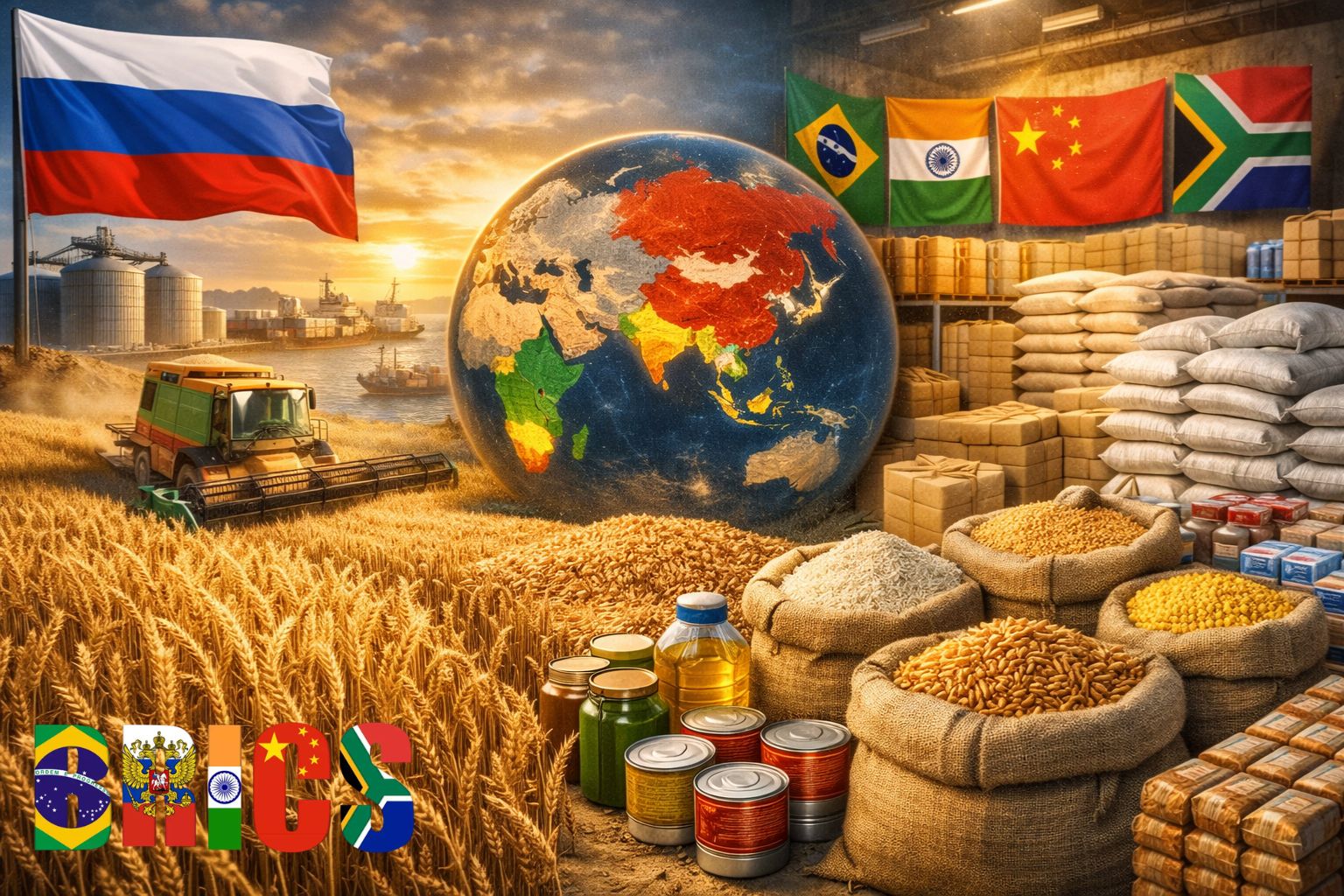

Russia proposed to create joint food reserves with BRICS countries and the Eurasian Economic Union to address food security risks caused by the war in the Middle East. With the Strait of Hormuz practically closed, one-third of global fertilizer trade is blocked, and Russian authorities warn that agricultural productivity could fall by half.
Russia, the world’s largest wheat exporter, wants to create joint food reserves with BRICS countries to protect itself against a famine crisis that the war in the Middle East could trigger. The proposal was presented by Alexander Maslennikov, Deputy Secretary of the Russian Security Council, who warned that the blockade of the Strait of Hormuz has already disrupted routes that accounted for one-third of global fertilizer trade. “To ensure food security, it is very important to expand cooperation with friendly countries, especially the member states of the Eurasian Economic Union and BRICS, including through the creation of joint food reserves”, Maslennikov stated on Monday.
The urgency of the proposal is justified by the numbers. About half of the world’s food is grown using fertilizers, and if the global shortage of these inputs persists until the beginning of summer, the productivity of major crops could fall by half, according to Maslennikov. The World Bank, the International Monetary Fund, and the UN World Food Program already warned last week that increases in oil, natural gas, and fertilizer prices caused by the war will inevitably raise food prices and worsen food insecurity. The number of hungry people in the world could reach a record 673 million, according to Russian estimates.
What Russia proposes to BRICS to tackle the food crisis
According to information from the Forbes portal, the Russian proposal goes beyond a conventional trade agreement. The creation of joint food reserves among BRICS countries would function as a collective strategic stockpile, similar to the oil reserves that some countries maintain for emergency situations. The idea is for each member to contribute agricultural production and store sufficient volumes to meet the bloc’s emergency demands, preventing external crises like the war in the Middle East from turning temporary shortages into widespread famine.
-
India’s Sugar Export Cuts and Ethanol Shift Amid El Niño Threat Could Impact Global Prices and Stocks

-
Quarantine Pest Threatening Palm Trees Puts Brazilian Authorities on Alert, Prompts Monitoring at University of Taubaté and Potential Control Measures Across São Paulo
-
Global Alert: Report Finds 159 Pesticides in Coffee Beans Sold in Europe, Posing Serious Risks to Millions of Farm Workers
-
Low-Demand Brazilian Beef Offal Gains Popularity Abroad: Indonesia Purchases $19.5 Million, Boosting Revenue and Reducing Waste



The scope of the proposal also includes the Eurasian Economic Union, led by Russia, which brings together Kazakhstan, a grain-exporting country, as well as Belarus, Armenia, and Kyrgyzstan. With BRICS including agricultural giants like Brazil, China, and India, the joint reserve would have the potential to cover a significant share of global food demand, creating a cushion against supply shocks that affect vulnerable importing countries. Egypt, a BRICS member and the largest importer of Russian wheat, would be one of the main beneficiaries of such a system.
Why the war in the Middle East threatens BRICS food security
The link between war and food lies in fertilizers. The Strait of Hormuz, a narrow shipping lane along the coast of Iran, has been virtually closed since the beginning of the conflict between the United States, Israel, and Iran, and approximately one-third of global fertilizer trade passed through this route. With the channel blocked, the inputs that feed the crops of dozens of countries are simply not reaching their destinations, and those that arrive via alternative routes cost significantly more.
The impact is not theoretical. Without adequate fertilizers, agricultural productivity could drop by half in the coming harvests, according to estimates presented by Maslennikov to the Russian Security Council. For BRICS countries that are large food importers, such as Egypt and Ethiopia, a drop of this magnitude in global production would mean higher prices, lower availability, and increased hunger. For exporters like Brazil and Argentina, the shortage of imported fertilizers could jeopardize the production that feeds not only their populations but dozens of markets around the world.
The strategic position of Russia within BRICS in the food crisis

Russia is not only a proponent of joint reserves; it is a central piece of the puzzle. The country is the largest wheat exporter in the world and one of the largest producers of fertilizers, two assets that gain extraordinary value in a global food crisis scenario. Maslennikov acknowledged that the situation poses risks to Russia’s own food security, but also “created long-term opportunities for the country’s agricultural producers.”
The statement reveals the dual dimension of the proposal to BRICS. On one hand, Russia wants to protect its allies from hunger and strengthen ties within the bloc. On the other, it wants to consolidate its position as an indispensable supplier of food and fertilizers to markets that increasingly depend on its exports. “Russia is in a strong position to increase food exports to Middle Eastern countries, as well as to Asia, Africa, and Latin America,” said Maslennikov. The BRICS joint reserve proposal is, simultaneously, solidarity and strategy.
What the blockade of the Strait of Hormuz means for BRICS and the world
The closure of the Strait of Hormuz affects more than just fertilizers. The route is vital for the trade of oil and natural gas, and its blockade has already caused sharp increases in energy prices that ripple throughout the food chain, from tractor fuel to the transportation of grains from fields to ports. Warnings from the World Bank and the IMF last week confirmed that the impact on food prices is inevitable and will be felt most acutely by the poorest countries.
For BRICS, which brings together both large-scale food producers and consumers, the crisis in Hormuz exposes a vulnerability that the joint reserves aim to address: the dependence on maritime routes controlled by geopolitical conflicts over which the bloc has little influence. China and India, the two largest economies in BRICS, are major importers of food and fertilizers, and any prolonged disruption in supply chains affects hundreds of millions of people in these countries.
What the BRICS reserve proposal means for Brazil
For Brazil, the Russian proposal to BRICS has direct implications. The country is one of the largest producers and exporters of food in the world, but heavily relies on imported fertilizers, with Russia being one of the main suppliers. A joint BRICS reserve that includes fertilizers in addition to food could provide Brazil with more supply predictability in times of crisis, reducing the vulnerability that the national agricultural sector faces when global supply chains are disrupted.
At the same time, Brazil would be one of the largest contributors to a BRICS food reserve due to its productive capacity. Brazil’s participation in a strategic stockpiling system of the bloc could strengthen the country’s position as a guarantor of global food security, but it would also require supply commitments that would need to be carefully negotiated so as not to compromise domestic supply. President Putin is expected to discuss the topic with Indonesian President Prabowo Subianto this Monday, signaling that the proposal is gaining diplomatic traction within BRICS.
Russia wants to create food reserves with BRICS while the war in the Middle East threatens to spike prices and cut fertilizers. Do you think Brazil should participate? Does this proposal protect or create dependency? Leave your opinion in the comments.