Portuguese
  Spanish


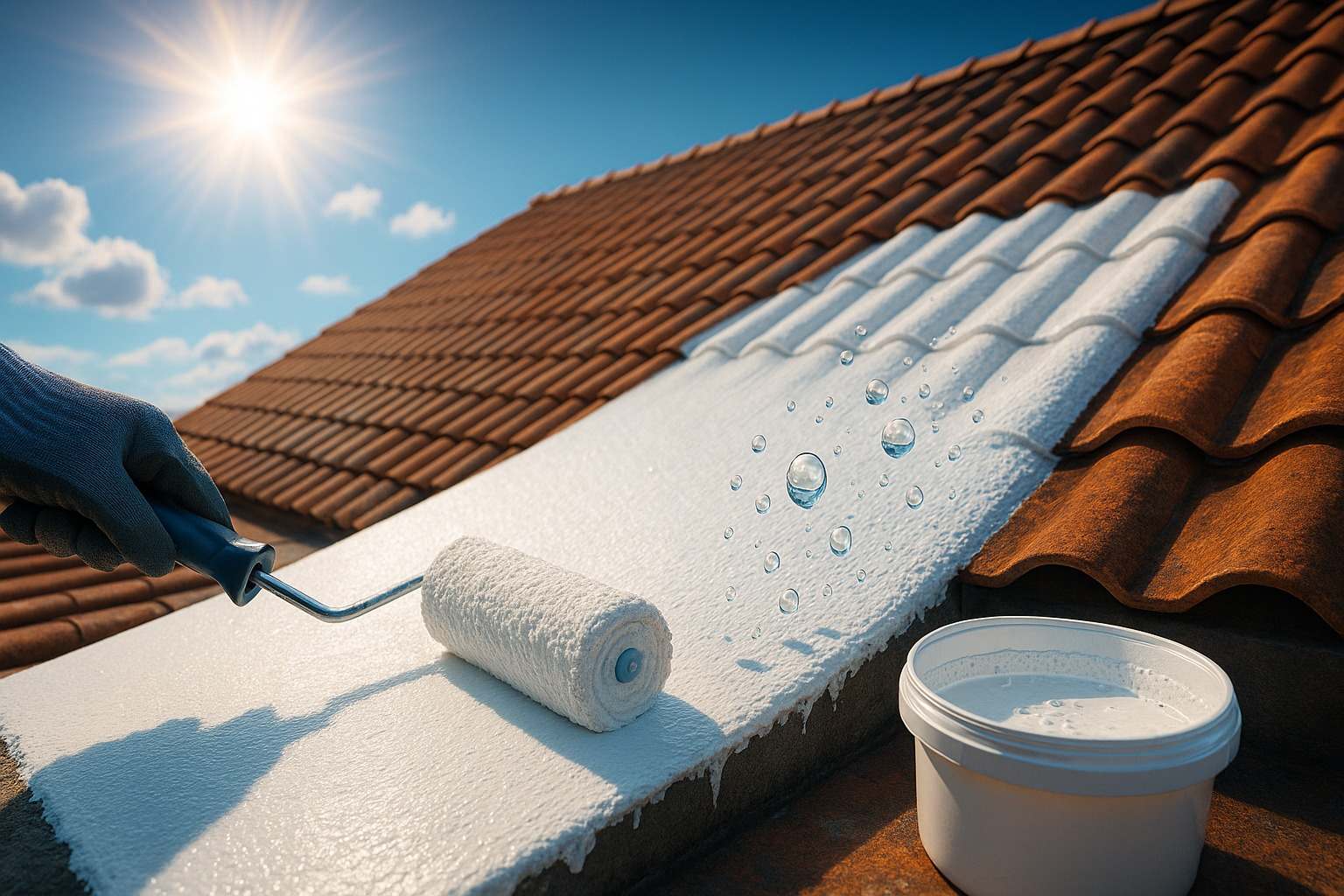

Created by Researchers from the University of Sydney, the New Paint Reflects 97% of Solar Light, Reduces the Internal Temperature of Houses by Up to 6 °C, and Also Transforms Water Vapor from the Air into Drinkable Water, Offering a Sustainable Solution Without Energy Consumption
A roof paint capable of reflecting nearly all solar light and collecting fresh water directly from the air promises to revolutionize the way we cool and supply our homes. Developed by researchers from the University of Sydney in partnership with the startup Dewpoint Innovations, the new nano-structured polymer coating reflects up to 97% of solar rays and simultaneously condenses water vapor into droplets that can be collected.
In tests, the material was able to maintain the internal temperature up to 6 °C lower than that of the external environment. This thermal difference creates the condensation effect similar to that of a cold mirror, resulting in a continuous flow of small water droplets.
On the roof of the Sydney Nanoscience Hub, where tests were conducted, the paint collected dew for more than 30% of the year, generating up to 390 mL of water per square meter daily.
-
China Develops Custom 140-Ton Electric Mining Truck with 770 kWh Swappable Battery, Deploys 290 Units in Xinjiang’s Largest Zinc Mine

-
Meta to Launch Arena, a New Prediction App Targeting 3.56 Billion Users, Competing with Polymarket and Kalshi

-
Scientist Challenges Famous Human Evolution Theory, Argues Homo Sapiens Evolved Gradually Over Thousands of Years
-
15-Year-Old American Builds Ocean Generator with PVC Pipe and 3D-Printed Propeller for $12, Wins National Prize, Presents at White House, and Makes Forbes 30 Under 30 List




Although it may seem modest, a 12 m² roof can produce about 4.7 L of water per day under ideal conditions — enough to cover the basic needs of one person.
Dewpoint Innovations claims that a typical residential roof could generate enough water for daily use, especially when combined with traditional rainwater harvesting systems.
In Sydney, for example, the annual precipitation allows for the collection of about six times more rainwater than that condensed, but the ratio would change in drier regions.
An Advance for a Sustainable Future
The lead researcher, Professor Chiara Neto, from the Institute of Nanotechnology and the School of Chemistry at the University of Sydney, highlighted that the technology represents a milestone in the science of “cool roofs” and sustainable water solutions.
“This technology not only enhances the science of cool roof coatings but also paves the way for decentralized, low-cost freshwater sources, a critical need in light of climate change,” Neto stated.
For six months, the team monitored the performance of the coating in external tests, collecting minute-by-minute data on cooling efficiency and water harvesting. The study showed that dew could be collected for more than 32% of the year, even during dry spells.
The paint also demonstrated resistance to intense sunlight and severe weather conditions, showing no signs of degradation.
Structure That Reflects Light Without Harming the Environment
The appearance of the material resembles that of a common white paint, but its structure is key to its performance. While commercial paints use titanium dioxide as a pigment to reflect ultraviolet light, the new coating employs a porous structure of polyvinylidene fluoride-co-hexafluoropropene (PVDF-HFP).
This composition creates microscopic air pockets that disperse solar light in multiple directions, avoiding excessive glare and eliminating UV-absorbing chemicals that tend to degrade over time.
The result is a durable, self-cleaning surface that is weather-resistant and capable of maintaining high performance over long periods. According to Dr. Ming Chiu, technology director at Dewpoint Innovations, the design combines energy efficiency with visual comfort.
“Our design achieves high reflectivity through its internal porous structure, offering durability without the environmental downsides of pigment-based coatings,” he explained.
“By removing materials that absorb UV rays, we surpassed traditional limits of solar reflectivity, avoiding glare and making the product more suitable for practical applications.”
Dew Collection and Multiple Uses of the Water Generated
The smooth surface of the top layer facilitates the runoff of water droplets to collection points. Thus, large painted areas could function as large-scale dew harvesting systems.
The team sees potential for the use of the generated water in horticulture, misting systems for cooling, and even in hydrogen production.
Professor Neto emphasized that the technology is particularly useful in locations with nighttime humidity, even if situated in arid or semi-arid regions.
“Although humidity conditions are ideal, dew can form even in dry regions, where humidity increases during the night,” she said. “This is not about replacing rain but complementing it, providing water when other sources are scarce.”
From Research to Market
Unlike many innovations that remain confined to laboratories, this technology is already being scaled for commercial use. Dewpoint Innovations is now developing a water-based version, applicable with conventional rollers or sprayers, which should facilitate its adoption in residential and industrial buildings.
“At Dewpoint, we are proud to partner with the University of Sydney to bring this innovation in passive atmospheric water harvesting to life,” stated Perzaan Mehta, CEO of the company. “It’s a scalable, energy-free solution capable of transforming roofs and remote infrastructures into reliable sources of drinkable water.”
The team believes that the product will reach the market soon. According to Chiara Neto, the potential impact goes far beyond energy savings. “Imagine roofs that not only stay cooler but also produce their own drinkable water — that is the promise of this technology.”
The complete study was published in the scientific journal Advanced Functional Materials, reinforcing the innovative character and global potential of this smart paint that combines thermal efficiency with sustainable water generation.