Portuguese
  Spanish


Railway project integrates plan to reorganize cargo flow in the Southeast, reduce obstacles in Greater São Paulo, and open new routes to ports in Rio de Janeiro and Espírito Santo, amid pressure on Santos.
The federal government has placed the São Paulo Ferroanel among the priorities of the new round of railway expansion, aiming to create alternatives to the Port of Santos and reduce obstacles in cargo circulation through the São Paulo metropolitan area.
Estimated at up to R$ 6 billion, the project envisions a little over 50 kilometers of tracks north of the capital and has returned to the center of logistics discussions in the Southeast.
According to the plan under study, the project would allow freight trains to be diverted from the urban section where there is currently competition for space with passenger transport, especially in the operational windows near the São Paulo capital.
-
Half of Brazilians Prefer Lower Taxes with Private Health and Education, While 44% Opt for Higher Taxes for State-Provided Services, Datafolha Survey Reveals

-
Brazil’s Most Expensive Toll Rises to R$ 40.60 on Route from São Paulo to the Coast, Nearly Matching Bus Fare to Santos

-
As Brazil Expands Social Welfare, Survey Reveals 40% Blame Poverty on Laziness, While 58% Cite Lack of Opportunities

-
China Tightens Control on Antimony, Driving Prices from $22,000 to Nearly $40,000 per Ton as U.S. Rushes to Bolster Strategic Reserves

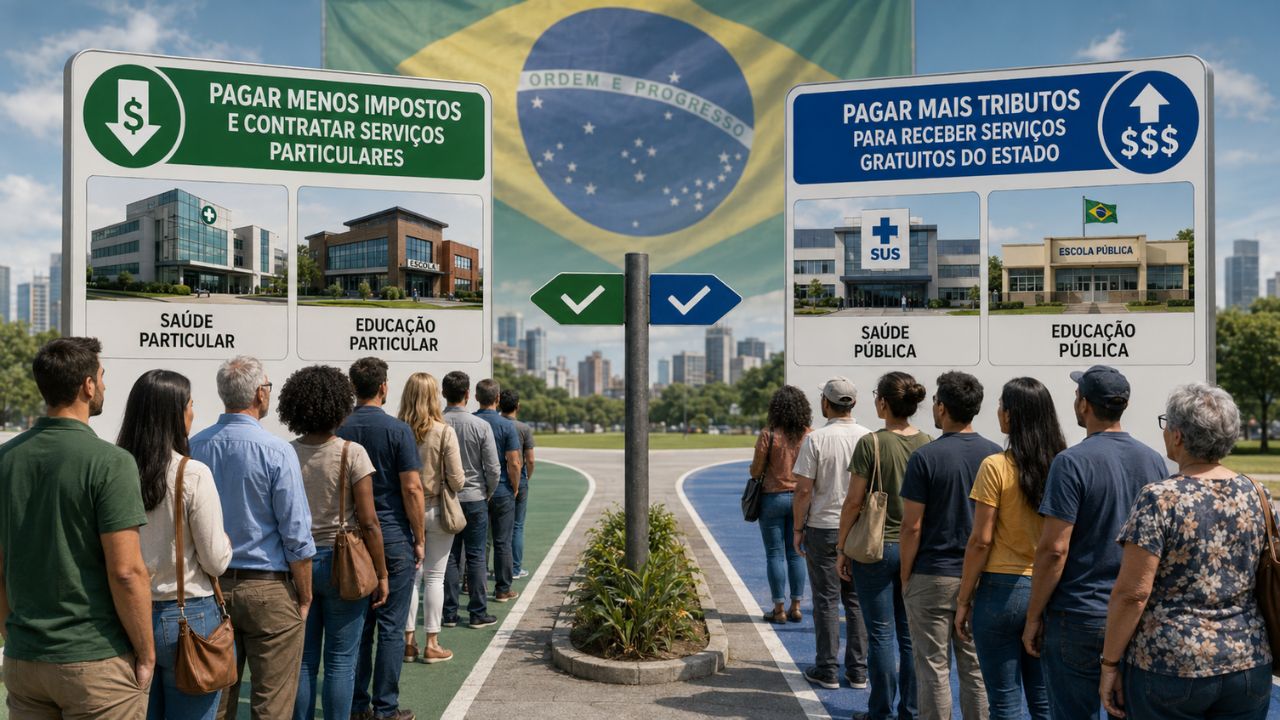


With the railway bypass, cargo coming from the interior of São Paulo could proceed more smoothly to ports in Rio de Janeiro and Espírito Santo.
Discussed since the 1960s, the Ferroanel never materialized and has returned to the federal agenda amid the search for alternative routes for agricultural, industrial, and container products.
Santos remains the country’s main port, but the government believes that the concentration of cargo at the terminal requires new railway connections in the Southeast.
According to CNN Brazil, Infra S.A. has already completed a basic engineering project, and the Minister of Transport, George Santoro, estimates that construction could take four to five years.
Part of the route follows the area of the Northern Rodoanel, where there is a strip reserved for the future implementation of tracks.
São Paulo Ferroanel can reduce railway obstacles
The Ministry of Transport is working with two alternatives to make the project feasible, both linked to railway concessions under the responsibility of the Union.
One of them plans to associate the construction with the new concession of the Western Network, a railway still operated by Rumo, which decided not to renew the current contract.
The new Western Network was modeled with 1,593 kilometers and a contractual term of 57 years, connecting Corumbá, in Mato Grosso do Sul, to Mairinque, in the interior of São Paulo.
The granting plan was approved by the National Land Transport Agency in May, and the proposal is under review by the Federal Court of Accounts.
To attract private operators, the model allows interested parties to compete for the entire corridor between Corumbá and Mairinque, an intermediate section up to Bauru, or just the connection between Corumbá and Três Lagoas.
The division was designed by the government to increase the competitiveness of the auction and reduce the risk of low participation due to the total length of the project.
Santoro told CNN that the government expects to receive proposals for at least part of the railway corridor.
“We are confident there will be proposals,” said the minister, commenting on the expected market interest in the future concession.
If this alternative progresses, the future concessionaire of the Malha Oeste could take over the Technical, Economic, and Environmental Feasibility Study of the Ferroanel and then execute the work.
The contract would have economic-financial rebalancing, with the possibility of using resources from the General Budget of the Union or cross-investments from other concessions.
MRS Logística may enter the Ferroanel project
Another possibility analyzed by the government involves an addendum to the contract of MRS Logística, responsible for the Malha Sudeste, which passes through Minas Gerais, São Paulo, and Rio de Janeiro.
According to Santoro, this solution could reduce the cost of the Ferroanel by about R$ 2 billion, due to synergies with works already underway by the concessionaire.
The MRS concession was renewed in 2022 until 2056, but the construction of the Ferroanel was not included as a requirement in that process.
At the time, the Union chose to include as a counterpart the segregation of tracks used by freight and passenger trains around the São Paulo capital.
With a new contractual rebalancing, the company could be partially released from this obligation and direct resources to the Ferroanel.
This scenario, however, is closely monitored by the Intercity Train project, which plans a medium-speed connection between São Paulo and Campinas.
In the same arrangement, MRS could also take on the railway bypass of Barra do Piraí, in Rio de Janeiro.
The section is treated by the government as a logistical bottleneck because it interferes with the movement of trains between São Paulo and Rio.
Cargo from São Paulo’s interior may gain new routes
The government’s intention is to allow cargo of grains, ore, cellulose, and containers to have alternatives to the route currently concentrated towards Santos.
With the Ferroanel, trains coming from São Paulo’s interior could bypass Greater São Paulo and access railway corridors towards Rio de Janeiro, Itaguaí, and Açu.
This design also depends on the EF-118, known as the Southeast Railway Ring, a project that integrates the federal strategy to expand connections between railways and ports.
The railway is planned to connect Nova Iguaçu, in Rio de Janeiro, to Santa Leopoldina, in Espírito Santo, with a total approximate length of 571 kilometers, according to ANTT.
In the priority stage, the EF-118 will have about 246 kilometers between São João da Barra, in northern Rio de Janeiro, and Santa Leopoldina.
ANTT reports that the section between São João da Barra and Nova Iguaçu, with approximately 325 kilometers, may be implemented later, as additional investment conditioned on the decision of the granting authority.
The regulatory agency indicates a projected investment of R$ 4.2 billion in capex, estimated operational costs of R$ 3.5 billion, and a Union participation of R$ 4.1 billion in the project.
The official projection considers operation starting from 2035 for the priority section.
On June 5, 2026, Folha reported that the railway schedule suffered delays and that the EF-118 auction, previously scheduled for June, was rescheduled for September.
The same report indicated that the West Network is now expected to have an auction in November.
Southeast Ports Enter the Cargo Dispute
The government assesses that the integration between Ferroanel, West Network, MRS, and EF-118 can increase competition among Southeast ports.
In practice, the cargo that today tends to go to Santos would gain alternatives in Rio de Janeiro and Espírito Santo, provided the projects are executed and connected operationally.
The strategy also seeks to reduce freight costs through competition among railway corridors.
According to Santoro, the most significant price drop depends on the creation of effectively competing routes, capable of disputing cargo with different port destinations.
If the expansion is executed according to federal planning, trains connected to the West Network, Paulista Network, Central Network, Centro-Atlântica Railway, and MRS will be able to access a broader network of ports in the Southeast.
After decades of discussion, the Ferroanel returns to the agenda as part of a broader railway reorganization, aimed at better distributing cargo flows in one of the country’s most significant logistical movement regions.