Portuguese
  Spanish


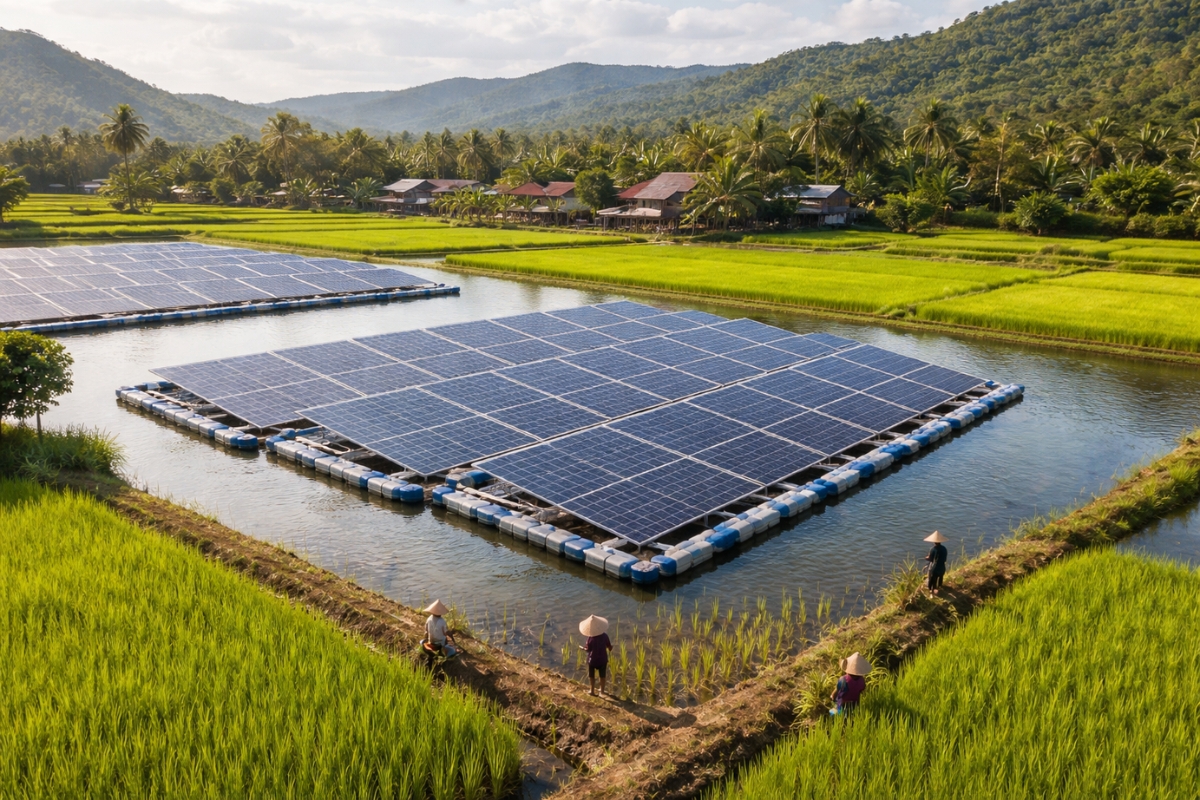


The Solution Uses Irrigation Water as Cover and Guarantees Cheap Electricity, with Direct Impact on Water Economy and Farming Routine
The installation of floating solar panels in irrigation areas has transformed the reality of a village in Cambodia, with effects that go beyond the electricity bill.
By covering part of the reservoirs used for rice, the community started generating energy right in the field, reduced water loss through evaporation, and changed the surrounding environment, requiring new care in management.
The Idea That Became Key in the Field: Irrigation Water Can Also Generate Energy
Rural engineering has gained a practical alternative: using the water surface as the base for solar panels, without taking up planting space.
-
Brazilian Startup Converts Tucumã Seeds into Bioplastic for Bicycle Pedals, Cups, and Construction Materials

-
NASA Captures Rare Encounter of South Korean “Surfboard” Spacecraft Crossing Lunar Orbit at Over 11,000 km/h

-
Germany Opens World’s Largest Smart Power Semiconductor Factory with €5 Billion Investment, Creating 1,000 Jobs and Doubling Capacity for AI and Energy Needs

-
Kazakhstan’s Torysh Valley Holds Thousands of Giant Stone Spheres, Intriguing Scientists with Ancient Oceanic “Cannonballs”

This creates a new use for agricultural reservoirs and opens the way to produce electricity where it is truly needed, within rural areas.
The impact quickly appears in the irrigation routine and in rice processing, with more accessible energy for essential tasks.
What Are Floating Solar Panels and How Do They Stay Afloat?

Floating photovoltaic systems rest on plastic or metal structures that remain on the water, in reservoirs, tanks, or channels.
Cables and anchors hold the system in place even with wind and small waves, preventing displacement and keeping the covered area stable.
The logic is to take advantage of already existing water surfaces, reducing competition for agricultural land and avoiding large soil movements.
Partial Reservoir Coverage Reduces Evaporation and Holds More Water for Rice
When part of the reservoir is covered, direct radiation decreases and the surface heats less, reducing evaporation.
There are records of evaporation reduction of 50% to 70%, varying according to climate, covered area, and wind.
In regions with a well-defined dry season, this can mean more water available until the end of the agricultural cycle.
Water Cools the Modules and Increases Generation by Up to 5% to 15%
The water surface acts as a natural cooling mechanism for the panels, helping to lower the operating temperature.
As a result, studies indicate that floating modules can yield 5% to 15% more energy than those installed on land.
This gain improves the cost-effectiveness of the system and reinforces the use of reservoirs as productive areas for energy as well.
Cheap Energy in the Field Changes the Pace of Irrigation and Rice Processing
With local and cheap electricity, it becomes easier to pump water when the crop needs it, without relying on expensive solutions.
The energy can also power equipment related to rice, such as small mills and cold storage systems.
In pilot projects, this combination has been associated with agricultural production increases of double digits, along with greater water availability.
Shade and Less Wind Change the Microclimate and Require Farmers to Relearn Management
The presence of the platforms alters the thermal balance of the reservoir, lowering the surface temperature and changing stratification.
There is also a partial reduction of wind near the water and the incident radiation on the surface, creating a cooler and more humid environment at the edges.
These changes can assist certain stages of cultivation but also require adjustments since the dynamics of humidity and temperature in the surroundings change.
The Side That Requires Caution: Impacts on Water, Oxygen, and Aquatic Life
Large-scale expansion demands attention to effects on the aquatic ecosystem, such as temperature, oxygen, and light availability for submerged plants.
The traditional use of the reservoir must also be considered, as the structure may affect circulation and maintenance of the site.
The goal is to ensure that water savings and energy generation do not create undesirable effects on the environment.
The experience in Cambodia shows that floating solar panels can reduce energy poverty and improve water use in agriculture.
At the same time, the impact on the microclimate and ecosystem reinforces the need for planning, so that cheap energy and water savings advance in balance.