Portuguese
  Spanish


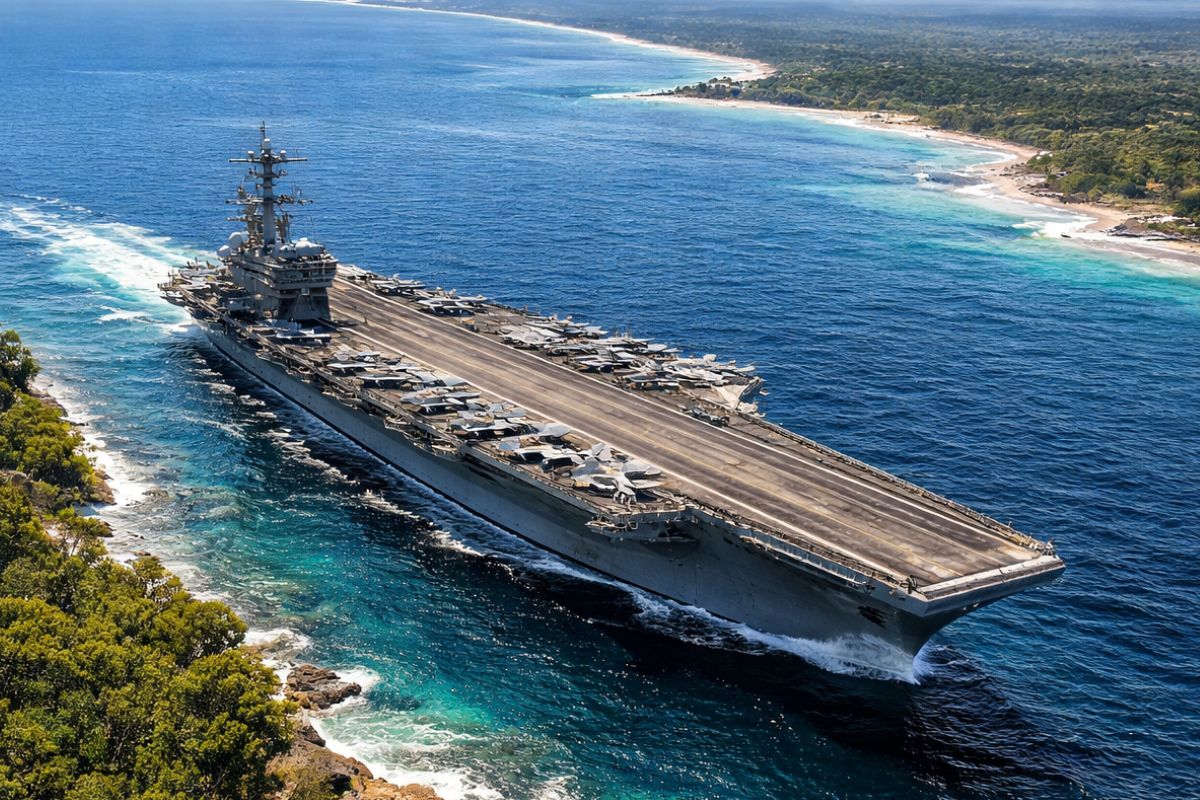

With the loss of the MQ-4C Triton and the diversion of the USS George H.W. Bush around Africa, the American strategy suggests maximum caution in straits where drones, missiles, and mines shorten the margin of error.
Where is the United States nuclear aircraft carrier at one of the tensest moments in the Gulf? What the base indicates is that the answer is not on a public map, and this seems intentional. When an asset of this size reduces exposure and “disappears” from the most obvious routes, it is not by free will: it is because the risk of an incident is no longer theoretical.
This context becomes even heavier with the confirmation of the fall of the MQ-4C Triton, a surveillance drone described as central to seeing what happens around the Strait of Hormuz. In a region where every decision depends on near-real-time information, losing this “eye” means operating with less visibility just when the tension calls for more clarity, not less.
The fall of the Triton and what is lost when surveillance fails
In 2019, an American surveillance drone valued at over 200 million dollars disappeared over the Gulf of Oman and, a few hours later, Iran displayed the wreckage on television.
-
U.S. Military Intervention Risk in Brazil Raises Alarm, Highlights National Sovereignty Amid Tensions Over Washington’s Terrorist Designation of PCC and Comando Vermelho

-
Brazilian Air Force’s Sole KC-30 Aircraft Completes Strategic Mission to Spain for 105mm Anti-Tank Ammunition for Leopard 1A5 Tanks

-
Brazilian Air Force Seeks to Acquire More Gripen Fighter Jets
-
U.S. Air Force Launches Air-to-Air Missile Project with Range of Up to 1,850 km for Indo-Pacific Operations



The episode was marked by an uncomfortable detail: equipment designed to see everything was detected and neutralized before it could react. Since then, the text suggests that “silences” in security systems have gained greater weight.
The confirmation of the fall of the MQ-4C Triton now enters this same line. The Triton was described as essential to monitor naval movements, detect threats, and maintain situational control in a sensitive corridor.
When it leaves the scene “under still obscure circumstances,” the effect is not just symbolic. An operational void emerges in an environment where mines, drones, and speedboats can turn a miscalculation into a real crisis.
Why the diversion of the aircraft carrier matters more than it seems

According to the portal Xataka, attention is drawn to a specific point: the diversion of the USS George H.W. Bush around Africa, instead of crossing the Suez Canal, is not treated as a common logistical choice. The argument is that the decision reveals an operational vulnerability that Washington prefers not to expose publicly.
The reason, according to the text, is to avoid the Bab el-Mandeb Strait. And the reading is straightforward: if a nuclear-powered aircraft carrier strike group avoids this stretch, it is because it cannot guarantee its absolute safety there. The relevant data is not just the greater distance.
It is what this choice admits: military superiority exists, but it does not always translate into full freedom of movement when the environment is saturated with asymmetric threats.
The inevitable comparison: Bab el-Mandeb as a warning for Ormuz
Analysts cited in the base raise a question that, at its core, summarizes the unease. If Bab el-Mandeb is already seen as too dangerous, what about Ormuz? The text describes Ormuz as narrower, more monitored, and surrounded by Iranian defensive systems.
Here, the point is not to exaggerate the risk, but to recognize the type of calculation. Iran is described as an actor with decades of specific preparation for this scenario.
This changes the operational logic because a devastating attack is not necessary to alter the balance. A symbolic, successful, and well-documented strike would already have the power to reorganize political and military decisions.
The American paradox: discourse of control, practice of prudence
While political discourse tends to speak of pressure, blockade, and control, tactical decisions indicate prudence. Redesigning the route of a high-value asset is a sign that the margin for error is small.
This does not mean automatic weakness. It means that the risk has become calculated more conservatively because the consequences of a loss would be disproportionate.
In an environment where a successful attack can trigger military and political effects much greater than the event itself, the goal becomes to avoid involuntary escalation.
When losing a drone is “acceptable,” but losing a ship is not
The text concludes with a reasoning that helps to understand the caution. Losing a surveillance drone, even an advanced one, can be absorbed. It is still serious, but it is manageable.
However, a damaged warship, or a compromised nuclear aircraft carrier, would be a crisis of another order, with a direct impact on credibility, conflict escalation, and regional security perception.
Therefore, the combination of the fall of the Triton and the “hidden aircraft carrier” paints a clear picture: the United States would not be operating from a comfortable position, but rather from a extremely delicate balance.
When a nuclear aircraft carrier avoids traditional routes and chooses a longer path, do you interpret this as temporary prudence or as a sign that the region near Hormuz has entered a new phase, where the risk has become permanent?