






 Portuguese
  Spanish


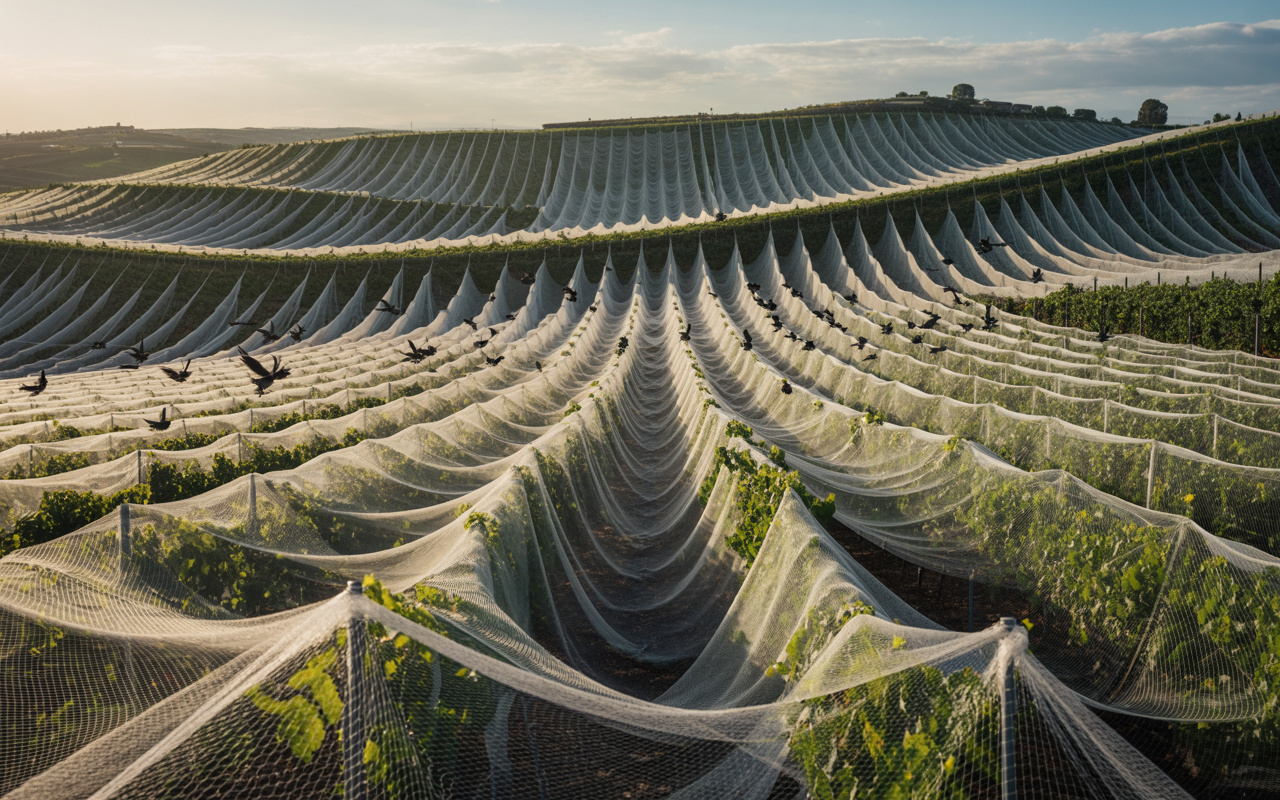


In Vineyards of France, Italy, and Chile, Producers Began Covering Entire Plantations with Giant Nets to Prevent Bird Attacks that Destroyed Crops in Just Hours.
For months, work in the vineyard follows an almost surgical rhythm. Precise pruning, water management, soil handling, and constant observation of grape maturation. However, in wine-producing regions of France, Italy, and Chile, all this effort could be wasted in just days or even hours — when flocks of birds discovered that the grapes had reached the ideal sugar level. It was this recurring risk that led producers to a visually extreme solution: covering entire agricultural areas with giant exclusion nets.
When Birds Became a Real Economic Problem
Species such as starlings, blackbirds, sparrows, and thrushes are attracted by the high sugar concentration in ripe grapes. Unlike sporadic pests, these birds move in large flocks and feed in a coordinated manner.
A single group can attack dozens of hectares in succession, piercing berries, knocking down bunches, and accelerating the deterioration of the remaining fruit.
-
Centuries Before Modern Greenhouses, English Gardeners Used Horse Manure to Grow Pineapples in Cold Climates

-
Sugarcane Cultivation in India: A Symbol of Water Stress and Environmental Strain Amidst Global Demand for Sugar and Green Fuel

-
Innovative Farm in Northeastern Brazil Combats Drought with Advanced Techniques, Aiming for 10,000 Liters of Milk Daily Production

-
Australian Desert Farm Uses Solar Power and Seawater to Produce 15,000 Tons of Tomatoes Annually, Resembling a Sci-Fi Agricultural Innovation



In addition to the direct loss of volume, the damage caused by birds creates entry points for fungi and bacteria, compromising the quality of the wine. In regions where the harvest is aimed at premium wines, small qualitative losses are already enough to downgrade entire batches.
Why Traditional Methods Failed
For decades, vintners tried solutions considered “simpler”: scarecrows, reflective tapes, sonic devices, artificial hawks, and even noise cannons. The problem is that birds adapt quickly. In just a few days, they begin to ignore visual or sound stimuli that do not represent a real threat.
Moreover, sonic methods create conflicts with neighboring communities and are increasingly restricted by environmental and noise legislation. The result was a practical realization: as long as physical access to the grapes was not blocked, no solution would be truly effective.
The Turning Point: Industrial-Scale Exclusion Nets
The solution found was straightforward and based on agricultural engineering: physically prevent birds from accessing the vineyards. The exclusion nets, made of high-density polyethylene with UV treatment, began to be installed covering entire rows of vines or even complete parcels.
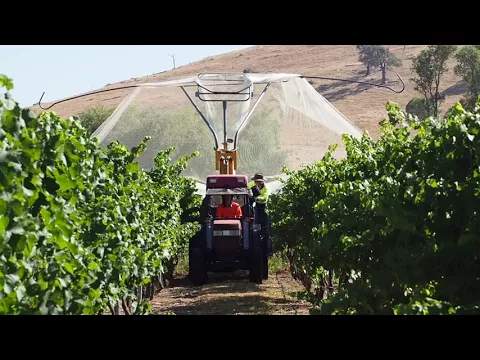
These nets are not makeshift. They are designed to withstand wind, rain, intense sunlight, and thermal variations for several years.
The mesh is calculated to prevent the passage of birds without compromising ventilation, sunlight incidence, or basic agricultural operations.
How the Nets Are Installed in the Vineyards
There are two main installation models. The first directly covers the rows of vines, forming continuous tunnels along the rows.
The second, more visually impressive, creates true “roofs” over large areas, supported by posts and cables, also closing the sides to prevent access from below.
In flat and highly mechanized regions, such as parts of Chile, this second model has become common. In sloped areas, more typical of Italy and southern France, the row system still predominates, adapting to the topography.
Scale of Investment and Protected Area
Although the initial cost is high, the scale of the avoided damage justifies the investment. In commercial vineyards, areas of dozens or hundreds of hectares can be covered. The cost per hectare varies according to the system, the durability of the material, and the complexity of the installation, but the return comes in the form of productive stability.
Producers report drastic drops in losses after adopting the nets, in many cases nearly eliminating the damage caused by birds. This transforms the net from an expense into a productive asset.
Direct Impact on Wine Quality
By preventing punctures in the grapes, the nets drastically reduce the incidence of rots and unwanted fermentations still in the field. This allows for more homogeneous harvests, with better control of sugar content, acidity, and fruit health.
For wineries focused on controlled designation of origin and high-value wines, this predictability is essential. A lost or downgraded harvest can compromise contracts, exports, and reputation built over decades.
An Environmentally Accepted Solution
Despite the visual impact, the nets are considered an environmentally acceptable solution. They do not harm animals, do not use chemicals, and do not directly interfere with the ecosystem beyond temporary physical exclusion.
In many European countries, this approach is seen as preferable to the use of aggressive or lethal wildlife control methods, aligning agricultural production and increasingly stringent environmental legislation.
Landscapes Transformed by Necessity
During grape maturation season, entire wine regions change appearance. Open vineyards begin to look covered by continuous veils, creating an artificial landscape that catches the attention of passersby.
This visual transformation is the direct reflection of an invisible problem to the end consumer: the fragility of agricultural production in the face of seemingly simple biological factors, but economically devastating.
The nets have ceased to be an emergency resource and have become part of the structural planning of vineyards. In new projects, posts, spacing, and vine training systems are already being designed to facilitate the installation and removal of the nets.
What started as a reaction to loss has solidified as a permanent layer of modern agricultural engineering.
The Logic Behind the Solution
In the end, the decision to cover entire vineyards was neither aesthetic nor exaggerated. It was mathematical. Between losing an entire crop in a few days and investing in a durable physical barrier, vintners opted for absolute risk control.
The giant nets represent a shift in mindset: accepting that, in certain contexts, the only way to coexist with wildlife is to establish clear physical limits. In the case of modern viticulture, this literally meant putting a roof over production.




Try to cover from the ground with some weights or the birds will get in U won’t see ok especially sparrows love to bath in soft soil and eat arround an play but will destroy your crop
There’s no mention as to how the nets are removed for harvesting in such a way as to be reusable???