






 Portuguese
  Spanish


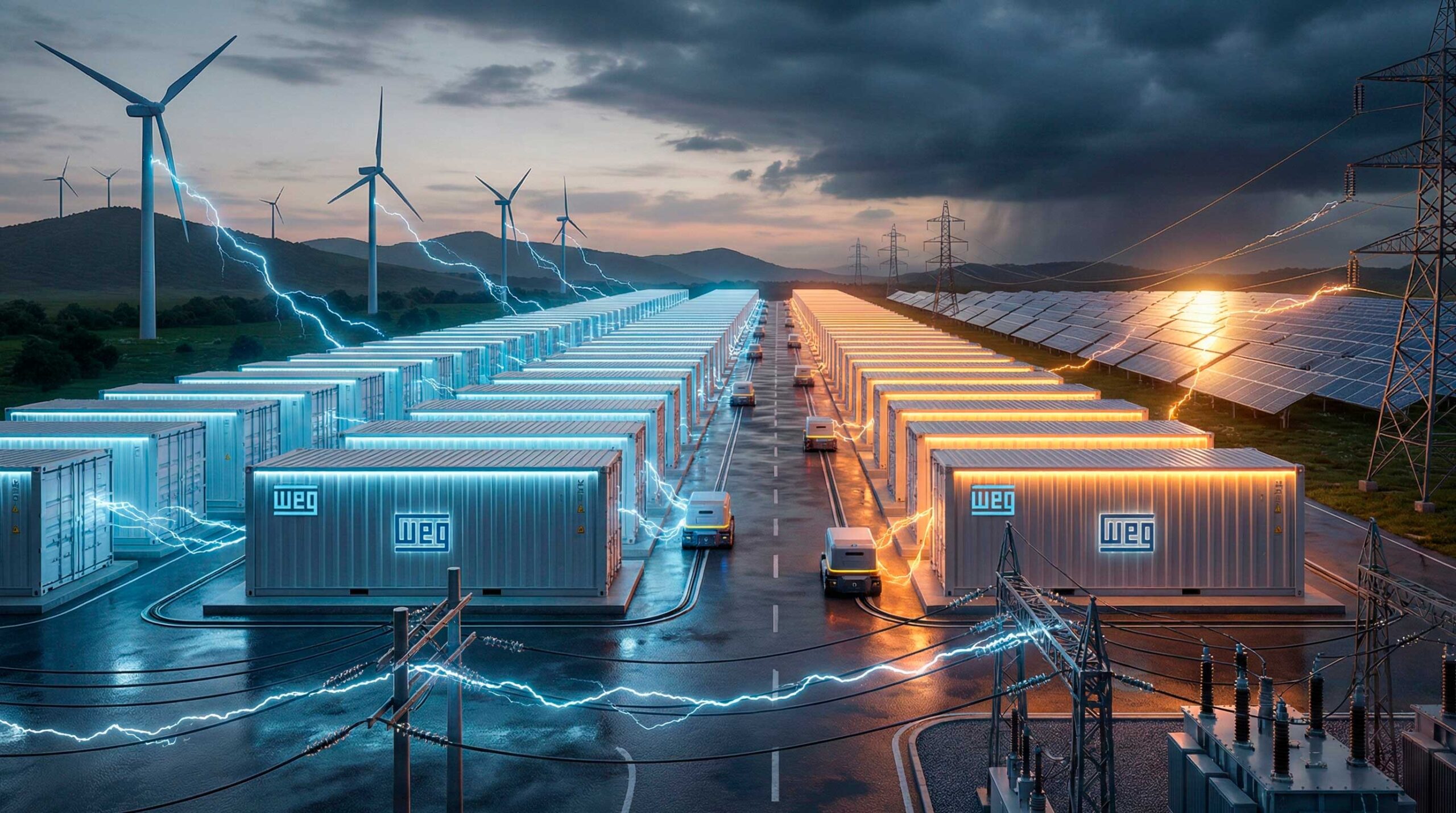
Santa Catarina Will Gain a Factory for Megabatteries from WEG Focused on Renewable Energy Storage. The Announcement Comes at a Time When the Government Accelerates an Auction for Batteries to Strengthen the National Interconnected System
In 2015, a speech at the UN by Dilma Rousseff about the difficulty of “storing wind” became a meme, but pointed out a real problem in the electricity sector. Ten years later, the technology to solve the issue has advanced with BESS (Battery Energy Storage System) systems, already common in China, the United States, and Europe, and now rapidly expanding in Brazil, according to Gazeta do Povo.
Earlier this month, Brazilian WEG announced a factory dedicated to BESS in Itajaí (SC), increasing the national capacity to store energy from sources like wind and solar. The move aligns with the public policy under discussion and the urgency to balance supply and demand at different times, when there is a surplus during the day and a shortage at night, according to information published by Gazeta do Povo.
In a statement on Wednesday (11), the Minister of Mines and Energy, Alexandre Silveira, said that the country will hold its first battery auction by June. In the sector, the timeframe set for the auction is June 2026, which reinforces the race among companies and investors to present competitive projects and mitigate risks to the National Interconnected System (SIN).
-
Russia and India Lift 320-Ton Pressure Vessel into Kudankulam Nuclear Plant Reactor, Advancing Project That Has Already Prevented 112 Million Tons of CO2 Emissions

-
Brazilian Student Wins Global Science Fair in the U.S. with Sound Wave Method to Alter Alzheimer’s-Linked Genes
-
Bosch Unveils Revolutionary 2.3 kg Hub Motor for E-Bikes with 45 Nm Torque and 400 Watts Power, Eliminating Resistance Above 25 km/h in Historic Shift for German Manufacturer
-
Brazilian Engineer Develops Marine Bacteria from Ubatuba into a Mini Power Plant Generating 227 mW per Square Meter, Cleans Air by Capturing CO₂ and Releasing Oxygen


WEG Factory in Itajaí Promises 2 GWh Per Year with High Automation and Investment of R$ 280 Million
The new WEG unit in Itajaí will be exclusively dedicated to BESS systems, raising the group’s production capacity to up to 2 GWh per year. This is equivalent to about 400 systems of 5 MWh, sufficient to power 400 thousand residences for one day solely with energy from the batteries, according to Gazeta do Povo.
The project anticipates a high level of automation, with automatic and semi-automatic lines and the use of autonomous mobile robots in internal logistics. The investment is R$ 280 million, and it is expected to generate 90 direct jobs, a number considered compatible with the degree of modernization of the plant. There will also be a testing and product qualification laboratory and a substation to simulate real operating conditions.
“This is an investment aligned with the strategic goal of positioning WEG and Brazil more competitively in the global energy transition scenario,” said WEG President Alberto Kuba. To make the project viable, the company obtained financing through BNDES Mais Inovação, in a public call held in partnership with Finep, aimed at the transformation of strategic minerals for decarbonization. Prior to this, WEG was already producing BESS equipment in its ecosystem in Jaraguá do Sul (SC), the city where the company was founded.
Battery Auction Could Unlock Up to R$ 10 Billion in Projects and Prevent Blackouts, But Depends on Regulation
According to the president of Absae (Brazilian Association of Energy Storage Solutions), Markus Vlasits, the auction is “the only alternative to prevent a blackout” and to expand a capacity currently close to 1 GWh in the country. According to him, the auction planned for June 2026 could attract up to R$ 10 billion in investments, with interested parties ready to offer more than 20 GW in projects, against a government expectation of contracting 2 GW, according to Gazeta do Povo.
However, there is a risk of further delays because Aneel has not yet incorporated the changes from the electricity sector reform, Law No. 15,269/2025, into the regulation. Globally, the technology accounts for about 250 GWh installed, and the outlook is to mobilize over R$ 80 billion by 2034. At the end of January, the MME sought to attract players like Huawei and CATL, the largest battery manufacturer in the world, during an official trip to China, signaling an appetite for scale.
How BESS Storage Balances Supply and Demand of Wind and Solar in Brazil
Wind and solar sources are growing rapidly, but face a basic challenge of temporal mismatch. Energy is injected when generated, not always coinciding with peak consumption times, leading to waste and putting pressure on the grid during peaks.
BESS systems solve this gap by storing excess energy during surplus moments and releasing it when demand rises. Thus, they reduce the operation of expensive and polluting thermal power plants and increase the reliability of the SIN.
According to Gazeta do Povo, experts have already warned of the risk of collapse without active battery management, especially on nights with low winds after days of high solar production. By leveling the load curve, batteries also relieve congestion and prevent overflows of clean energy.
In other words, storage is the bridge between the energy we have and the consumption we need to meet. Integrating BESS in a planned manner is a pragmatic step to keep tariffs more stable and the grid more resilient.
Uses Already in Operation in the Country, from Amazonas Outside the SIN to the Agribusiness of Registro in São Paulo
In Amazonas, more than 200 locations disconnected from the SIN rely on diesel thermal power plants, and solutions with BESS are already helping to reduce costs and emissions. In Registro (SP), a project strengthens the energy security of the local agribusiness, with gains in predictability and quality of supply, as reported by Gazeta do Povo.
Furthermore, there are isolated initiatives in industries and businesses throughout the country, demonstrating that the technology is modular and scalable. The government’s interest in attracting giants like Huawei and CATL reinforces the expectation that regulatory and financial viability will gain traction in the coming months.
What do you think about the entry of megabatteries into the Brazilian system, priority for the auction and incentives, or focus on generation and transmission lines first? Leave your comment, stating whether the auction should favor domestic production or open up completely to imports, and how this could affect prices and the reliability of the SIN. The debate is technical, but your impressions help map expectations and market pressures in this transition.






Be the first to react!