Portuguese
  Spanish


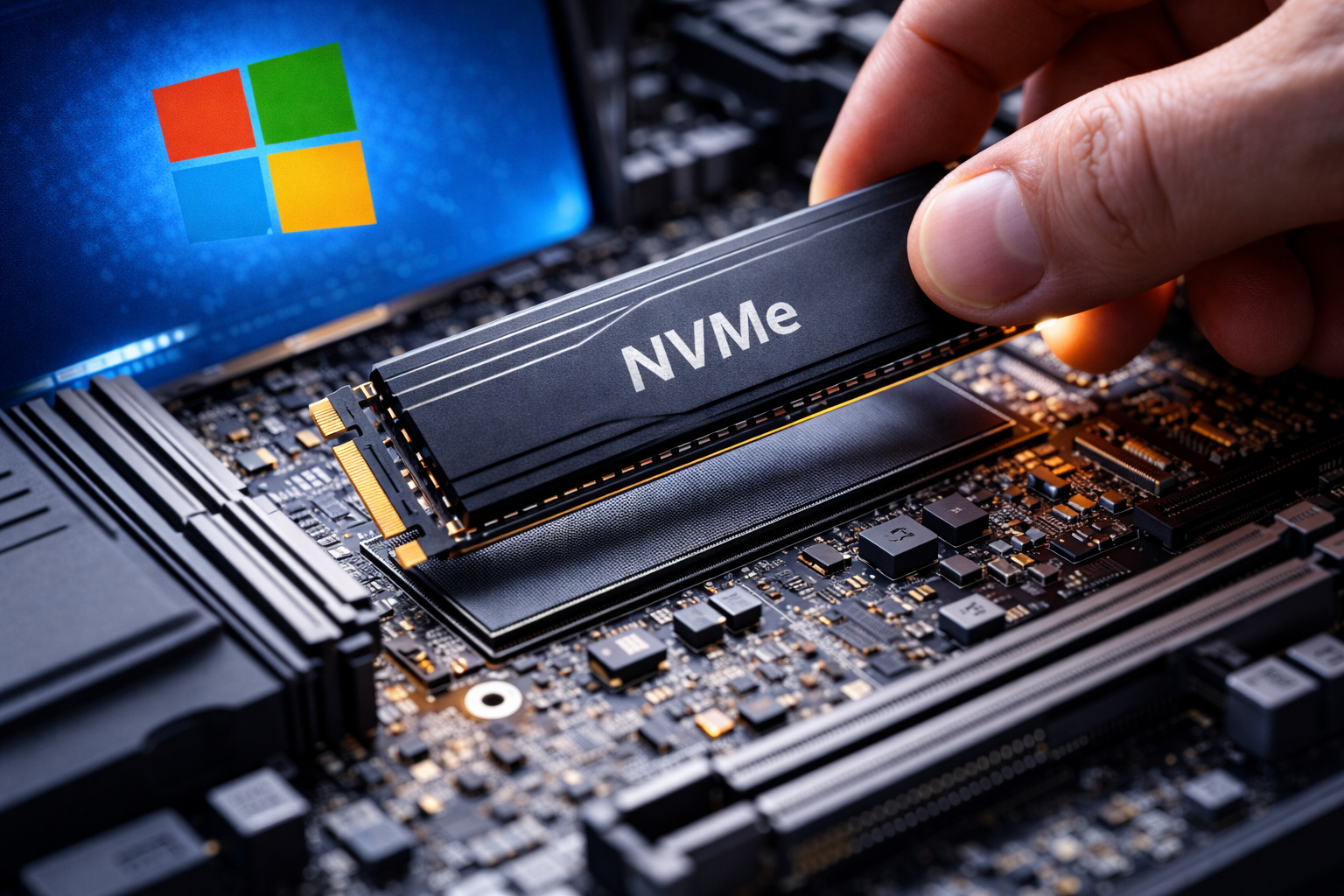

Structural Update Announced by Microsoft in 2025 Reduces Historic Bottlenecks, Cuts CPU Usage, and Prepares Windows for the Era of High-Speed Storage
Microsoft announced, in October 2025, a significant technical change in Windows. With the release of Windows Server 2025, the company began offering native support for the NVMe protocol, addressing a historic limitation in the way the operating system manages modern storage.
For years, even with the rapid evolution of NVMe SSDs and multicore processors, Windows maintained technical decisions inherited from the era of mechanical hard drives. As a result, performance bottlenecks persisted even on advanced machines. Now, the system keeps pace with current hardware.
Change in Storage Stack Eliminates Old Bottlenecks
Until now, Windows treated virtually all storage devices as SCSI, a standard created for spinning disks, with single queues and high latencies. In contrast, NVMe was designed for flash memory, allowing multiple queues and thousands of simultaneous commands.
-
Ohio Carpenter Finds 308-Gram Meteorite the Size of a Baseball After Dreaming of Its Location
-
Chinese Humanoid Robots Transition from Labs to Real Factories to Assemble Tablets: AgiBot Deploys G2 Machines at Longcheer, Aiming for 100 Robots in Electronics, Cars, Chips, and Energy by 2026
-
College Dropout Turned Window Cleaner Builds $1 Million Cleaning Business with Subscription Model After 18 Years of Door-to-Door Work
-
Race for Data Centers in Brazil Intensifies Pressure on Critical Energy Resources


With Windows Server 2025, the system eliminates this intermediary layer. Thus, Windows communicates directly with the SSD via the NVMe protocol. Consequently, the path for input and output operations becomes shorter, more efficient, and more predictable.
According to internal tests released by Microsoft in 2025, the gains are substantial:
- Up to 80% more IOPS in common random read workloads on NTFS
- About 45% less CPU usage per I/O operation
- Significant reduction in latency in storage-intensive tasks
Thus, the results are no longer just theoretical and begin to impact the actual use of the system.
Invisible Efficiency, but Crucial for Performance
With native support for NVMe, Windows triggers fewer locks in the kernel. Additionally, the system reduces the waste of processing cycles used solely for organizing read and write requests. This way, the processor operates more efficiently.
This optimization occurs quietly. Still, it directly influences system boot, application launching, virtualization, and processing large volumes of data. Therefore, experts consider this one of the most significant changes in Windows storage in recent years.
Manual Activation Reinforces Microsoft’s Caution
Despite the technical advancement, the feature is not enabled by default. Since the cumulative update of October 2025, administrators must manually enable support through Windows Registry or Group Policy.
According to Microsoft, this approach ensures greater stability. The company chose to validate the new storage stack in controlled environments before automatically rolling out the functionality to all scenarios.
Future Reflections for Windows 11 Users
Although the announcement focuses on Windows Server 2025, there is an important strategic point. The system shares the codebase with Windows 11 24H2 and the upcoming Windows 11 25H2.
Therefore, expectations are growing that native support for NVMe will also reach personal computers. For users who game, edit videos, or handle large data loads, this could mean more performance, lower CPU consumption, and greater responsiveness, without hardware changes.
In light of this structural change in Windows, do you believe Microsoft should expedite the release of native NVMe for all users or maintain caution to preserve system stability?