Portuguese
  Spanish


In a video about the cost of living in China, a resident named Gangzi, who earns about 100 yuan per day, or 15 dollars, showed how much food he took from a Chinese supermarket. With one day’s salary, he filled the fridge and even had a typical pork dish for lunch for 2.50 dollars.
How much can you buy with one day of work? In a video posted on May 13, 2026, that drew attention by showing the cost of living in the Chinese countryside, a resident from a town in the interior of Vilas Taobao, China, decided to take the equivalent of one day’s salary, about 100 yuan, or 15 dollars, to the supermarket and record everything he could put in the cart.
In the end, the money filled the fridge and there was still enough for lunch out. The scene, recorded in an economical Chinese supermarket, became a snapshot of how food prices weigh on the pocket there and ended up going around the world precisely because of the inevitable comparison with the cost of living in other countries, such as Brazil.
What fits in the cart with one day of Chinese salary

image: video
The protagonist of the video states that people in the region earn around 100 yuan per day, something like 15 dollars or about 75 reais at the current exchange rate.
-
Rescue Teams Use Flashlights to Find 47 Dogs in Abandoned, Powerless U.S. Home, Offering Them a Fresh Start Through Responsible Adoption

-
Siblings Discover 1939 Superman Comic in Late Mother’s Attic, Sets Record at $9.12 Million Auction

-
12-Year-Old Discovers 80-Million-Year-Old Marine Tylosaurus Fossil During Kansas Field Trip
-
At 24, Beatriz Becomes First Woman from Mato Grosso to Work on Live Power Lines with Energisa, Starting as a Meter Reader in 2022



With this amount in his pocket, he cycled three kilometers on an electric bike, under 35°C, to a popular supermarket that, according to him, has everything for daily needs. The idea was simple: spend one day’s salary and see how much food could fit in the cart.
The list was filled with basics. Among the items, rice, described as essential on any Chinese table, was about 28 cents per 500 grams, while tofu cost around 30 cents per box, fresh milk about 1.40 dollars per liter, and green bell pepper something like 42 cents per 500 grams.
The resident also took the cheapest cut of pork, a watermelon sold at approximately 56 cents per kilo, garlic, green onions, bread, and a coconut.
At the checkout, the total was 16 dollars, with the coconut alone accounting for about 1.50 dollars, and according to him, the refrigerator was almost full.
How much does the famous regional pork cost at the restaurant

The second part of the video shows that eating out can also be cheap. The resident went to a restaurant and ordered a typical pork dish from his region, accompanied by green vegetables and a seaweed roll.
The complete meal cost 2.50 dollars, including rice for about 24 cents and served at will, as well as a simple soup offered for free, as is customary there.
Even so, the resident makes a remark that helps to understand the local cost of living: he considers that restaurant a bit expensive. According to the man himself, if he ate the same dish at a street stall, the price would not exceed 1.50 dollars.
It’s a detail that shows how, in that reality, a ready-made lunch can cost a fraction of a day’s wage, something that impresses the outside audience.
Why comparing with Brazil is misleading and what to look at
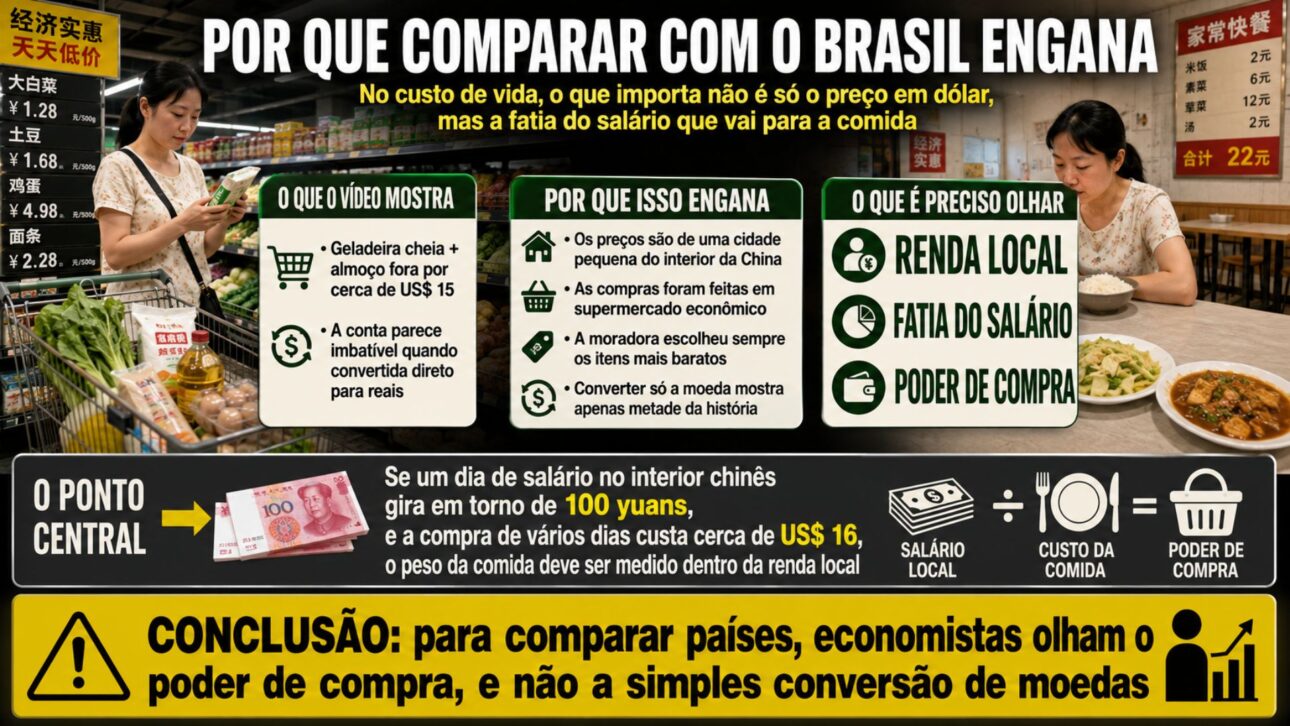
The video went viral because the account seems unbeatable: filling the fridge and eating out with 15 dollars. However, comparing this value directly with Brazil, converting it into reais, tells only half the story.
The prices shown are from a small town, in an economical supermarket, with the resident always choosing the cheapest item. For a fair comparison, it’s necessary to look at how much this expense represents within the local income.
And there lies the central point. If a day’s wage in the Chinese interior is around 100 yuans, and the purchase of several days costs about 16 dollars, food weighs differently than it would on a Brazilian income.
What really matters when discussing the cost of living is not the isolated dollar price, but the portion of the salary that goes to the plate. Therefore, economic experts often use the concept of purchasing power, rather than simple currency conversion, to compare countries.
What the video shows and what it doesn’t show


It is worth remembering that the portrayal is partial, and the creator herself does not hide this. It is about a single day, in a small town, and in a supermarket focused on low prices.
In metropolises like Shanghai or Beijing, the cost of living is much higher, and the video also does not cover expenses such as housing, energy, and transportation, which tend to weigh as much as food in the budget of any family, in Brazil or China.
Even so, the record is valuable for showing, in practice, how the food basket can be cheap in the Chinese interior when compared to the income of those living there.
More than proving that one country is better than another, the supermarket has become a window for a debate that interests everyone: how much the salary stretches when it comes to eating, a topic that keeps growing on social media.
Filling the fridge and still having lunch out with the equivalent of a day’s salary is the kind of scene that makes anyone grab a calculator.
It is worth noting that a day’s work in China with minimum wage varies from ¥ 70 to ¥ 120 (about R$ 55 to R$ 90), depending on the province.
The country does not have a single minimum wage, and each region sets its own value according to the cost of living.
Tell us in the comments how much this same purchase would cost in your supermarket and if a coconut, in your case, would be cheaper or more expensive than in China.