Portuguese
  Spanish


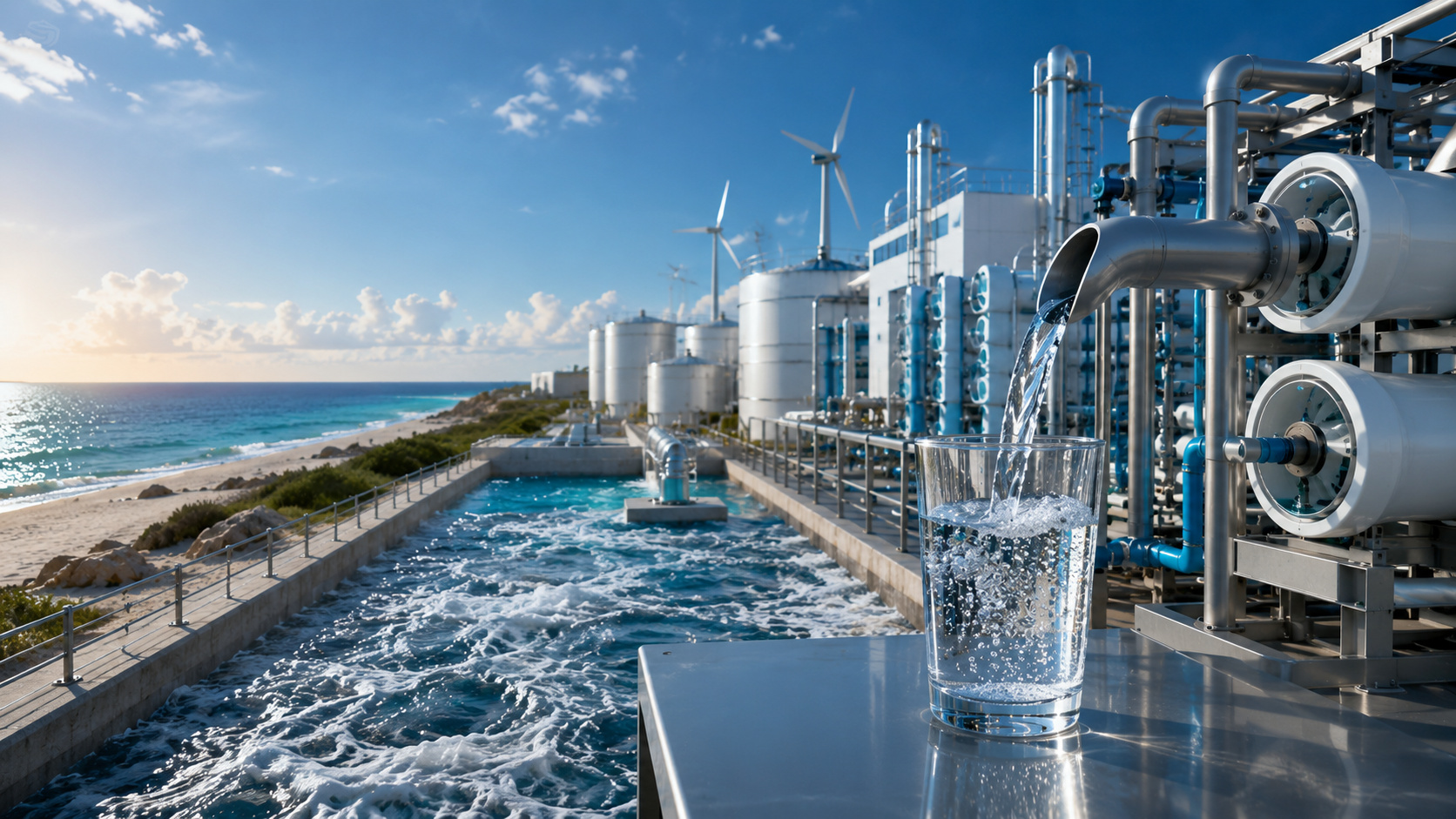

XPRIZE global competition offers US$119 million for desalination and potable water production technologies, and for combating the global water crisis.
The global water crisis is no longer a distant prediction and has begun to pressure governments, coastal cities, and agricultural systems on a planetary scale. While countries invest billions in desalination plants and water infrastructure, the XPRIZE Foundation launched, on March 1, 2024, the XPRIZE Water Scarcity, a five-year global competition with US$119 million in prizes for teams capable of creating more reliable, sustainable, and accessible desalination solutions.
The challenge seeks to accelerate technologies capable of transforming seawater into a large-scale potable source, in a scenario that concerns international organizations and water security specialists. The competition’s official page itself states that, by 2030, the world could face a 40% gap between the supply and demand of water needed to meet global needs, while traditional desalination technologies still face cost, energy, and environmental impact barriers.
XPRIZE Competition Aims to Revolutionize Desalination and Potable Water Production Technologies
XPRIZE became known worldwide for launching technological challenges related to space, artificial intelligence, carbon capture, and health. Now, the foundation has decided to focus one of its largest prize awards on a theme that is beginning to enter the center of global concerns: the scarcity of potable water and the increasing pressure on supply systems.
-
Stingless Bee Honey from Brazil Can Cost Up to $120 a Liter, Surprises with Flavors of Wood, Citrus, and Even Cheese

-
Woman Claims to Have Spotted a Technical Pattern in Recent FIFA Tournaments, Predicts Possible World Cup Winner
-
Chevrolet Offers Chance to Win a 2026 Sonic RS for Free via WhatsApp
-
Earthquake vs. Tsunami: Which Causes More Destruction and Why One Can Be Even More Dangerous


The XPRIZE Water Scarcity was structured to award real, scalable, and applicable technologies outside the laboratory.
Participating teams will need to demonstrate solutions capable of transforming seawater, contaminated water, or difficult water sources into potable water in an efficient, sustainable, and economically viable manner for large-scale use.
The competition has become one of the planet’s largest private initiatives exclusively focused on water technologies, bringing together startups, universities, independent engineers, and large companies in the same global race for water solutions.
Global Water Crisis Increases Pressure on Cities, Agriculture, and Reservoirs
Water scarcity is no longer a problem restricted to desert regions. In recent years, prolonged droughts have begun to affect reservoirs, rivers, and underground aquifers in different parts of the planet, putting pressure on urban supply systems and agricultural production.
Agriculture continues to be responsible for most of the world’s freshwater consumption. In several regions, rural producers have begun to face reduced water availability precisely during periods of greatest irrigation need. Large cities have also started to compete more intensely for the same available water resources.

The advancement of climate change has transformed water into one of the most important strategic resources of the 21st century, increasing concern for food security, economic stability, and urban supply in highly populated regions.
Seawater Desalination Has Become a Strategic Solution for Several Countries
Desalination is no longer an experimental technology and has become an integral part of the strategic infrastructure of various countries. Nations such as Saudi Arabia, Israel, and the United Arab Emirates already heavily rely on desalination plants to supply entire cities in regions with low freshwater availability.
The problem is that a large part of these facilities require billion-dollar investments, enormous energy consumption, and extremely complex industrial systems. In many cases, the operational cost still prevents the technology from being widely adopted by poorer countries or isolated regions.
The main objective of the XPRIZE Water Scarcity is precisely to find ways to produce potable water with less energy, less infrastructure, and lower costs, allowing desalination to become more globally accessible.
Water production technologies can move from small laboratories to the real world
The XPRIZE competition does not limit participants to traditional desalination alone. The challenge also accepts projects involving water reuse, advanced purification, atmospheric capture, and hybrid supply systems.
This has opened up space for technologies little known to the public, including advanced membranes, nanotechnology, special filtering materials, and systems capable of extracting water directly from atmospheric air. Some teams are even working with chemical and thermal processes that are still in an experimental stage.
The foundation’s expectation is to accelerate technologies that would normally take decades to achieve commercial application, transforming academic ideas into real water supply systems.
Water scarcity could redefine global infrastructure in the coming decades
Experts state that the water crisis could profoundly alter the planet’s urban and agricultural infrastructure in the coming decades. Governments have already begun investing in underground reservoirs, smart distribution networks, water reuse, and large coastal desalination projects to try to prevent future collapses.
At the same time, climate change and population growth are reducing the predictability of traditional water systems. Reservoirs considered stable for decades have begun to experience severe fluctuations due to reduced rainfall and increased average global temperatures.
Water has come to occupy a strategic position similar to energy and food, making supply technologies an increasing priority for governments and infrastructure companies around the world.
XPRIZE bets that technological innovation can prevent global water collapse
The XPRIZE logic is relatively simple: use large prizes to accelerate solutions considered critical for the future of humanity. Instead of relying solely on traditional academic funding, the foundation creates an international race where teams compete directly to solve complex problems.
In the case of water, the bet is that new technologies will be able to make potable water production more efficient before scarcity turns into an even greater crisis. The competition seeks to discover systems capable of functioning in arid regions, coastal cities, and vulnerable areas without requiring gigantic infrastructure.
The XPRIZE Water Scarcity stems from a central concern: the planet has abundant water in the oceans, but has not yet found a cheap, sustainable, and accessible way to transform it into a safe supply for billions of people.
Given the advance of the global water crisis, do you believe that desalination and potable water production technologies will be able to prevent a scenario of severe scarcity in the coming decades, or is the global dispute for fresh water likely to become even more intense in the future?