





 Portuguese
  English
  Spanish
  7 min of reading
  0 comments


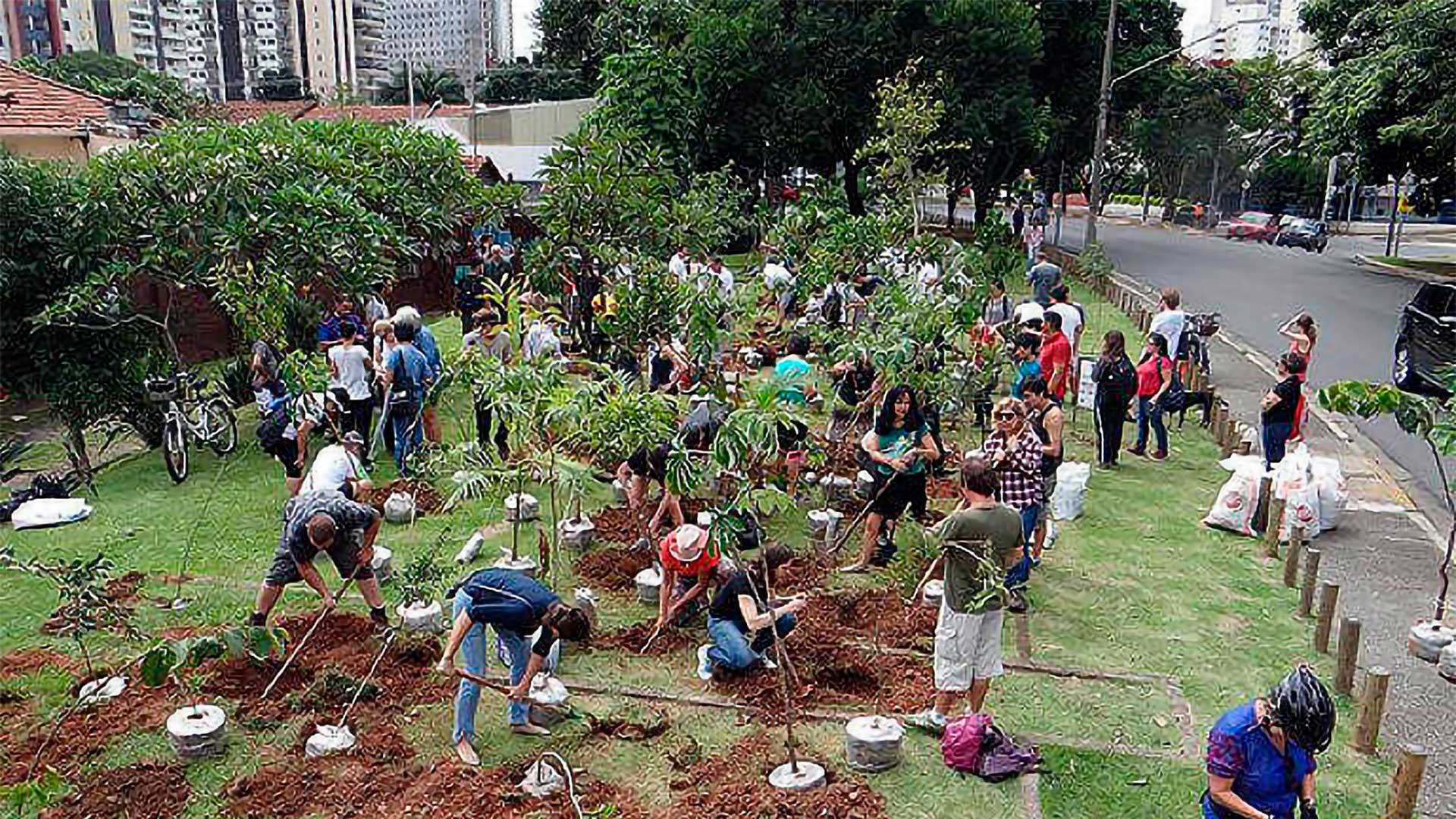
Project conceived by Ricardo Cardim occupied 1,200 square meters near the Tatuapé Bridge and bets on native trees to create biodiversity, shade, and greater resistance to the urban climate
A previously abandoned plot of land near the Tatuapé Bridge, in the eastern zone of São Paulo, began to be transformed into a small forest formed exclusively by native species. The space received one thousand seedlings of more than 100 Atlantic Forest species, planted densely in an area of approximately 1,200 square meters.
Held on May 30, 2026, the task force marked the implementation of the 18th Pocket Forest conceived by botanist and landscape designer Ricardo Cardim. The initiative seeks to recover, in small urban spaces, part of the vegetation that existed in the São Paulo territory before the advance of constructions, avenues, and ornamental species brought from other regions.
According to a report published by Conexão Planeta on June 8, 2026, the planting was funded by the British Consulate, with participation from volunteers and collaboration from São Paulo City Hall employees. This was the first public Pocket Forest implemented since 2019 and also the first in which municipal employees directly participated in the logistics of the seedlings.
-
A resident of the Brazilian countryside became known for searching for underground water by holding a peach tree fork, a practice called dowsing that dates back to ancient Egypt but which scientific studies in Germany have concluded has no proven effectiveness.

-
Spray technology promises to shield electrical cables against severe storms and prevent blackouts caused by the weight of ice in winter.

-
Inventor creates a bicycle without springs and without hydraulic oil, using only powerful magnets in the suspension, and demonstrates in tests why the idea works, but still faces engineering risks and limitations.

-
Thousands of residents went to the Sabaneta dam to defend rivers and crops, walked 20 km, and the pressure led the President of the Dominican Republic to suspend the gold and copper project.


The new grove was installed in a spot surrounded by heavy traffic, near the Tietê Marginal. The choice reinforces one of the central proposals of the project, which is to recover degraded or underutilized areas and transform them into nuclei capable of promoting biodiversity within the largest city in the country.
One thousand seedlings transform 1,200 square meter plot in Tatuapé
The planted seedlings vary from approximately 40 centimeters to three meters in height. The selection took into account factors such as the amount of light received by the land, humidity, soil characteristics, available space, and each plant’s ability to interact with others.
Among the chosen species are cambuci, araçá, gabiroba, grumixama, ingá, embaúba, cereja-do-rio-grande, sete-capotes, pau-pólvora, fumo-bravo, and laranja-de-macaco. Many produce fruits that can serve as food for birds, insects, and other animals that circulate in the urban environment.
Diversity is an important difference compared to traditional plantings, where few species are repeated along streets and squares. In the Pocket Forest, trees, shrubs, and plants of different sizes are combined to form various levels of vegetation, bringing the space closer to the structure found in a young forest.
Dense planting attempts to reproduce the dynamics of the Atlantic Forest


The method does not simply consist of placing several trees close to each other. Before planting, the land needs to be studied and prepared so that the roots find suitable conditions for development, especially in compacted urban soils, shallow soils, or those mixed with stones and debris from old constructions.
The seedlings are placed in high density to stimulate a dynamic similar to that observed in natural environments. In this system, the plants compete for light and space, while their roots help structure the soil and the accumulated organic matter begins to create favorable conditions for the vegetation as a whole.
The proposal is that, after the initial adaptation phase, the forest can grow with less need for irrigation, pruning, and constant interventions. This does not eliminate the need for monitoring, especially during prolonged droughts, heat waves, vandalism, or improper waste disposal.
As Ricardo Cardim explains when promoting the project, the combination of species needs to be planned so that the grove functions as a kind of biodiversity distribution hub. Fruits and seeds can be transported by birds, while flowers and shelters attract pollinators and other animals important for environmental balance.
Idea emerged in 1994 and had its first public planting in 2016
The origin of the project dates back to 1994, when Cardim observed the natural regeneration of small forest fragments on a family property in the Serra da Mantiqueira. Even surrounded by altered areas, the plants grew close together, competed with each other, and quickly restored the vegetation.

The experience served as a starting point for creating a method adapted to cities. The first Pocket Forest on private property was implemented in 2013, in the south zone of São Paulo, for the Basf House.
The project reached public spaces on March 31, 2016, when about 200 people participated in a task force in Vila Olímpia. A few weeks later, another planting brought together volunteers at Soichiro Honda Square, near Ibirapuera Park.
According to the Cardim Paisagismo portfolio, one of the most well-known experiences was implemented at Largo da Batata, in Pinheiros. Approximately 400 seedlings of 80 native species were planted after the removal of debris, soil preparation, and incorporation of organic matter, forming a shaded area with different layers of vegetation in just a few years.
The Pocket Forests also reached places like Parque Cândido Portinari, Parque da Juventude, Parque do Belém, Marginal Pinheiros, Ponte Cidade Jardim, Vila Prudente, the banks of the Pinheiros River, and the Tamanduateí region. Some trees planted in previous projects have already reached about ten meters in height.
Small forests can reduce urban heat impacts

Tree planting alone does not solve the climate problems of a metropolis, but it can be part of a set of adaptation measures. Vegetated areas provide shade, help with rainwater infiltration, offer shelter for animals, and reduce the amount of surfaces that accumulate heat during the day.
The São Paulo Municipal Urban Afforestation Plan indicates that the combination of intense paving and little vegetation is associated with significant temperature differences within the city. Studies compiled by the document found regions with temperatures close to 19°C and others reaching 28°C, in a gradient related to land use and the presence of trees.
Dense groves can also retain some of the suspended dust, improve humidity around the vegetation, and reduce the speed at which water flows over the ground. In areas near avenues, these benefits become especially relevant, although the result depends on the size of the space, the health of the plants, and the maintenance provided.
High vegetation coverage is not equally distributed throughout the city
The São Paulo City Hall reported in 2023 that 54.13% of the municipal territory had some type of vegetation coverage. The indicator includes large green areas located mainly in more remote regions and does not mean that all streets, neighborhoods, and communities have the same availability of trees, parks, or shade.
This inequality helps explain why small projects are still important in highly impermeable regions. A 1,200 square meter forest represents a small portion compared to the extent of the capital, but it can serve as a connection point for birds and seeds, as well as offer direct benefits to its surroundings.
The discussion also goes beyond the city’s limits. Data released in May 2026 by the SOS Mata Atlântica Foundation indicates that about 24% of the biome’s original coverage remains, of which only 12.4% corresponds to mature forests.
The Ministry of the Environment estimates that the Atlantic Forest hosts more than 20,000 species of trees and shrubs, with thousands found only in this biome. Therefore, restoring native species in cities also helps bring the population closer to a biodiversity that has disappeared from much of the urban landscape.
Authorizations, financing, and maintenance limit new plantings
Despite reaching the 18th planting, the continuity of the project depends on the release of land, obtaining resources, and forming partnerships. Cardim states that he spent about four years, not counting the most critical period of the pandemic, trying to get authorization for a new public implementation.
The landscaper estimates that each Pocket Forest may require about R$ 100,000, an amount allocated to soil preparation, machinery, transportation, seedlings, supplies, and professionals responsible for logistics. The conceptual work developed by him is presented as philanthropic, but the physical implementation requires a structure that can hardly be maintained by volunteers alone.
In the case of the forest near the Tatuapé Bridge, the São Paulo City Hall would have committed to monitoring and caring for the space. The survival of the seedlings in the first few months will be crucial for the planting to progress to the formation of a closed and more resistant canopy.
The project shows that small plots, flowerbeds, and degraded areas can receive native vegetation instead of remaining empty or covered only by ornamental lawns. The challenge now will be to ensure adequate maintenance and transform isolated initiatives into a continuous policy of urban ecological recovery.
Should the city allocate more land and public resources for native forests or prioritize traditional infrastructure and landscaping works? Leave your opinion in the comments and say whether the lawns and empty spaces of São Paulo should give way to small Atlantic Forest groves.




Be the first to react!