Portuguese
  Spanish


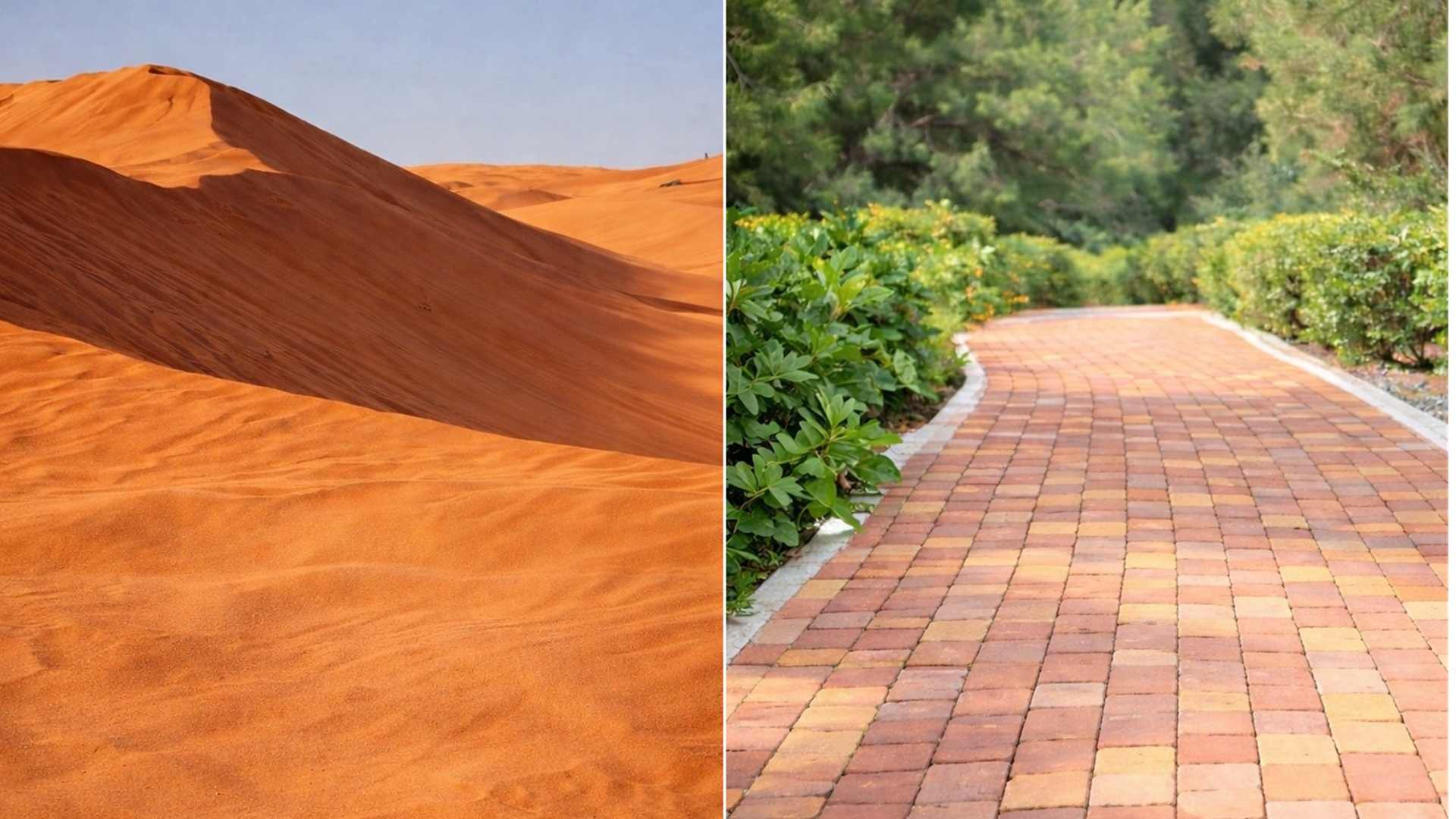


Researchers from Norway and Japan Developed a Material Called Sandcrete That Uses Desert Sand Combined with Wood Waste and Industrial Pressure to Produce Alternative Paving Blocks That Seek to Reduce the Extraction of Sand from Rivers and Part of the Emissions Linked to Cement Production
Researchers from Norway and Japan developed a material that transforms desert sand into paving blocks from wood waste. The new compound, called Sandcrete, emerges as an alternative in light of the global shortage of suitable sand and emissions from the concrete sector.
Concrete is currently the most widely used construction material on the planet, second only to water in terms of volume consumption. Every year, more than 4 billion tons of cement are produced, a process associated with about 8% of global CO₂ emissions.
This environmental impact occurs at the same time as another structural problem in the construction industry grows. The availability of suitable sand for producing conventional concrete is rapidly declining in various regions around the world.
-
OnePlus N6 Smartphone to Launch in India with 8,000mAh Battery and 45W SuperVOOC Charging, Lasting Up to Three Days

-
Scientists Plan to Release Air Bubbles Underwater to Protect Antarctica’s “Doomsday Glacier” from Melting

-
Chinese R6000 Drone Combines Airplane and Helicopter Features, Carries Up to 12 People for Multiple Missions
-
In the World’s Most Densely Populated Desert, Families Dig Funnel-Shaped Underground Cisterns to Capture Rare Rainfall and Store Drinking Water for Up to Eight Months




Global Shortage of Aggregates and the Paradox of Desert Sand Abundance, Paving Blocks
Not all sand can be used to produce traditional concrete. For the material to function properly, the grains need to have specific shapes and sizes that ensure stability and adhesion in the mixture.
For this reason, rivers are excavated, deltas are dredged, and mountains are crushed to obtain compatible aggregates. This process has caused accelerated erosion, loss of biodiversity, social conflicts, and increasing pressure on already fragile ecosystems.
At the same time, the planet has immense amounts of sand in desert regions. Desert sand is extremely abundant, but its ultrafine and wind-rounded structure prevents its use in conventional concrete.
For decades, this type of sand was considered practically useless for construction. The obstacle has always been related to the physical behavior of the grains within traditional cement mixtures.
Botanical Concrete Transforms Desert Sand, Paving Blocks Without Using Traditional Cement
In light of this impasse, European and Japanese researchers have developed a material called botanical sand concrete. The proposal breaks with traditional construction principles by designing the material based on the natural characteristics of desert sand.
Instead of trying to adapt the sand to conventional concrete, the process was redesigned to take advantage of its properties. The material combines ultrafine desert sand with plant-based additives, primarily wood powder.
The mixture is subjected to pressure and heat in an industrial compaction process. Unlike traditional concrete, the material is not simply poured and left to dry but is pressed in a manner similar to the production of engineered wood panels or ceramics.
In the laboratory, researchers tested different combinations of temperature, pressure, pressing time, and component ratios. The goal was to find a formulation that ensured sufficient strength without resorting to classic cement.
Initial Applications Focus on Sidewalks and Pedestrian Areas
The first planned uses for the material are non-structural applications. Among them are stone paving, exterior paving, sidewalks, and areas designated for pedestrian traffic.
In these urban spaces, mechanical resistance, durability, and stability are necessary. However, the structural requirements are lower than those needed for buildings or large infrastructures.
Comparative tests indicate that botanical concrete can achieve density and strength comparable to conventional materials. For this, the manufacturing process needs to be carefully controlled regarding pressure and temperature parameters.
So far, experiments have only been conducted in a laboratory setting. This stage allows for precise adjustments of the process variables before any attempts at industrial-scale production.
Researchers still need to assess the material’s behavior under different environmental conditions. Among the planned tests are cold cycles, prolonged exposure to moisture, mechanical wear, and aging under real conditions.
Environmental Potential Reduces Pressure on Rivers and Mountains
The development of materials that utilize desert sand, paving blocks may reduce some of the current pressure on ecosystems. If part of the demand for aggregates is met with locally processed sand, extraction from rivers and rock crushing could decrease.
This scenario also implies a reduced need for transporting heavy materials. The reduction of trucks, dredging, and mining operations could limit cumulative environmental impacts associated with civil construction.
Another relevant factor is the simplicity of the production process. Sandcrete does not require extreme temperature furnaces or complex chemical chains, making its implementation easier in regions near deserts.
The proximity between raw material and production is considered an essential point by researchers. Transporting sand thousands of kilometers would compromise the environmental benefits of the solution.
Local Production Can Transform the Perception of Sand in Arid Regions
In many arid and semi-arid regions, sand is often seen as an obstacle to development. It interferes with agriculture, infrastructure, and land occupation.
The possibility of transforming this material into a resource for local construction changes this perception. Desert sand, paving blocks become a potential raw material for basic infrastructure.
The material has not yet been designed to replace traditional concrete on a large scale. Its initial role is to diversify options and reduce dependence on aggregates obtained through environmentally intensive processes.
Researchers emphasize that the advancement does not represent a universal solution. The environmental benefit depends on the local use of the material and adaptation to the specific conditions of each region.
In the long term, the combination of local sand, biomaterials, and relatively simple industrial processes can influence new approaches in sustainable construction. The proposal aims to integrate circular economy, emission reduction, and more efficient use of available resources.