Portuguese
  Spanish




Researchers From China Present New Solid-State Battery That Uses Hydrogen Ions As An Alternative To Lithium, Expanding The Debate On Storage Technology For Electric Cars And Renewable Energy Networks.
The global energy transition pressures governments, industries, and research centers to develop safer, more durable, and efficient storage solutions. According to an article published by O Antagonista, in this context, a new solid-state hydrogen-based battery begins to gain prominence as a promising alternative to lithium-ion batteries.
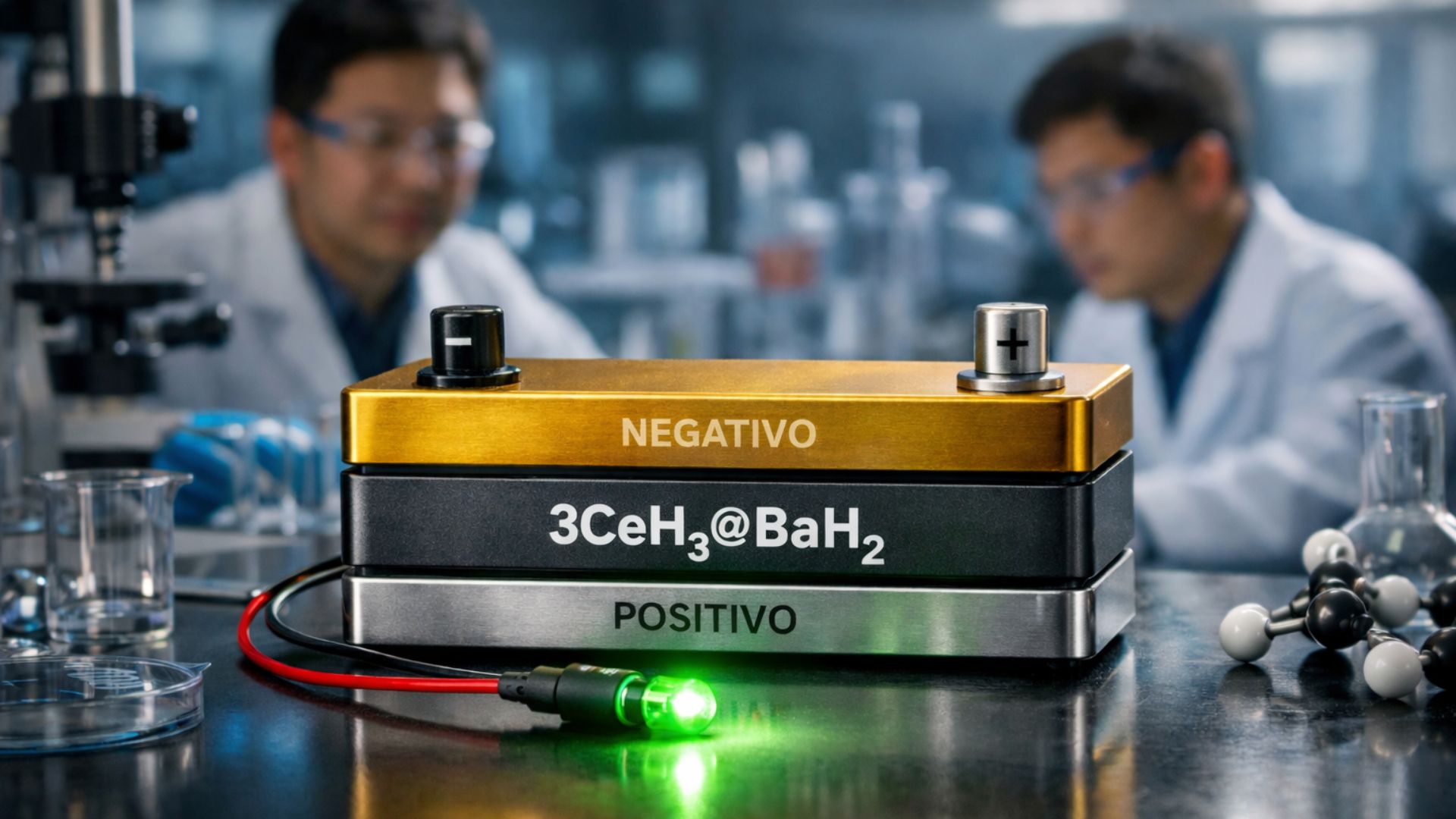
The prototype presented by Chinese researchers utilizes hydride ions (H⁻) as charge carriers and operates at a voltage of around 1.9 volts, a value sufficient to power an LED in an experimental demonstration. Although still in the laboratory phase, the technology has already surpassed the purely theoretical field and raises discussions about its potential impact on electric cars and storage systems for energy networks.
Why The Battery Is A Central Piece In The Expansion Of Renewable Energies
Solar and wind generation has accelerated rapidly over the past decade. However, producing electricity is not enough. The real challenge lies in storing this energy for use when the sun sets or the wind dies down.
-
Antarctic Sea Creature Yields Promising Compound Against Melanoma, Captivating U.S. Researchers

-
Underwater Guardian: The Autonomous Robot Monitoring Submarine Cables, Self-Returning, Wirelessly Charging, and Transmitting Data Without Onboard Crew

-
Robots Clean Solar Panels in Desert Power Plants Without Water, Preventing Energy Losses
-
AI Radar Built with Old Camera and $20 Gains Attention After Alleged $317,000 Sale to Chinese Government, But Lack of Documentation and Official Confirmation Raises Questions




Without an efficient battery, the electrical system loses flexibility. That’s why storage has become an essential element of the energy transition. The ability to store electricity ensures grid stability, prevents waste, and reduces dependence on backup thermal power plants.
Today, lithium-ion batteries dominate the global market. They are present in smartphones, laptops, industrial systems, and especially in electric cars. Despite commercial success, they have known limitations, such as the risk of flammability due to liquid electrolyte and the formation of metallic dendrites that can cause short circuits. These weaknesses drive research for new technological pathways.
China Invests In Hydrogen Battery Technology To Reduce Lithium Dependency
China is the world leader in lithium battery production and in supplying components for electric cars. At the same time, the country is increasing investments in research to diversify its technological bases.
The new hydrogen-based battery uses hydride ions (H⁻) instead of lithium ions (Li⁺). This substitution alters the internal dynamics of the cell and may reduce typical structural problems of conventional batteries.
Another differentiator lies in the fully solid-state architecture. Instead of flammable liquid electrolytes, the system employs solid compounds, which tends to increase thermal stability and reduce the risk of fire. This approach places Chinese technology at the forefront of one of the most promising areas of global research: solid-state batteries.
How The Solid Hydrogen Electrolyte Redefines Battery Functioning
The central point of the innovation lies in the solid electrolyte responsible for conducting ions between the electrodes. The Chinese team developed a structure known as “core-shell,” combining different metallic hydrides.
The system uses sodium and aluminum hydride in the positive electrode, while the negative electrode employs cerium dihydride. The solid electrolyte was structured with a cerium hydride core coated with barium hydride, forming the compound identified as 3CeH₃@BaH₂.
This combination was designed to balance ionic conductivity and chemical stability at room temperature. The conduction of hydride ions in a solid medium eliminates the need for flammable solvents.
The prototype exhibited a voltage of approximately 1.9 volts, demonstrating practical functionality by powering an LED. Although simple, the test confirms that the technology has surpassed the exclusively conceptual phase.
Structural Differences Between Hydrogen Battery And Lithium Battery
The replacement of lithium with hydrogen as a charge carrier modifies fundamental aspects of the electrochemical cell. While traditional batteries rely on the movement of Li⁺ ions, the new model works with H⁻.
This change may reduce the formation of metallic dendrites, microscopic structures that grow over charge and discharge cycles and pose a short-circuit risk. The solid architecture also contributes to greater mechanical stability.
Furthermore, the absence of flammable liquid electrolytes may make the battery safer in critical applications. However, there is still no evidence that the energy density exceeds that of commercial lithium batteries. It is important to emphasize that the current stage is experimental and long-duration tests still need to be conducted.
Technical Challenges That The Technology Needs To Overcome
Despite scientific advancement, the new hydrogen battery still faces significant limitations. The prototype exhibited performance loss after a few charge and discharge cycles, something incompatible with commercial applications that require hundreds or thousands of stable cycles.
Scalability is another obstacle. Transforming a laboratory cell into industrial production requires strict quality control, material standardization, and cost reduction.
It will also be necessary to assess the availability and environmental impact of the compounds used, including specific metallic hydrides. The final cost will determine whether the technology can compete with lithium in price-sensitive markets.
Potential Impact On Electric Cars And Electric Mobility
Electric cars directly depend on the evolution of the battery. Range, recharge time, and vehicle cost are strongly linked to the performance of the storage system.
A solid hydrogen-based battery could offer advantages in thermal stability and lower combustion risk. This may be relevant for applications that prioritize structural safety, such as commercial vehicles or public transportation systems.
However, there are still no data proving higher energy density or better comparative performance in electric cars. Progress will depend on extensive testing and optimization of materials.

Strategic Applications In Renewable Energy Grids
In addition to mobility, the new technology may play a relevant role in stationary storage. Electrical networks with high solar and wind participation need robust systems to balance supply and demand.
A solid-state hydrogen battery may be advantageous in environments where safety and low flammability are priorities. Dense urban installations and industrial centers could benefit from systems with lower thermal risk.
The integration of multiple cells to achieve adequate voltages and capacities is still a technical challenge. However, the concept broadens the range of alternatives for long-term energy planning.
The Strategic Role Of China In Advancing Storage Technology
China already holds a dominant position in the global lithium battery supply chain. By investing in new chemistries, the country seeks to further strengthen its industrial and technological leadership.
Diversifying technologies reduces vulnerabilities associated with the concentration of raw materials and increases international competitiveness. The bet on hydrogen as a storage vector demonstrates strategic insight in the face of the growing global demand for clean energy solutions. Even if the new battery does not immediately replace lithium, the scientific advancement alone strengthens China’s position in the global innovation landscape.
A New Chapter In The Evolution Of Battery And Energy Technology
The innovative hydrogen-based battery developed in China represents a significant scientific advancement in the quest for safer and more efficient solutions. With a demonstrated voltage of 1.9 volts and a fully solid architecture, the prototype proves initial viability.
There are still challenges related to life cycles, cost, scalability, and industrial integration. However, the proposal expands the possibilities for electrical storage at a crucial moment for the energy transition.
The future of energy may not depend exclusively on lithium. The combination of different technologies, including hydrogen-based systems, may offer greater safety, stability, and flexibility for electric cars and renewable energy networks. The Chinese innovation reinforces that the evolution of the battery remains one of the central pillars of the global energy transformation.