






 Portuguese
  Spanish


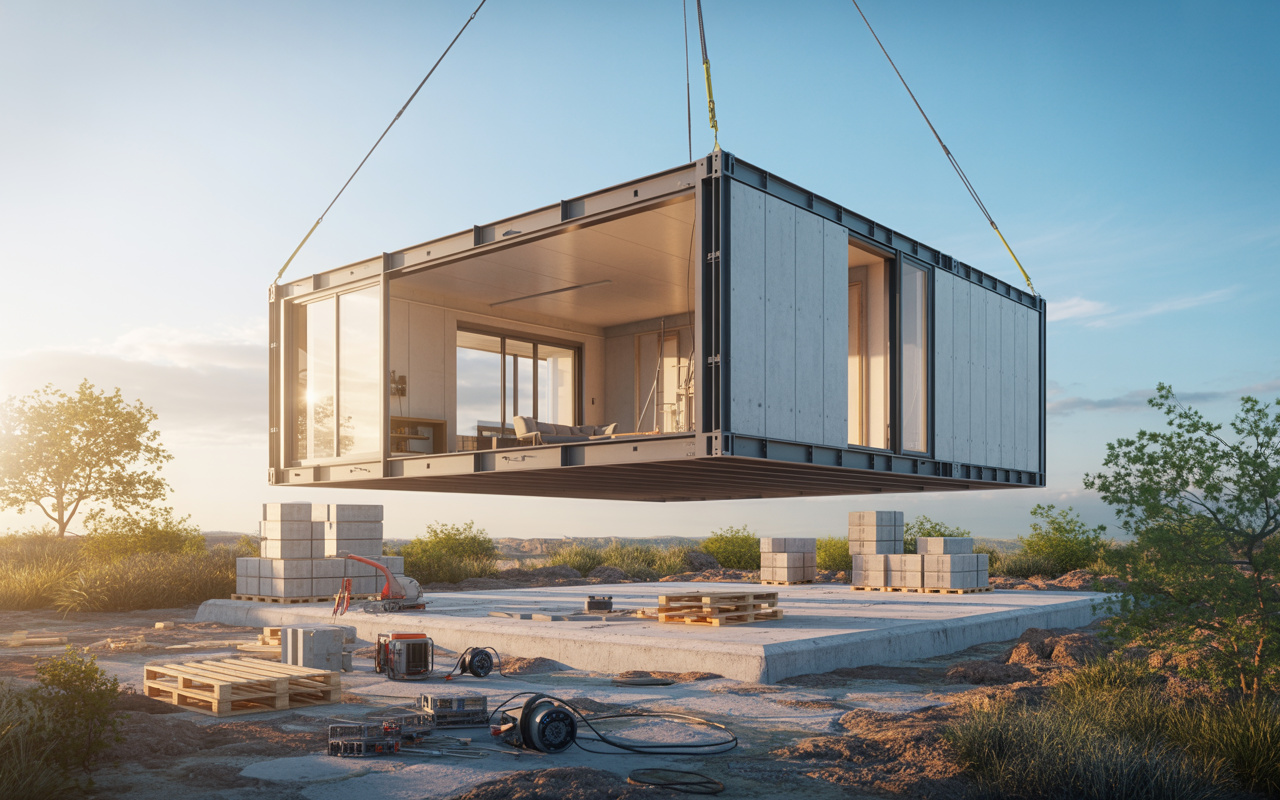


Modular Houses of 40 Sqm Gain Ground in Brazil: Quick Installation, Lower Cost Than Brickwork, and Clean Works Make the System a National Trend.
In recent years, Brazil has witnessed an accelerated expansion of the modular and prefabricated housing market, driven by construction tech companies, industrial standardization, and demand for quick and predictable solutions for those looking to build at controlled costs. Units of 30 to 40 sqm have become the most sought after by those seeking first housing, rental investment, guest houses, studio apartments, or residential expansions, especially in large centers where labor is scarce and expensive.
The model is based on a simple logic: the house is built inside a factory, in a controlled environment, with industrialized stages, precise cuts, minimal waste, and constant technical oversight. Afterward, it is transported to the client’s land and installed on a light foundation, often in just a few hours. The result is a clean, quick, and predictable build, with less noise, less dust, and without the unpredictability typical of traditional brickwork.
The national popularization began in 2022, when companies from Santa Catarina, Paraná, São Paulo, and Goiás started offering compact models ready for delivery. From 2023 onward, increasingly minimalist versions emerged, featuring streamlined finishes, complete bathrooms, embedded electrical systems, and future expansion possibilities with additional modules. In 2024 and 2025, the segment consolidated a strong presence on digital platforms, with architectural influencers and housing programs starting to consider industrialized methods as viable solutions.
-
Engineering Feat in Brazil: 6.4 km Tunnel and Powerful Pumps Overcome 200-Meter Elevation to Save São Paulo’s Cantareira Water System

-
Engineering Students Build Off-Grid Tiny Home with Sustainable Features and Offer Free DIY Guide
-
Historic Brazilian Championship Stadium Demolished for New Supermarket and Shopping Center Development

-
Workers excavate one of the world’s longest railway tunnels beneath the Alps between France and Italy, stretching nearly 60 km, 600 meters deep, with an investment of 11 billion euros.


How Much Does It Really Cost to Install a 40 Sqm Modular House in 2025
Prices vary according to material, finish, company, and delivery region. On average, the prices practiced in Brazil for 40 sqm modular houses follow four main ranges, considering models structured in steel frame, wood frame, or prefabricated concrete panels.
- Basic Models (Light Structure and Simple Finish)
Average price: R$ 95 thousand to R$ 120 thousand
Include internal walls, electrical, plumbing, doors, windows, and a ready bathroom. Generally do not include premium flooring, air conditioning, or custom furniture. - Intermediate Models (Standard Residential Finish)
Average price: R$ 120 thousand to R$ 160 thousand
Offer better thermal performance, more elaborate internal coatings, and minimalistic facade options. - Premium Models (High Thermal and Acoustic Performance)
Average price: R$ 160 thousand to R$ 220 thousand
Typically use premium cement boards, insulation with mineral wool, aluminum frames, and technical slabs for air conditioning. - Structural Prefabricated Concrete Models
Average price: R$ 150 thousand to R$ 250 thousand
These models are more robust, with greater durability and resistance to fire and weather, along with excellent thermal comfort.


The final cost also depends on transportation fees, as the module needs to be taken to the site by truck and raised with a crane in some cases. Regions close to factories have a significant financial advantage, especially in the South and Southeast.
Foundation: The Only Mandatory Element Before Delivery
An important characteristic of the modular house is that the foundation must be ready before installation. Most companies require:
- concrete slab of 8 to 12 cm,
- or running footings,
- or leveled concrete blocks.
For a 40 sqm house, the average foundation cost ranges from R$ 6 thousand to R$ 12 thousand, depending on the land and the region. Since the module is light, there is no need for deep excavations or complex structures.
This cost is still significantly lower than that of a conventional build, which requires various additional stages: beams, pillars, walls, plastering, alignment, leveling, concrete curing, tie rods, and waterproofing.
Technical Advantages That Explain the Growth of This Market
The modular house has not only gained popularity due to price but also because of the combination of technical performance and speed. Factors sustaining the advancement of this model include:
1. Total Build Time Between 7 and 30 Days
While a brick house may take months to complete, the module arrives pre-fabricated. In many cases, installation is completed on the same day.
2. Predictable Cost Without Surprises
Traditional construction budgets often vary by 20% to 40% due to labor, rework, and unforeseen issues.
In the modular house, the final value is locked in a contract.
3. No Material Waste
In the factory, every cut is precise, and material surplus is almost zero. In traditional construction, waste can reach up to 30%.
4. Low Maintenance and High Durability
Cement boards and steel frames have high resistance to rain, sun, and thermal variations.
Models made of prefabricated concrete have a lifespan of over 50 years.
5. Great Thermal Performance
Industrialized walls can include layers of EPS, rock wool, or mineral wool, reducing heat entry and decreasing the need for air conditioning.
6. Clean Build Without Debris
There are no mountains of sand, piles of bricks, accumulated bags of cement, or overflowing dumpsters.
The impact on the land is minimal.
Modular or Brickwork: Which Is Cheaper in the End?
The answer depends on the owner’s goal. For a compact 40 sqm house, the general comparison is clear:
- Average Cost of Traditional Brickwork:
R$ 140 thousand to R$ 190 thousand (depending on the region and quality).
Includes extensive labor, finishes, long stages, and high material consumption. - Average Cost of Modular:
R$ 95 thousand to R$ 160 thousand (basic and intermediate models).
Includes a ready structure, quick installation, and fewer execution stages.
In the current scenario, building modular tends to be cheaper, more predictable, and faster. This explains why this market is growing at double digits each year and why so many families and investors are migrating to this type of solution.
Why Does This Model Draw So Much Attention in Brazil?
The Brazilian real estate sector has faced three major challenges in recent years:
- rising labor costs,
- shortage of qualified professionals,
- need for quick and economical builds.
The modular house addresses these three points simultaneously, in addition to offering aesthetics aligned with contemporary minimalism, featuring straight lines, flat slabs, clean facades, and expansion possibilities with new modules.
There is also a strong appeal among investors: 40 sqm modules are ideal for Airbnb, urban rentals, studio apartments, guest houses, and compact inns. The quick financial return is one of the main reasons for the increasing demand.
The Future of Modular Construction in Brazil
The coming years indicate expansion. The trend is that:
- new factories opened in the interior of São Paulo, Minas, and Paraná will reduce transportation costs,
- concrete models will gain more strength,
- hybrid systems (modular + steel frame) will become common,
- customizable projects will expand the high-end market.
Modular construction, once seen as an alternative, is heading towards becoming one of the pillars of compact housing in Brazil, especially in cities facing increasingly high construction costs.








gostaria de mais informações sobre a construção modular, qual mais perto de Vacaria RS?
A Flowin Engenharia Offsite está liderando com a melhor solução de casa modular do mercado!