Portuguese
  Spanish


The space debris from abandoned Chinese rockets in low Earth orbit increased between 2021 and 2025, according to LeoLabs. The report cites 51 bodies, three explosions, and prolonged risk to military and commercial satellites in congested space regions for decades or centuries.
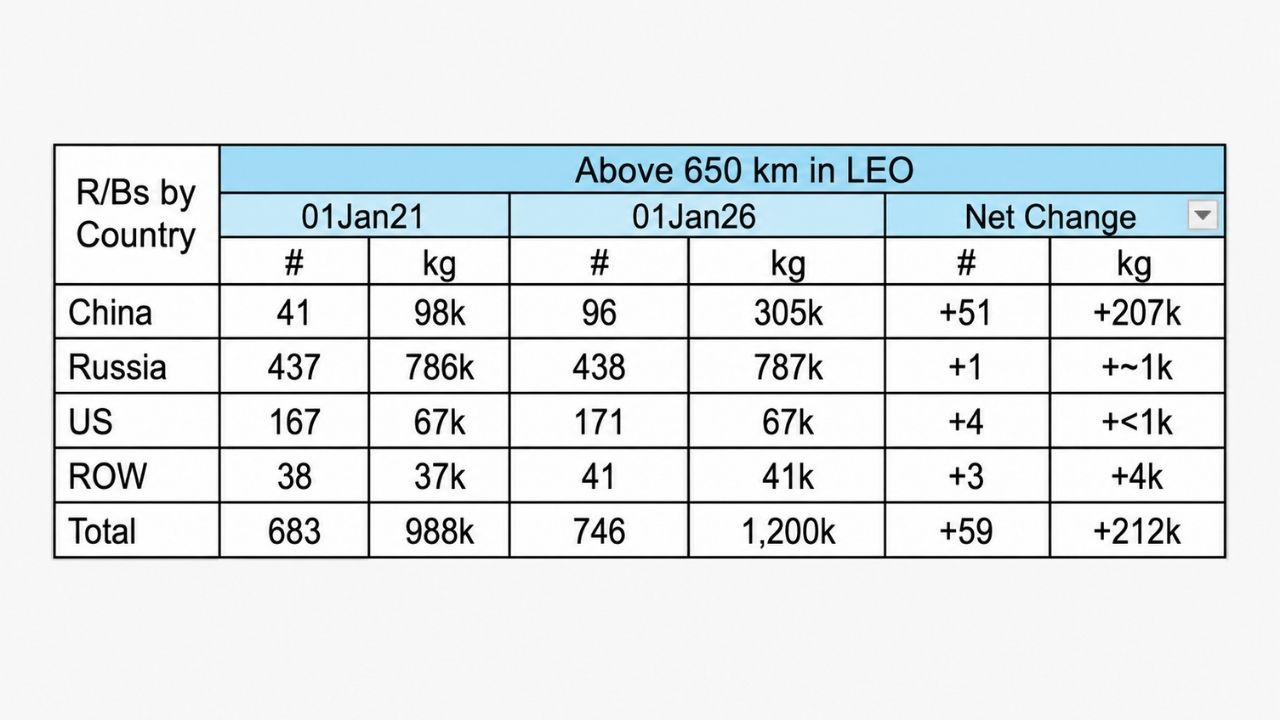
The space debris left by abandoned Chinese rocket bodies in low Earth orbit has once again raised alarms among experts. Between January 2021 and January 2025, China left 51 used rocket bodies above 650 kilometers in altitude, according to an analysis by LeoLabs released by Breaking Defense on June 25, 2026.
The report indicates that this number more than doubled compared to the previous five years and raised the total Chinese count to 96 such objects in the analyzed region. The risk is concerning because rocket bodies can carry fuel residues, explode in orbit, and generate debris capable of threatening military and commercial satellites for decades.
Rocket bodies are among the most dangerous objects in orbit

Not all space debris poses the same level of risk. Small fragments can damage satellites, but entire used rocket bodies are more concerning because they have high mass and can remain uncontrolled for a long time. When a large object breaks apart or explodes, it can create a cloud of fragments that is difficult to track and even harder to remove.
-
Brazilian Researcher Uses Low-Cost Sensors to Measure Cyclists’ Pollution Exposure in São Paulo

-
18 Iron Age gold coins discovered by a teacher using a metal detector in a Suffolk field sell for £33,200 at auction, exceeding estimates.
-
Chinese Farmer with No Formal Education Builds Over 60 Homemade Robots from Scrap Metal, Each Bearing His Surname
-
Telescope Set to Discover 100,000 New Planets Arrives at Launch Site, Ushering in a New Era of Astronomy


In the case analyzed by LeoLabs, the problem lies in the concentration of rocket bodies left in low Earth orbit, especially above 650 kilometers. This range is important because many objects there can remain in space for long periods before re-entering the atmosphere. The longer they remain abandoned, the greater the window of risk for collisions.
China concentrated most of the bodies left in the region
The survey attributes to China 86% of the rocket bodies abandoned globally in low Earth orbit during the observed period. In comparison, the United States would have left four such objects and Russia, one. The data not only indicates a numerical increase but also a significant concentration in an already contested orbital region.
The analysis also highlights the mass of these objects. According to the report, the amount of mass abandoned by China above 650 kilometers increased from 98,000 kilograms to 305,000 kilograms. This growth matters because greater mass means a higher potential for debris production in the event of an explosion or collision.
Three recent explosions increased the alert about space debris
The alert about space debris became stronger because three Chinese rocket bodies exploded in the last four years, according to the cited study. The report mentions two cases involving the CZ-6A and a recent episode linked to the Zhuque-2, reinforcing the concern with objects that remain uncontrolled after launch.
Explosions in orbit do not quickly disappear from the problem. They spread fragments in different trajectories, increasing the complexity for satellite operators. Even small pieces can cause serious damage when traveling at high speed around the Earth. Therefore, each explosion amplifies the challenge of predicting dangerous encounters in space.
Military and commercial satellites enter the risk zone
The growth of abandoned objects in low orbit concerns both commercial operators and military actors. Communication, observation, monitoring, and defense satellites depend on orbital predictability to operate safely. When the environment becomes more congested, the need for maneuvers, approach alerts, and planning to avoid collisions increases.
The concern is even greater because some of these rocket bodies are at altitudes close to regions of strategic interest. Victoria Samson, from the Secure World Foundation, highlighted to Breaking Defense that many of these objects are between 800 and 820 kilometers, while the proliferated space architecture of the United States, known by the acronym PWSA, was planned to operate around 1,000 kilometers. The proximity does not mean automatic collision, but it increases attention on orbital crossings.
Low Earth orbit is already more congested
Low Earth orbit has become one of the busiest regions in space. It is used by internet satellites, remote sensing, meteorology, defense, research, and communication. With more launches and planned constellations, any increase in space debris makes orbital management more difficult.
The report also mentions the Chinese Qianfan constellation, considered a rival to Starlink, with satellites positioned between 800 and 1,160 kilometers. According to the cited expert, the constellation has already reached 200 satellites, while Beijing plans to deploy up to 15,000 units. This scenario increases the pressure for mitigation practices, because more satellites and more abandoned bodies make the operational space more complex.
25-year rule appears at the center of the discussion
International best practice guidelines, adopted by more than 60 countries, including China, recommend measures to reduce risks of explosions and debris in orbit. One of them is to use remaining fuel to position rocket stages at altitudes that allow reentry within 25 years, preferably in a controlled manner.
Another practice used by operators in higher regions of low Earth orbit is to release launch stages in lower orbits, allowing them to fall more quickly, while the satellites proceed to the operational altitude with their own propulsion. The logic is simple: the fewer large objects are abandoned in long-lasting orbits, the lower the accumulated risk for all operators.
Beijing claims to follow mitigation rules
The topic also involves the official Chinese position. In a statement presented on June 11 to the Scientific and Technical Subcommittee of the United Nations Committee on the Peaceful Uses of Outer Space, Beijing claimed to follow the 25-year debris mitigation rule, according to its own national space use laws.
This statement contrasts with LeoLabs’ interpretation, which suggests that the abandonment of rocket bodies in long-duration orbits would not be aligned with international best practices. The divergence shows that the debate is not only technical but also regulatory and diplomatic, as space depends on coordination between countries, companies, and military operators.
Why do decades or centuries make a difference?
When experts say that debris can remain for decades or centuries, the warning is related to the orbital permanence time. At higher altitudes of low orbit, the atmosphere is too thin to quickly slow down objects. Thus, abandoned bodies and fragments can continue circulating for very long periods.
This prolonged time multiplies the risk. An object that remains in orbit for a few months poses a limited threat in time; an object that remains for decades participates in thousands of crossings with other trajectories. In space, the danger is not just in the size of the debris, but in the combination of speed, altitude, mass, and permanence.
Space debris has become a security and economic problem
Space debris is no longer just a topic of scientific curiosity. It affects national security, telecommunications, satellite internet, Earth observation, and commercial chains that depend on orbital infrastructure. When a satellite needs to perform an evasive maneuver, there is fuel expenditure, operational risk, and a reduction in the equipment’s lifespan.
For military satellites, the concern involves surveillance, communication, and response capability. For commercial satellites, the risk involves service interruption, loss of expensive assets, and the need for more robust insurance. The orbit, once seen as an almost unlimited space, now requires management similar to a shared critical infrastructure.
The alert grows along with the new orbital race
The new phase of the space race involves not only large scientific missions but also constellations, frequent launches, and military use of space. In this context, abandoned rocket bodies become dangerous liabilities. They no longer provide service but continue occupying trajectories and accumulating risk for active objects.
The LeoLabs report places China at the center of this discussion, but the problem is global. Any country or company that leaves large objects uncontrolled in long-lasting orbits contributes to a riskier environment. The difference, in this case, lies in the scale attributed to the Chinese program between 2021 and 2025.
The advancement of space debris in Earth’s low orbit shows that each launch leaves consequences that can last far beyond the original mission. The 51 rocket bodies mentioned in the report, the three recent explosions, and the increase in abandoned mass above 650 kilometers reinforce the need for more efficient rules, oversight, and orbital responsibility.
Do you think countries and companies should be required to safely remove or deorbit rocket bodies after each mission, even if it increases launch costs? Comment on whether space should be treated as a free exploration area or as common infrastructure that needs stricter rules.