Portuguese
  Spanish


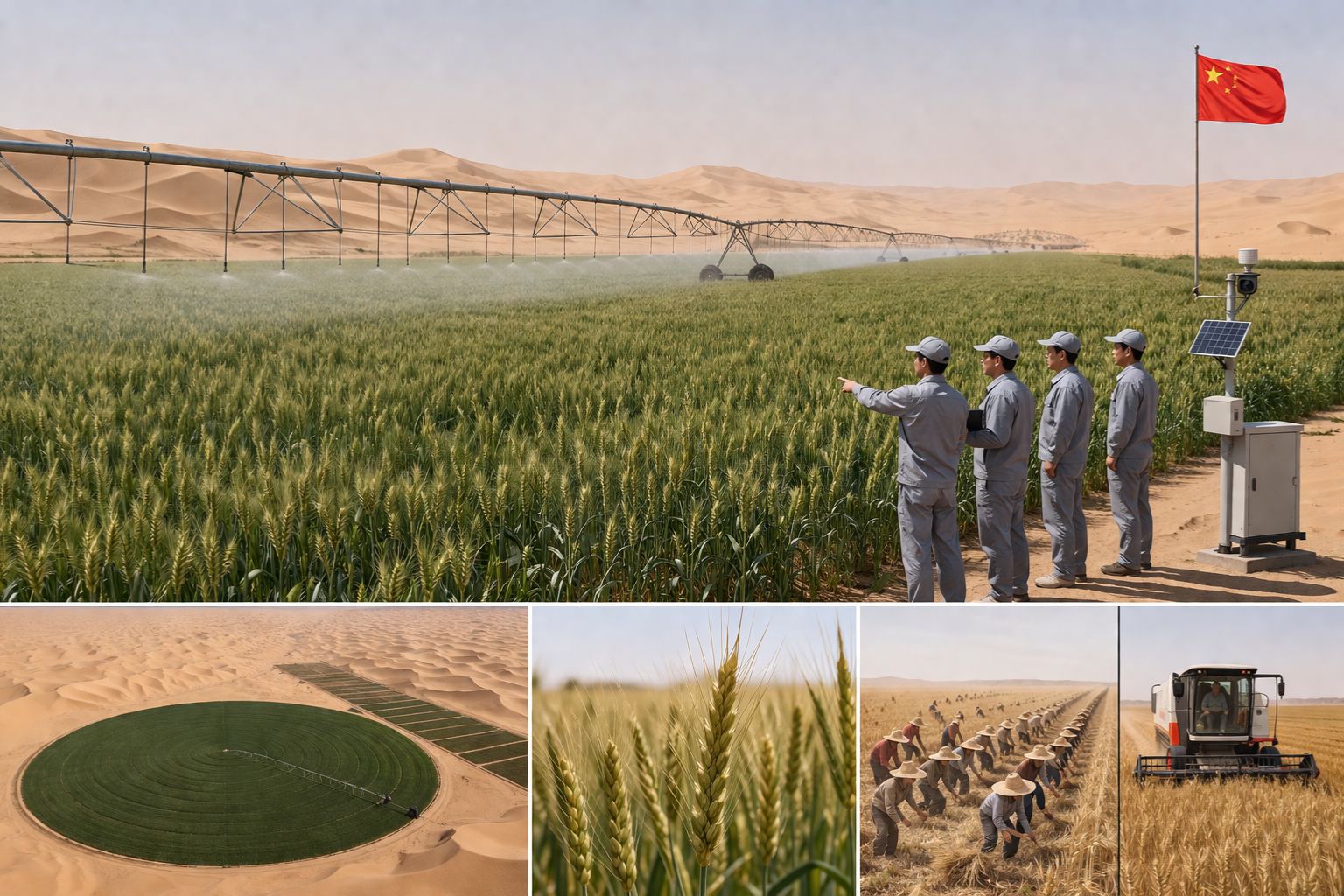

China has achieved a seed germination and seedling survival rate above 90% on 547 hectares of wheat planted in the Taklamakan Desert in Xinjiang. The center pivot irrigation system reduced labor from 30 to 4 workers, and the model can serve as a reference for Global South countries facing desertification and water scarcity.
The China has just proven that it is possible to harvest wheat in the desert. In the city of Kunyu, south of Xinjiang, the most recent crop planted on about 547 hectares of sand dunes surrounding the Taklamakan Desert showed a seed germination and seedling survival rate above 90%, according to records from early April. The result is impressive not only for the productivity achieved in hostile soil but also for the operational efficiency: the automated center pivot irrigation system allowed labor to be reduced from 30 workers to just 4, according to Cui Gangchuang, the field manager in the desert.
The experiment is not isolated. Two years after the project began, the planted area expanded from 400 hectares in the first harvest to the current 547 hectares, an expansion that reflects improvements in cultivation methods and the ability to keep plants alive in an environment where sandstorms are frequent. In Makit County, in Kashgar, another field planted in desert soil recorded an average yield of 294 kilograms per mu, exceeding expectations. China is transforming desert into farmland, and the numbers show that the strategy works.
How China manages to plant wheat in the desert with 90% survival
video: DEBONT CORP.
The secret is not a single technology, but the combination of several. According to information from the portal scmp, the center pivot irrigation system, consisting of elevated rotating sprinklers that cover large areas automatically, is the backbone of the operation in the desert. These devices distribute water in a calibrated manner, avoiding both waste and saturation of sandy soil that does not retain moisture like conventional soils.
-
India’s Sugar Export Cuts and Ethanol Shift Amid El Niño Threat Could Impact Global Prices and Stocks

-
Quarantine Pest Threatening Palm Trees Puts Brazilian Authorities on Alert, Prompts Monitoring at University of Taubaté and Potential Control Measures Across São Paulo
-
Global Alert: Report Finds 159 Pesticides in Coffee Beans Sold in Europe, Posing Serious Risks to Millions of Farm Workers
-
Low-Demand Brazilian Beef Offal Gains Popularity Abroad: Indonesia Purchases $19.5 Million, Boosting Revenue and Reducing Waste



In addition to irrigation, calibrated fertilization and proper soil preparation have proven vital to ensure that plants withstand the extreme conditions of the desert. Wheat varieties adapted to dry and cold climates have been specifically selected to withstand the thermal fluctuations of a region where temperatures can vary by dozens of degrees between day and night. In desert areas with favorable thermal conditions, annual double cropping practices have also been implemented, maximizing productivity per hectare.
The revolution of automated irrigation that reduced 30 workers to 4

The reduction in labor is one of the most revealing data points from the experiment in the desert. Where previously 30 workers were needed to manage planting, irrigation, and field maintenance, today only 4 people operate the entire system, thanks to the automation of sprinklers and digital monitoring of crops. The remaining 4 workers focus on supervision, equipment maintenance, and operational decisions that automation has not yet replaced.
For countries facing drought and desertification, this data is as important as the survival rate. The economic viability of cultivating in the desert depends not only on being able to make the plant grow but on doing so at a cost that justifies the investment, and reducing labor by more than 85% makes the model significantly more attractive. Automated irrigation in the desert is not only efficient in water use, it is efficient in the use of people, a resource that in many arid regions is as scarce as water itself.
The results that show planting in the desert is viable at scale
The numbers from the Chinese experiment in the desert go beyond the survival rate. In Makit County, the average yield of 294 kilograms per mu exceeded initial expectations for soil that, until a few years ago, was considered unproductive. For context, the average wheat productivity in conventional soils in China is around 300 to 400 kilograms per mu, which means the desert is achieving values close to those of traditional arable land.
The expansion of the planted area, from 400 to 547 hectares in two harvests, demonstrates that the model in the desert is not just a laboratory experiment. The agricultural production body of the Xinjiang Production and Construction Corps (XPCC) has already implemented irrigation systems that exceed national standards in yield per mu of wheat and corn, indicating that the technology is being scaled beyond pilot projects. Per capita grain production in China has remained well above the food security line of 400 kilograms per person during the 14th Five-Year Plan (2021-2025), and cultivation in the desert contributes to widening this margin.
What the Chinese desert model can teach countries facing drought
For Global South countries dealing with desertification, the Chinese experiment in the desert offers concrete lessons. The combination of efficient irrigation in water use, automated mechanization, digital monitoring, and drought-resistant varieties demonstrates that it is possible to produce food in extreme environments without relying on regular rainfall or naturally fertile soils. The model does not require conditions exclusive to China; the principles behind it are adaptable.
No-till planting, used in some areas of the desert, reduces soil disturbance and preserves the little moisture available. Drip irrigation, adopted in fields complementary to the main project, maximizes every drop of water by delivering it directly to the roots, avoiding evaporation that in desert environments can consume more than 70% of the water applied by conventional methods. For regions in Africa, the Middle East, and even Brazil’s Northeast, these techniques represent viable pathways to transform arid lands into sources of food production.
What Desert Cultivation Means for China’s Food Strategy
The Kunyu project is not just agriculture; it is geopolitics. China invests in desert cultivation as part of a food sovereignty strategy in a global context marked by instability in food production chains, trade sanctions, and disputes over natural resources. Every hectare of desert converted into productive farmland reduces China’s dependence on grain imports, especially wheat, whose global supply can be affected by conflicts such as the war in the Middle East.
The achievements in the Taklamakan Desert are concrete evidence that agricultural expansion on arid land can be viable and productive. Even in extreme environments, with frequent sandstorms and chronic water scarcity, the combination of technological innovation, adapted varieties, and efficient use of natural resources has shown that it is possible to achieve high productivity with reduced human resources. The desert that seemed useless could be the next breadbasket of the world.
China is planting wheat in the desert with a 90% survival rate and irrigation that replaces 30 workers with 4. Do you think this model could work in Brazil’s semi-arid region? Can the desert become a solution to hunger? Leave your opinion in the comments.