Portuguese
  Spanish


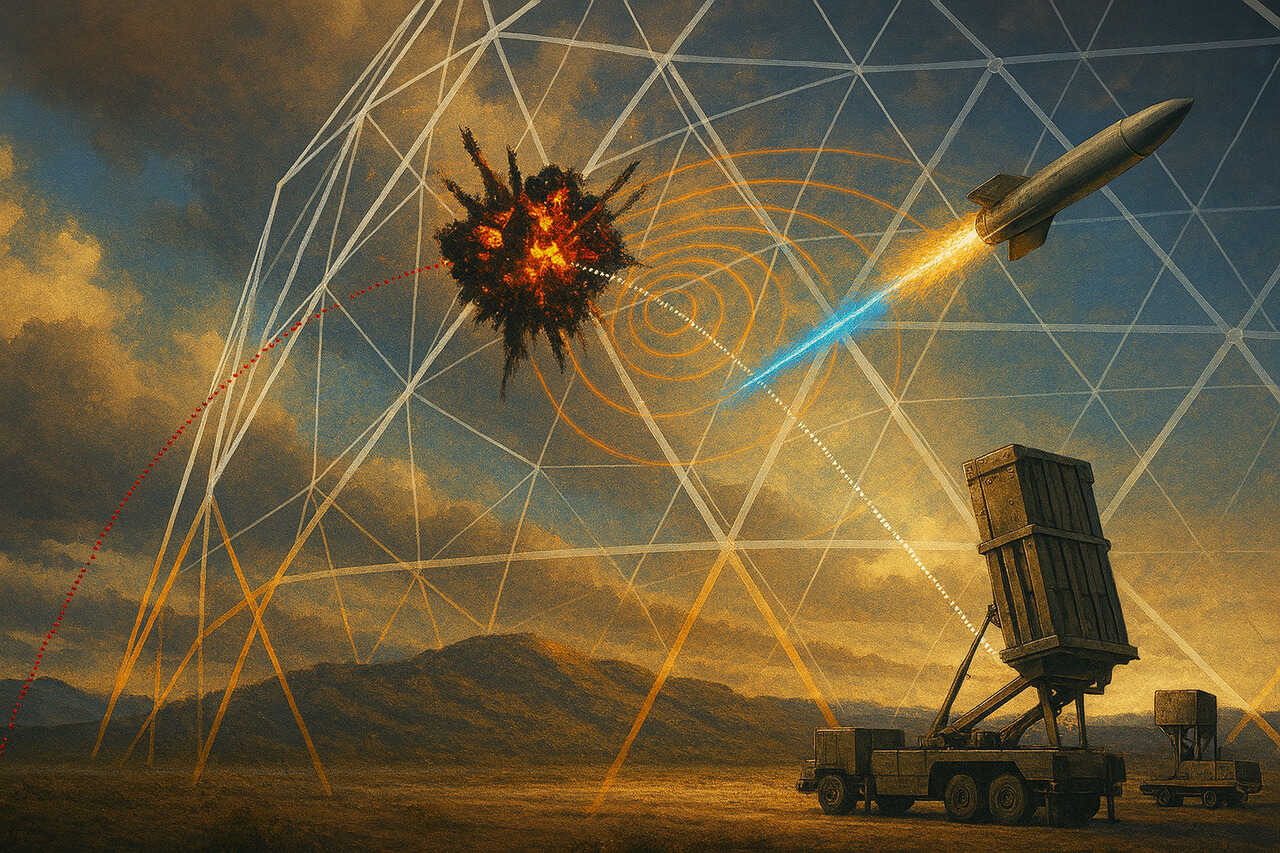


Inspired by a Beetle, Chinese Thermal Sensor Promises to Revolutionize Missile Defense Shields with Biological Precision, Fast Response, and Operation in Any Environment
The development of missile defense systems has returned to the center of international debates. Recent conflicts in the Middle East have reignited the discussion about technologies capable of neutralizing ballistic threats.
The United States, Israel, China, and European countries have intensified efforts to create more agile, precise shields prepared to deal with hypersonic missiles and simultaneous attacks.
With this shifting scenario, China presents a promising solution. Researchers in the country have developed a technology based on thermal sensors inspired by a beetle with an unusual ability: to see fires from great distances.
-
Australia to Deploy Up to 8 Nuclear-Powered Submarines in Indo-Pacific, Establishes Billion-Dollar Naval Chain Through AUKUS, Joining Elite Group Capable of Extended Underwater Missions

-
Indonesia Begins Construction of 2,000-Ton Scorpène Stealth Submarines with Advanced Weaponry and French Steel

-
Brazil’s Largest Navy Ship, NAM Atlântico, Transforms into Field Hospital During National Crises

-
Brazilian Navy Demonstrates Strength in Naval Exercise with Over 20 Nations, Deploys Frigate Independência in Anti-Submarine and Air Defense Scenarios, and Joins Historic Formation with 26 Ships from 14 Allied Navies off the U.S. Coast





The exoskeleton of this insect was the basis for creating highly sensitive infrared sensors, more efficient than those currently used.
Advanced Materials Ensure Extreme Precision
The technology combines materials such as palladium diselenide and pentacene, allowing for the detection of thermal radiation even in difficult environments.
Smoke, fog, and dust do not impede the system’s operation. In another configuration, using black phosphorus and indium selenide, the response is even faster.
The so-called photonic memories achieve speeds thousands of times higher than current optical technologies.
This innovation is not limited to the military field. Applications include detecting forest fires over large areas, vision for autonomous vehicles in low visibility situations, nighttime security systems, and even industrial equipment that measures temperature without direct contact.
Even so, the strategic use for defense is what draws the most attention from experts.
In the military area, China’s advantage lies in the combination of three functions that normally operate separately: detection, memory, and processing.
By integrating everything into a single device, the system responds faster and more efficiently. This reduces the time between identifying a threat and the necessary action to neutralize it.
While the U.S. Designs, China Tests
China does not yet have a complete and unified system like the one announced by the United States. The “Golden Dome,” officially revealed by President Donald Trump on May 20, 2025, aims to protect the U.S. against hypersonic missiles and space threats. It is expected to be operational by 2029.
Meanwhile, China relies on different layers of protection. Among them are the Dong Neng-3 for interception outside the atmosphere, the HQ-19, which acts against medium-range threats, and the HQ-29, with anti-satellite capability.
With the new thermal technology, these systems can become even more effective, even in the face of electronic warfare tactics or target saturation.
Another relevant difference is the operation at ambient temperature. Many thermal sensors require constant cooling to function properly.
This new sensor, on the other hand, does not need that. This facilitates its use in various contexts and reduces installation and maintenance costs.
Sensor Combines Biological Precision with Technological Agility
The materials used also bring technical benefits. The high thermal sensitivity brings the sensor’s performance closer to the natural capabilities of the beetle that inspired it.
It operates in adverse environments, detecting heat sources amid smoke or dust. And as it combines analysis and real-time response functions, it offers an advantage over systems that split these tasks.
The world is closely watching this advancement. The U.S. proposal is still under study, but the Chinese project already shows practical results in tests.
The impact of this could be significant. Countries interested in missile defense see this innovation as a possibility to elevate their defense systems to a new level.
Inspiration from Biology Could Define the Future of Defense
The Chinese development also challenges established models, such as Israel’s “Iron Dome,” which has been widely used in recent conflicts.
The difference lies in the origin of the technology and how it handles response time. The integration of functions and the use of new materials pave the way for more compact, faster, and precise solutions.
The technological race for efficient missile defense shields is just beginning. China, with its beetle-inspired system, is taking a bold step.
By betting on biology as inspiration for defense, the country proposes a new paradigm. It is not just about intercepting missiles, but anticipating movements with more intelligence and speed.
A New Chapter in the History of Missile Defense Shields
If it can integrate this technology into its current systems, China could position itself as a leader in missile defense.
In a world where response time can define the outcome of a conflict, precision and agility make all the difference.
The future of missile defense shields is transforming. Nature and science walk hand in hand in this process, and China shows that, even without a unified system like the “Golden Dome,” it is getting closer to creating a global and highly efficient defense.
With information from Terra Brasil Notícias.