






 Portuguese
  Spanish
  5 min of reading
  0 comments


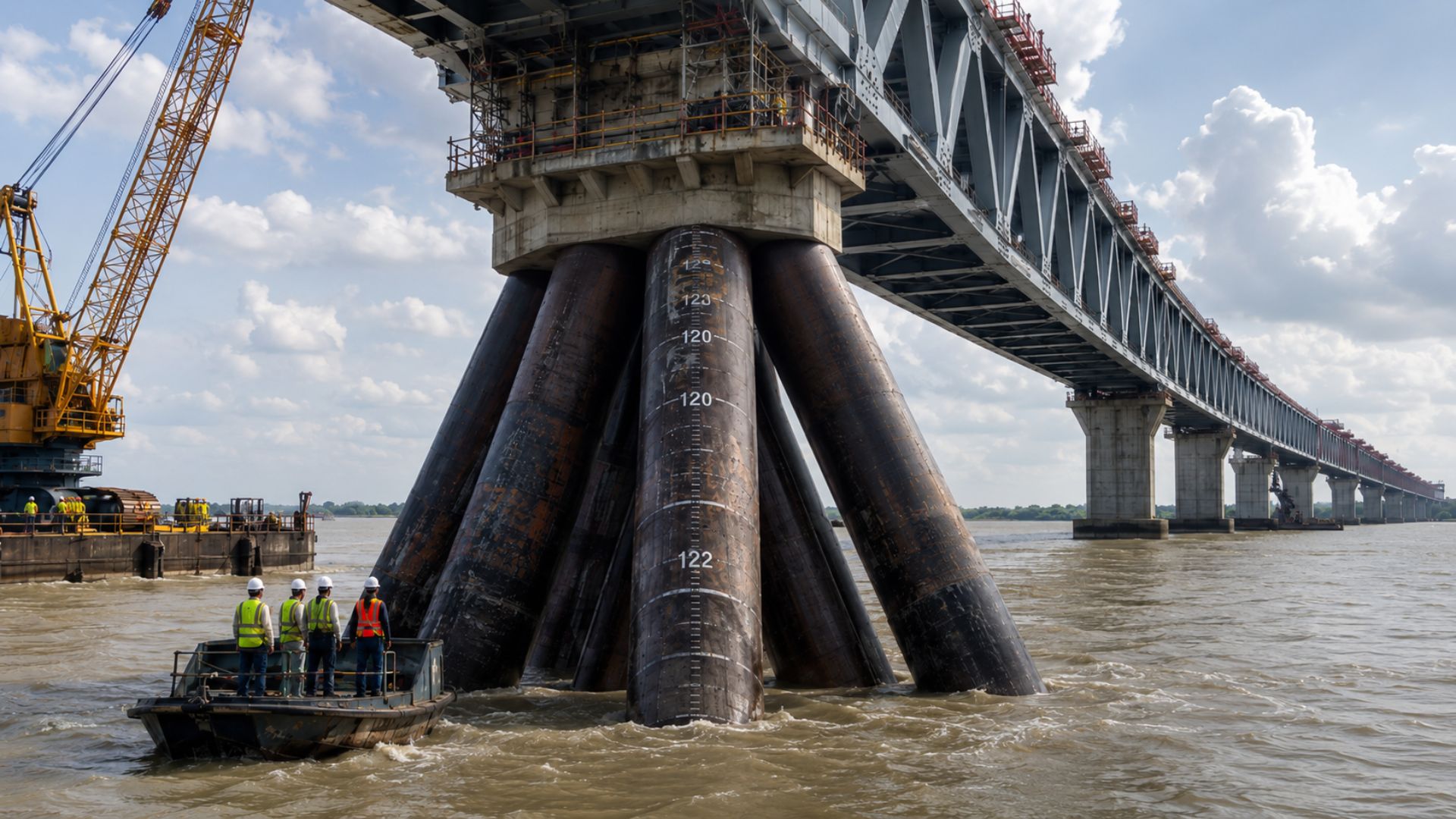
Engineering hidden beneath the Padma River supports a 6.15 km crossing in Bangladesh, with deep foundations, road and rail structure, monsoon resistance, and seismic solutions in one of the most complex river works ever built in the country.
The Padma Bridge in Bangladesh has become one of the most complex infrastructure works in South Asia by combining a road and rail crossing over one of the world’s largest river systems, in an area subject to monsoons, intense erosion, and seismic activity.
Spanning 6.15 km, the structure connects the southwestern region of the country to the capital, Dhaka, and has reduced the reliance on ferries on routes that previously could take almost an entire day of travel, according to data released by AECOM, responsible for the engineering project.
Behind the crossing visible to the public, the most decisive part of the work remains submerged and buried in the riverbed, where steel tubular piles with a diameter of 3 meters were driven at an angle more than 122 meters deep.
-
Tired of seeing families sleeping on the street, São Paulo delivered 18 m² furnished microhouses and took 888 people off the streets: Vila Reencontro became the model social housing for the homeless population.

-
The hydroelectric plants on the Madeira River, like Jirau, came for the energy, but now the drought wave has reduced artisanal fishing by 39% and emptied the tables of the riverside communities in the Amazon.
-
The Zuluk road has 32 zigzag curves at 3,400 meters in the Himalayas, originated as the Silk Route in Sikkim and became a military border where foreigners cannot pass.
-
Rio de Janeiro receives more than R$ 5.5 billion in sanitation, includes almost 1 million residents from communities in the formal customer base, and brings water, sewage, and proof of residence to regions historically neglected by urban infrastructure.


Deep foundation against the river’s force
Below the waterline, the biggest challenge of the Padma Bridge was the action of the currents, which remove sediments around the foundations during flood periods and increase pressure on the supports, especially during monsoon seasons.
In engineering, this phenomenon is known as erosion or bed scouring and can compromise superficial supports in bridges exposed to wide, unstable rivers subject to sudden changes in water volume and speed.
To address this terrain behavior, the designers adopted large-diameter inclined piles, capable of transferring loads to deeper layers and preserving support capacity even when part of the material around the pillars is displaced by the current.

According to AECOM, these foundations are among the longest and deepest ever used in bridges worldwide, which helps to gauge the complexity of constructing a permanent crossing over a constantly changing river environment.
In large bridges over rivers subject to intense erosion, structural safety does not depend only on the deck, pillars, and visible metallic sections, but also on the buried elements that support the structure out of the user’s sight.
When designing the Padma Bridge, engineering had to consider the variation of the riverbed, the strength of the waters, the volume of rainfall, and the loss of soil around the supports, in addition to the permanent loads of the structure itself.
Padma Bridge connects road and railway
Designed as a two-level crossing, the Padma Bridge combines road and rail transport in the same structure, with a four-lane highway on the upper deck and a single-track railway on the lower level.
This configuration allows vehicles and trains to cross the river in a direct connection between Dhaka and the southwestern districts of Bangladesh, reducing dependence on ferry routes in a region historically limited by the river barrier.
According to AECOM, the project also connects to the Trans-Asian Railway, which expands its logistical role and creates potential to facilitate cargo transport between India and container ports on the coast of Bangladesh.
In addition to the traffic lanes and the railway, the bridge incorporates a 750-millimeter diameter gas pipeline and fiber optic communication cables, elements that transform the structure into a corridor of essential infrastructure.
In the superstructure, prefabricated steel truss modules with 150-meter spans work together with prestressed concrete slabs, forming an arrangement capable of spanning long sections over the river with fewer supports on the riverbed.
This solution reduces the need for pillars very close to each other, an important feature in an area marked by strong currents, deep erosion, and frequent changes in the riverbed during different periods of the year.
Structure was designed for monsoons and earthquakes
In addition to monsoons and riverbed instability, the project considered the seismic risk of the region, as Bangladesh is in an area where tremors needed to be addressed as part of the safety requirements of the crossing.
Between the superstructure and the top of the pillars, friction pendulum bearings were installed, used to help isolate part of the movements during earthquakes and reduce the forces transmitted to the bridge compared to conventional supports.
According to AECOM, these devices are part of a set of solutions aimed at the resilience of the structure, alongside deep foundations, metal trusses, and a design prepared to withstand severe environmental conditions.


The combination of these measures highlights the difficulty of building over a river associated with the Ganges system, where moving water, unstable soil, large volumes of rain, and high structural efforts act simultaneously.
Therefore, the uniqueness of the crossing is not only in its 6.15 km length but in the engineering required to keep pillars, deck, railway, pipeline, and cables operating over a river environment considered highly demanding.
Connection reduced dependence on ferries
Before the bridge opened, travel between Dhaka and 21 southwestern districts heavily relied on ferries, making the crossing more time-consuming and vulnerable to queues, fog, bad weather, and extreme currents.
Data cited by AECOM indicates that these trips could take from 15 to 22 hours and, in certain situations, reach 24 hours, affecting passengers, goods, and perishable products transported between the two banks of the river.
With the direct connection, the bridge began to reduce traffic bottlenecks and integrate areas that had more limited access to the country’s main economic axis, especially on routes previously dependent on ferry transport.
Inaugurated on June 25, 2022, the structure was recorded as the largest infrastructure project in Bangladesh by the South Asia Subregional Economic Cooperation program, which also indicates an approximate cost of US$ 3.6 billion.
Besides bringing the southwest of the country closer to Dhaka, the crossing reduces the distance between the capital and the port of Mongla, the second-largest seaport in Bangladesh, reinforcing its role in the circulation of goods and services.
Invisible engineering sustains the crossing
Although the most well-known image of the Padma Bridge is formed by the deck, pillars, and the long metallic span over the river, the most critical part of the work lies in the inclined foundations that plunge into the riverbed.
These piles were designed to keep the bridge stable even under deep erosion, in a scenario where water, sediments, wind, rain, and seismic shocks continue to impose efforts on the structure after opening to traffic.
In a crossing of this magnitude, overcoming the distance between the banks is only part of the challenge, because the central requirement is to sustain operation for decades over a natural environment that remains in motion every day.








Be the first to react!