Portuguese
  Spanish


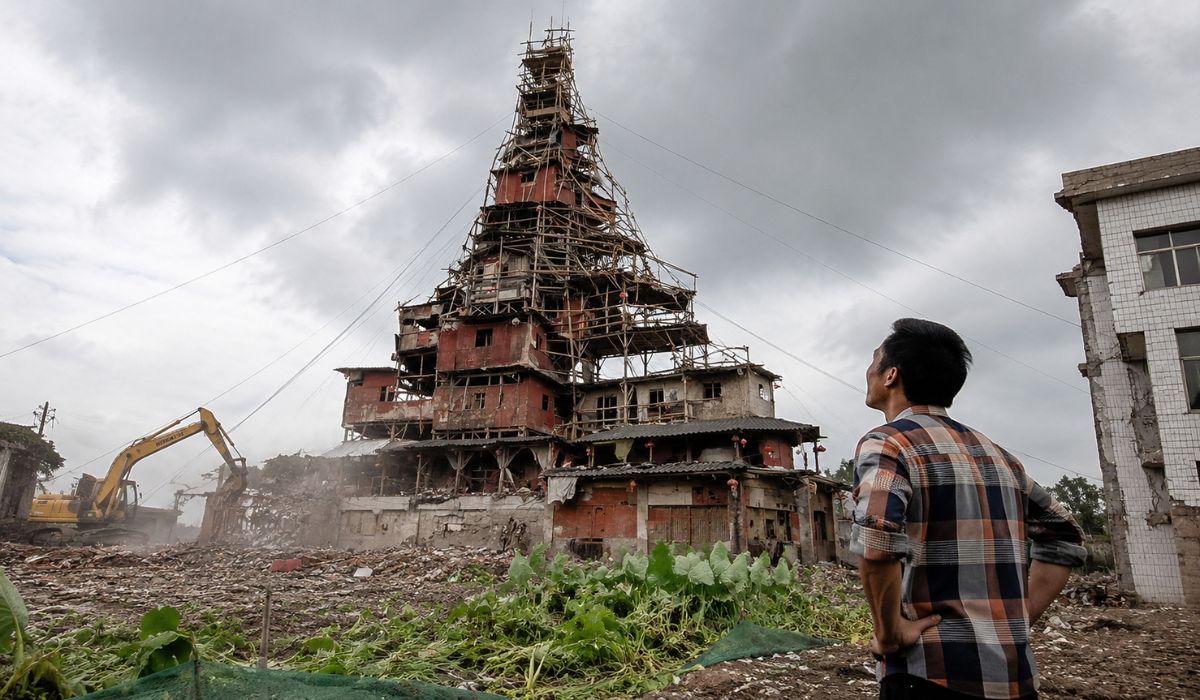

An improvised ten-story house in Guizhou became a tourist attraction after years of dispute between a resident and local authorities, until it was demolished in a few hours by administrative order.
The ten-story house built by Chen Tianming on an old stone bungalow was demolished in Xingyi, in the province of Guizhou, in southwest China, after years of dispute between the resident and local authorities.
The structure, made of wood, stairs, balconies, and overlapping rooms, had become a tourist spot, but was torn down on Wednesday (20), after a final notice issued two days earlier by the local government.
According to AFP, Chen, 43, stated that the agents took only a few hours to reduce the construction to its original one-story format.
-
Faced with College Costs, Brazilian Student Lived in a Minivan for Nearly Two Years to Graduate Debt-Free

-
Tokyo Scientists Create First 18cm Biohybrid Hand Using Human Muscle, Capable of Scissor Gesture and Holding a Pipette

-
Brazil Faces Norway in World Cup at Stadium Linked to Jimmy Hoffa’s Mysterious Disappearance

-
Retired Woman Leaves French Public Housing Due to Fear, Lives in Van for Weeks, Prompting Response from Local Authorities and a Priest

The property started as a simple family house and had been expanded over nearly eight years, with an estimated cost by the resident himself of about 200,000 yuan, equivalent to approximately US$ 29,000.
“I do not feel regret, because regret is useless,” Chen told the news agency.
He also stated that he does not blame himself for failing to protect the house, because, as he reported, the force that led to the destruction was “simply too powerful.”
Ten-story house became a well-known case of “nail house” in Guizhou
The property began to receive attention after most of the village where Chen lived was demolished in 2018.
The authorities planned to build a tourist resort in an area known for mountainous landscapes and rice fields, but the resident’s family refused to leave the property.
With the tourist project having no foreseeable progress, Chen began to erect new floors on the family bungalow.
The house came to be referred to as a “nail house”, a term used in China for properties whose owners resist removal in areas designated for construction or development plans.
The expansion occurred gradually.
Reports from AFP published by international outlets informed that Chen completed the fifth floor in 2019, the sixth in 2022, and the seventh in 2023, while continuing to receive demolition notices.
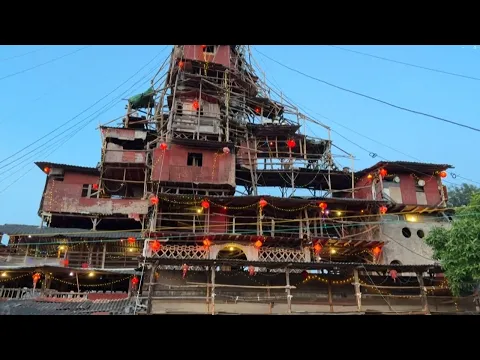
The result was a vertical structure with narrow passages, beams, stairs, wooden annexes, and overlapping floors.
The construction also began to attract visitors.
According to AFP, Chinese tourists and vehicles compared the look of the house to the fantastic constructions associated with the films of Japanese animator Hayao Miyazaki, co-founder of Studio Ghibli.

Authorities claimed lack of license and safety risk
Despite the visitation, the property had been under questioning by the authorities for years.
The local government stated that the construction did not have the necessary licenses and posed a safety risk.
The house was supported by improvised elements, including wood, beams, bamboo scaffolding, ropes, and cables.
In August 2024, authorities classified the house as an illegal construction.
At the time, Chen was ordered to remove everything that had been added to the original property, preserving only the old stone bungalow.
The resident contested the decision, filed appeals, and tried to take the case to administrative bodies and courts.
Even so, the measures did not prevent the final demolition action, according to information published by AFP.

On May 18, 2026, the Xingyi Coordinated Administrative Enforcement Office issued the final notice.
The document ordered Chen and his family to leave the construction considered illegal by 9 a.m. on Wednesday (20), local time.
After the deadline, enforcement agents and members of the public security department went to the property.
Chen reported that he and his parents were removed from the house by local authorities and said his phone was confiscated during the operation.
Images taken after the demolition showed piles of materials scattered at the site where the ten-story structure once stood.
AFP reported that the construction was reduced practically to the first floor, corresponding to the original bungalow.
Chen Tianming states he will seek legal assistance
After the demolition, Chen told AFP that he intends to seek legal assistance to try to have the forced demolition deemed illegal.
He said he still wants to defend his rights, although he acknowledged the difficulty of reversing the official classification of the work as an irregular construction.
The house had accumulated different uses over the years.
Besides serving as a residence, it was featured in reports as a personal construction by Chen and as an informal tourist attraction for visitors who went to the site to take photos.
In a previous interview with AFP, Chen said he started building out of practical necessity, with the intention of renovating and expanding the family space.

Later, according to his account, the work also became a personal interest and a hobby.
The case occurred in a region where, according to international reports, authorities had planned a 324-hectare tourist resort, with a theater and artificial lake.
The project was canceled months later, but part of the village houses had already been demolished, while Chen’s family remained on site.
Before the demolition, the house visually stood out compared to the surrounding lands, according to descriptions published by AFP.
The structure featured stacked rooms, improvised passages, exposed wood, and decorative lanterns used by Chen at nightfall.
For the authorities, the elements used in the construction reinforced the claim of safety risk.
Meanwhile, residents and visitors cited by AFP saw the property as a local attraction; a resident identified as He Diezhen stated, before the demolition, that the house was “beautiful” and could become an official tourist spot if there were no safety issues.
With the action in May 2026, the structure built over nearly eight years ceased to exist in the form that had attracted tourists and media outlets.

According to Chen, if he can have the demolition declared illegal, he may try to restore the property.
The dispute over the house brought together issues about resident removal, development projects, structural safety, and limits of unlicensed constructions.
In the case of Chen Tianming, these issues remained focused on a family property that went from a stone bungalow to a ten-story structure before being demolished by administrative order.