Portuguese
  Spanish


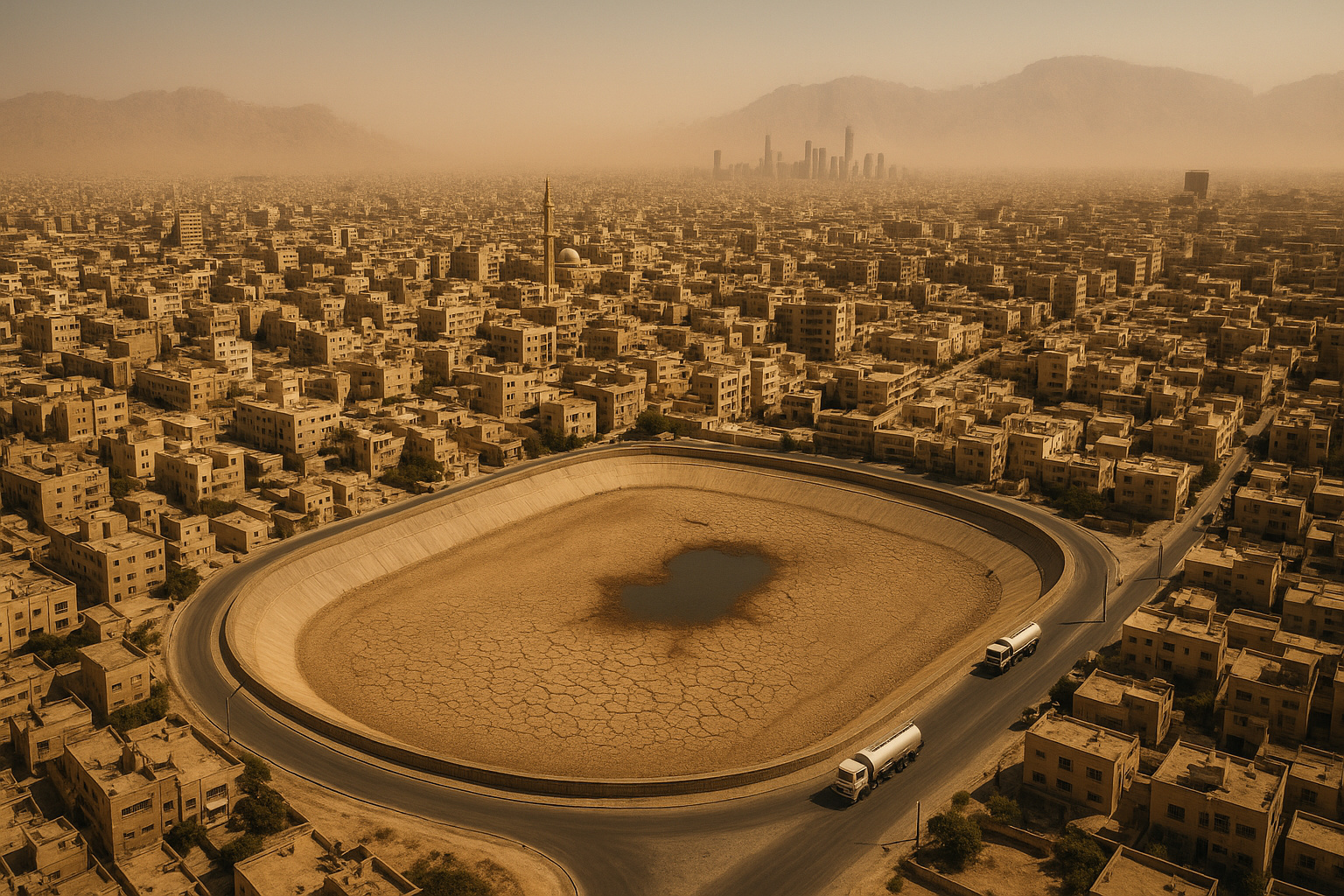


The Water Crisis Affecting Tehran Is Advancing Rapidly After the Worst Drought in Nearly 60 Years, Leaving Reservoirs With Less Than 8% of Capacity, Imposing Severe Rationing and Raising for the First Time the Real Possibility of Evacuating an Entire Capital
Tehran, a megacity with approximately 10 million inhabitants, is on the brink of what experts classify as an unprecedented water collapse. After facing the driest and hottest autumn in nearly 60 years, the Iranian capital is already experiencing daily rationing, known as “night pressure cuts,” taking place between midnight and 5 a.m. With no rain since early September — and no precipitation forecast for the coming weeks — the scenario is rapidly advancing towards the dreaded Day Zero, the moment when taps cease to provide water entirely.
The information was disclosed by the website Vox, which details the progressive worsening of the crisis. Tehran depends on five major reservoirs, but one of them has already completely dried up, while another operates with less than 8% of capacity. To worsen the situation, the Karaj dam, one of the most important for urban supply, reportedly has only two weeks of potable water available. And the problem is not limited to the capital: Mashhad, the second largest city in Iran, has seen its reserves fall below 3%, putting 4 million people at immediate risk.
Deep Causes: Isolation, Poor Management, and the Worst Drought in Decades
While the historic drought helps explain part of the crisis, experts point to deeper causes. Iran is experiencing an explosive combination of geopolitical isolation, economic sanctions, and water management decisions considered misguided over decades. According to data cited in the original article, reliance on mega-projects — such as deep drilling, massive dams, and water transfer schemes — has created a false sense of water security, ignoring basic principles of hydrology and ecological balance.
-
US Navy Sinks USS Oriskany with 230 kg of C-4, Creating World’s Largest Artificial Reef in 37 Minutes

-
U.S. Dumped Tanks, Jeeps, and Coca-Cola into the Pacific in 1945 After British and French Lowball Offer, Creating “Million Dollar Point”
-
WHO Warns of Unnecessary Interventions in Natural Births Worldwide, Advocates for More Human-Centered Care, Reigniting Debate on Medicalization

-
World War II American Bombs Discovered in German City Prompt Evacuation of 20,500 Residents



Water resources analyst Nik Kowsar described the phenomenon as “water failure,” driven by a sort of “water mafia” that he claims uses multimillion-dollar projects for its own gain. In his words, published in Time, “demand far exceeds supply, and the collapse of water security in Iran has been building for decades.”
Another critical point is the agricultural sector, responsible for about 90% of all water consumed in the country. Highly water-intensive crops, poor irrigation, and the goal of food self-sufficiency sidestep any possibility of sustainable balance. Furthermore, over 82% of Iranian territory is classified as arid or semi-arid, making the country the sixth most vulnerable to natural disasters.
Social Impacts, Inequality, and Risks of Urban Collapse
As the crisis worsens, social disparities become even more apparent. In the event of a total supply disruption, wealthier residents may resort to buying bottled water or hiring water trucks — a service extremely costly and inaccessible to most. For much of the population, the only alternative would be to rely on charity or face the risk of death from dehydration.
The President of Iran, Masoud Pezeshkian, recently declared that Tehran “may cease to be able to function as a capital if the rains do not return.” He warned that if it does not rain by the end of November, official rationing would be implemented and, in the absence of additional precipitation, the evacuation of the city could be formally discussed.
However, experts argue that a complete evacuation would be practically impossible, not only due to the city’s size but also because of the concentration of jobs, services, infrastructure, and government agencies. The former mayor of Tehran, Gholamhossein Karbaschi, called the idea a “joke,” arguing that there is no viable alternative for relocating 10 million people.
Lessons for the Future: Cities Around the World May Repeat Iran’s Drama
Despite the local severity, Iran’s water crisis is not an isolated case. Cities like São Paulo in Brazil and Cape Town in South Africa have come very close to Day Zero, escaping only thanks to unexpected rains. However, Tehran does not share the same fortune with the climate outlook.
According to David Michel, water security expert at the Center for Strategic and International Studies, measures like “trucks, rationing, and prayer” are insufficient. He argues that cities in similar situations should implement economic models that finance the maintenance of systems, expansion of networks, and more efficient use of water. Volumetric tariffs, which charge more to those who consume more, are examples of policies that could alleviate the pressure on the poorer population.
Meanwhile, arid regions of the United States — like California and the southwestern part of the country — are closely watching what is happening in Iran. Experts say that similar crises could hit other megacities in the near future if climate change continues to accelerate and water management remains inadequate.
The alert has been raised. And as historian Arash Azizi predicts, the psychological impact of hearing that an entire capital may need to be evacuated “could be the future of anywhere in the world.”
In the meantime, entire countries are following with concern the advancement of the Iranian crisis. Arid regions of the United States and Latin American megacities — including Brazilian capitals that have already suffered from severe droughts, such as São Paulo and Brasília — also face increasing pressures on their supply systems. Experts warn that if climate change continues to accelerate and water management remains outdated, the scenario currently threatening Tehran may be repeated in other parts of the world. In light of this global alert, the inevitable question remains: Is Brazil Really Prepared to Avoid Its Own “Day Zero”?