Portuguese
  Spanish


Chinese Investment in Nicaragua: 13 Gold and Other Mineral Mining Concessions in Six Months. Learn About the Involved Companies, Affected Municipalities, and the Role of Dictator Ortega in the Rapid Approval of Mining Projects
China is rapidly gaining extensive areas for metallic mineral exploration in Nicaragua, with the “blessing” of the dictatorship of Daniel Ortega and Rosario Murillo. In six months, between October 2023 and April 2024, three Chinese companies received thirteen mineral concessions. The total area of these thirteen granted plots accounts for 11.66% of the total hectares granted for metallic mineral exploration in Nicaragua, according to official data from the Ministry of Energy and Mines (MEM).
The concessions for Chinese mining companies were also expedited. All were approved between two to eight months after being requested.
The thirteen plots granted to Chinese companies are distributed across nine municipalities in Nicaragua. Eight are located in the North Caribbean Autonomous Region (RACCN) and part of a municipality in Jinotega. Four other plots are in the Chinandega department and one more in the South Caribbean Autonomous Region (RACCS). Additionally, there are three more pending requests: two in the North Caribbean and a third in the Estelí department.
-
Ancient Mines in Spain Reveal Tools and Metals That May Explain Bronze Age Trade with Scandinavia

-
XCMG Launches 240-Ton Mining Truck in Brazil, Promising Increased Productivity with Lower Fuel Consumption
-
Facing a housing shortage, Hong Kong uses prefabricated concrete modules to construct a 12-story public building with the help of massive cranes and trucks.
-
Brazilian City Innovates Waste Collection with Underground Vacuum System


Three Chinese Companies Leading Thirteen Mineral Concessions
The thirteen metallic mineral exploration plots in Nicaragua, granted to China, are in the hands of three companies: Zhong Fu Development S.A., Thomas Metal S.A., and Nicaragua XinXin Linze Mineria Group S.A.
Each mineral concession has a validity of 25 years, and the three companies have exclusivity for exploration, extraction, and the establishment of beneficiation plants for processing mineral materials.
Zhong Fu Development, the “Lifeline” of the Sanctioned Comintsa
Zhong Fu Development, S.A. is the Chinese company with the most metallic mineral concessions in Nicaragua. On February 28, 2023, this company requested eight plots located in the North Caribbean and the departments of Chinandega and Jinotega from the Ministry of Energy and Mines.
On October 10, the Santo Tomás concession was approved, situated between the municipalities of Cinco Pinos and Santo Tomás del Norte, in Chinandega. Twenty-one days later, on October 31, six of the eight requested concessions were authorized: Columbus I, Kuikuinita I, Mulukukú, Puerto Cabezas, Siuna, and Waslala. In other words, seven of the eight concessions were approved in less than eight months, although the certifications were published only on November 11 and December 20 in the Official Journal La Gaceta.
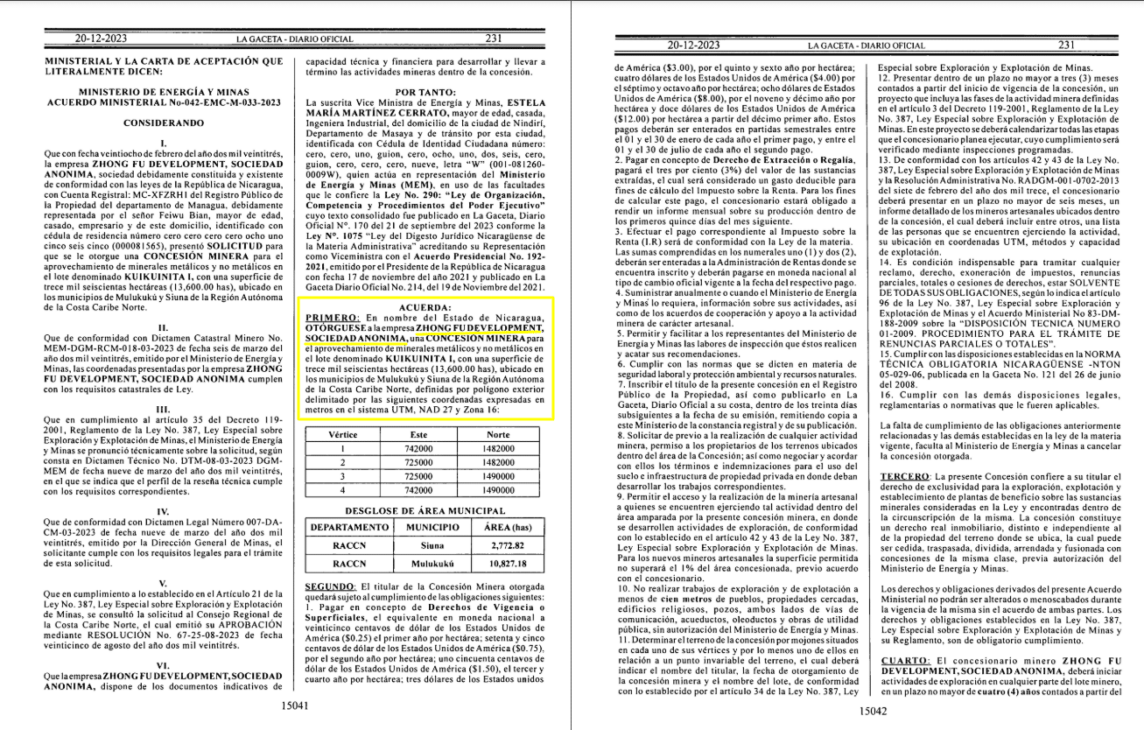
Zhong Fu Development, S.A. also stands out among Chinese miners for having obtained the transfer of a concession from Compañía Minera Internacional, S.A. (Comintsa), less than a month before it was sanctioned by the U.S. Department of the Treasury.
On April 17, 2024, the MEM authorized the transfer of the Tutuwaka plot, located in the municipality of El Rama, in the South Caribbean of Nicaragua, which was granted in May 2022 to Comintsa. Less than a month after this transfer, on May 15, Comintsa was sanctioned by the United States.
According to the Department of the Treasury, Comintsa “is owned and directed” by Salvador Mansell Castrillo, head of the Ministry of Energy and Mines, sanctioned by the Department of the Treasury in November 2021.
“Gold is Nicaragua’s main raw material export, and this action (the sanction) aims to degrade the Ortega-Murillo regime’s ability to manipulate the sector and benefit from the corrupt operations of Comintsa,” assured the Department of the Treasury, which also sanctioned the company Capital Mining, accused of being “an intermediary in the gold sector controlled by Laureano Ortega Murillo and Mansell Castrillo.”
The Meteoric Rise of Zhong Fu Development
With the transfer of 6,000 hectares from the Tutuwaka plot that previously belonged to Comintsa, Zhong Fu Development, S.A. now has eight plots for metallic mineral exploration in Nicaragua, with a total area of 181,206 hectares. The plots are located in the municipalities of Siuna, Mulukukú, Waslala, Waspam, and Puerto Cabezas in the North Caribbean; El Rama in the South Caribbean; and Villanueva, Cinco Pinos, and Santo Tomás del Norte in Chinandega.
In addition, the company is in the process of approval for a plot of 20,150 hectares located in Waspam, from the list presented in February 2023.
Zhong Fu Development, S.A. is registered in the Public Property Registry of Managua with the registration account MC-XFZRH1, and according to the MEM, it has the technical and financial capacity to develop mining activities in the country. The company is legally represented by Feiwu Bian, a foreign businessman with residency and domicile in Nicaragua, according to publications in the Official Journal La Gaceta.
In less than a year, Zhong Fu Development has become the Chinese company with the most mineral concessions in Nicaragua, and it has also distinguished itself among the five largest mining companies in the country, being surpassed only by the “veterans” Calibre Mining Nicaragua, S.A., the Canadian-owned Desarrollo Minero (Desminic), the Colombian Hemco – Nicaragua, S.A. and the British Condor, S.A.
The Expedited Mineral Concessions of Thomas Metal
The company Thomas Metal, S.A., represented by Chinese citizen Xiangming Gu, appeared for the first time in the Nicaraguan mining business on September 27, 2023. On that day, it requested the concession for the Wonderful Gold plot, located in the municipality of Villanueva, in Chinandega, in the western part of the country. The MEM authorized the concession in less than two months, on November 24, demonstrating the regime’s speed for extractive projects.
Less than a month later, on December 1 and 20, Thomas Metal, S.A. requested two more mineral concessions: the Carambola and Dragão Rojo plots, also in the Chinandega department. The approvals took three months. One was granted on March 15 and the other on March 20.
The MEM only noted that, in the case of the Carambola concession, 0.32 hectares are located within the buffer zone of the Delta del Estero Real Natural Reserve, which is why that area was excluded from the concession.
Thomas Metal’s three metallic mineral concessions total 10,308 hectares, all in the municipality of Villanueva, Chinandega. According to the resolutions from the Ministry of Energy and Mines, the company must allow access and activities of artisanal mining for people who were already established and conducting this activity within the granted area.
In Villanueva, hundreds of residents have worked for decades as “güiriseros” in the hills of this municipality, where they abandoned agriculture and livestock to engage in artisanal mining in search of gold. For more than five decades, they have worked in small groups or cooperatives. Now, it remains to be seen how they will coexist with the Chinese mining company.
The Most Recent: Nicaragua Xinxin Linze Minería Group, S.A.
Nicaragua Xinxin Linze Minería Group, S.A. is the Chinese company that has operated in Nicaragua for the shortest time. However, it has received over 37,000 hectares for exploration and extraction of minerals.
On October 9, 2023, the Chinese miner requested the plots: Chinotega — located between San José de Bocay, Jinotega and Siuna, in the North Caribbean — and Caribe, located in the northern region of the same name. Five months later, on March 15, 2024, the MEM granted the concession for the Chinotega plot, consisting of 651 hectares. Although the certification was published only in early May in the Official Journal La Gaceta.
While awaiting a response, on November 13, 2023, Nicaragua Xinxin Linze Minería Group requested a third plot: Nuevo Bijagual, consisting of 36,610.1 hectares, located between the municipalities of Siuna and Mulukukú, in the North Caribbean. The concession for Nuevo Bijagual was approved three months later: on February 27, 2024, although the certification was published only at the end of April.
The two approved concessions for Nicaragua Xinxin Linze Minería Group total 37,261 hectares. Furthermore, the Caribe plot, consisting of 2,091 hectares, and a fourth plot of 3,628 hectares called El Guaylo, in the municipality of San Juan de Limay, in Estelí, are still pending approval.
One-Fifth of Nicaragua in Mineral Concessions
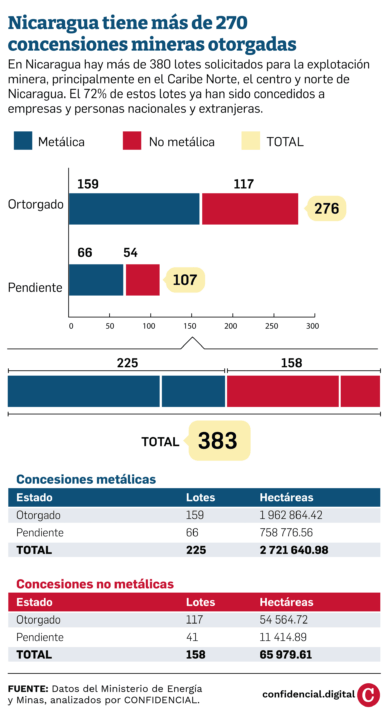
As of May 2024, in Nicaragua, there are over 1.96 million hectares granted for metallic mineral exploration.
A total of 11.66% of these areas have been granted to the three Chinese mining companies between October 2023 and April 2024.
Another 758,776 hectares requested by various companies and individuals are pending approval, which would bring the area granted for metallic mineral exploration to over 2.72 million hectares. This total corresponds to 20.88% of Nicaragua’s surface area, estimated at 13,037,300 hectares.
In addition, 54,664.72 hectares are approved for non-metallic mineral exploration, and there are 11,414.89 hectares pending approval for this same sector. This smaller amount raises the total hectares requested for mineral exploration of any kind in Nicaragua to over 2.78 million, of which more than 2.01 million have already been approved, with over 97% of these hectares allocated to metallic mining.
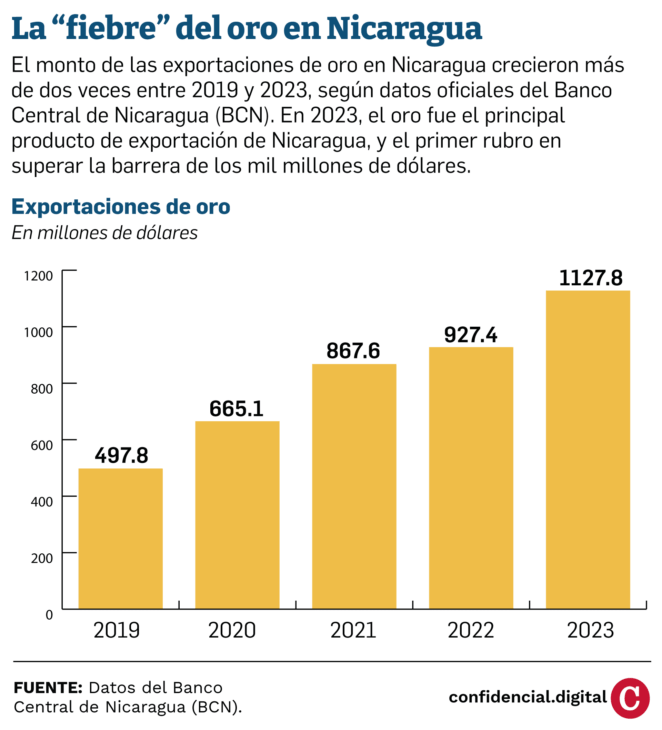
In Nicaragua, exports from the mining industry, mainly gold, are on the rise. Between 2019 and 2023, the value of gold exports grew by over 226.5%, according to official data from the Central Bank.
In China, the “hunger” for gold is also growing relentlessly. Through gold, Beijing bets on diversifying its reserve funds. The People’s Bank of China was the largest official gold buyer in 2023, purchasing 7.23 million ounces, according to the World Gold Council, and the trend remains high. In April 2024, the bank added 60,000 troy ounces to its reserves, leading gold purchases for eighteen consecutive months.
This demand also pushes the price of gold to historic levels. This year, the cost of each troy ounce has already broken the record of $2,330.
China Also “Buys Gold” from Other Companies
Environmentalist and president of the illegalized Fundación del Río, Amaru Ruiz, argues that the management of mineral concessions in Nicaragua has been “quite discretionary.” He reports that, in several cases, environmental studies are unknown and affected communities were not consulted.
Furthermore, he warns that the companies obtaining the concessions “are not necessarily” the same ones extracting the metals. Therefore, he believes there is a “sub-registration” of Chinese miners operating in Nicaragua.
“We know that there are Asian intermediaries buying gold in concessions granted to other companies. That’s why I say there is a fog in the concession granting process,” remarks the environmentalist.
However, he considers that the presence of Chinese businessmen in the mining business in Nicaragua still does not represent “a reconversion” of the market, although he emphasizes that their introduction is part of the dictatorship’s strategy to evade sanctions imposed by the United States.
Before the sanctions against Comintsa and Capital Mining, the United States had already sanctioned, in October 2022, the General Directorate of Mines, linked to the Ministry of Energy and Mines. Similarly, the then president of the Board of Directors of the Nicaraguan Mining Company (Eniminas), General Ramón Humberto Calderón Vindell, in January 2022, and the Minister of Energy and Mines, Salvador Mansell Castrillo, in November 2021.
“We saw this phenomenon after the sanctions imposed on the mining sector,” asserts Ruiz. “There is clearly an interest in increasing gold trade markets, and from there, some companies, mainly Asian, generated interest in entering the sector to establish a level of commercialization and access to the Asian market,” he estimates.
Concerns About Low Environmental Standards
In addition to the regime’s speed in approving concessions to Chinese companies, the environmentalist is concerned about the environmental and labor standards that are lower than those applied by other mining companies.
“In the case of China, it is historically known that their environmental and labor standards are very low. This raises concerns about the impact they may have on the environment and also on the people involved in this company,” emphasizes Ruiz.
Up until the publication of this report, neither the Ministry of Energy and Mines nor the Ministry of Environment and Natural Resources (Marena) or the Chinese companies have published the environmental studies required before the project execution, according to the General Environmental Law.
Mining Industry Exported Almost $1.16 Billion in 2023
In 2023, the mining industry in Nicaragua registered $1.158.6 million, according to official figures from the Central Bank of Nicaragua (BCN). These exports are primarily of gold. Gold became Nicaragua’s main export product in 2023 and the first to surpass the billion-dollar barrier in a single year.
With this total, the mining industry grew by 22.4% compared to 2022, when it exceeded $946.6 million.
The BCN itself details that this increase was driven by higher gold (+$200.4 million; 21.6%) and silver (+$12.9 million; 83.3%) exports, as a result of increases in average contracted prices and exported volumes.
The “Gold Fever” in Nicaragua
The mineral concessions in the country grant exclusive rights for exploration, extraction, and the establishment of benefits over mineral deposits, for a period of 25 years, which can be extended for a similar period. All these attractive conditions have not gone unnoticed by mining companies from the Asian giant, and their accelerated and “blessed” step by the Ortega dictatorship in Nicaragua.