Portuguese
  Spanish


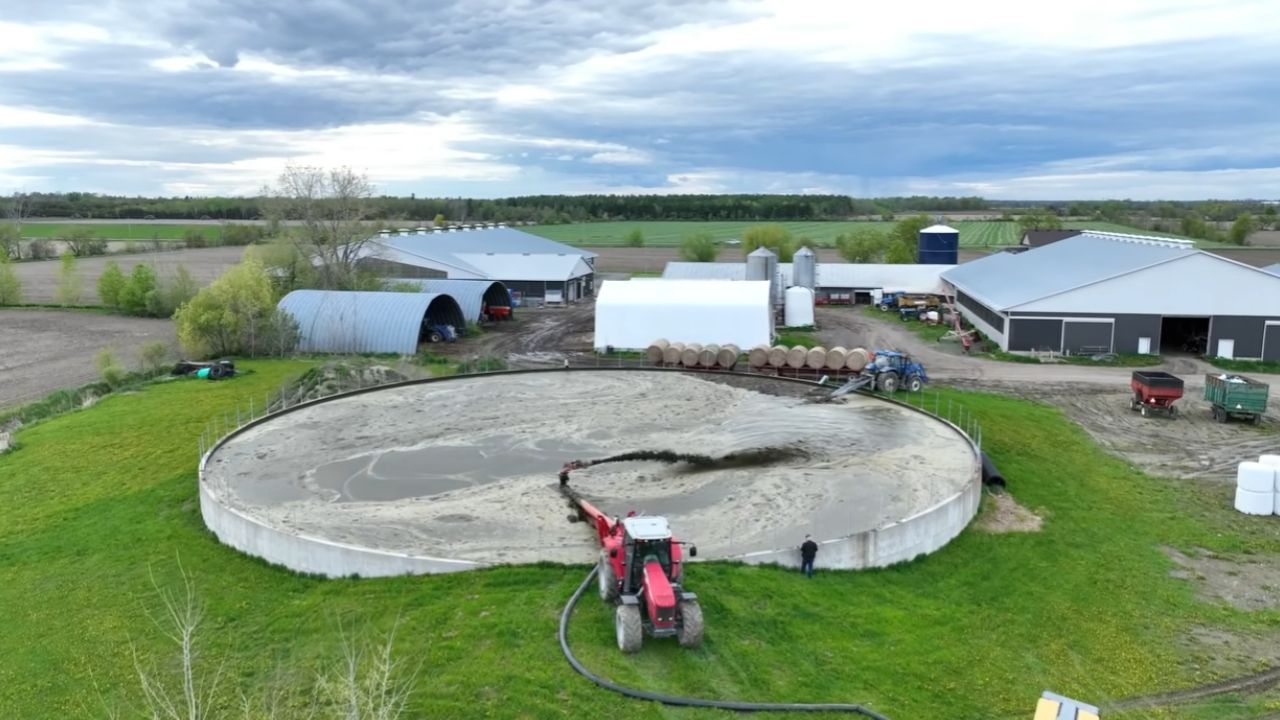

Video from the Farmer Drone channel, published on 05/24/24, shows an operation at a dairy farm south of Ottawa to pump manure from an almost full lagoon, stir solids, release flow through mainline hoses, and apply waste in the field using tractors, industrial pump, compressor, and precise coordination for a safe start.
The manure accumulated in a lagoon at a dairy farm south of Ottawa, Canada, mobilized a heavy operation recorded by the Farmer Drone channel in a video published on 05/24/24. The recording shows tractors, industrial pump, large diameter hoses, and field application to transform liquid waste into agricultural fertilizer.
The footage follows the removal of material from an almost full lagoon, with explicit concern to avoid damage to the reservoir walls. The scene reveals a rarely seen part of modern dairy farming: the logistics necessary to move, stir, and distribute large volumes of manure safely and precisely.
Almost full lagoon required caution before stirring
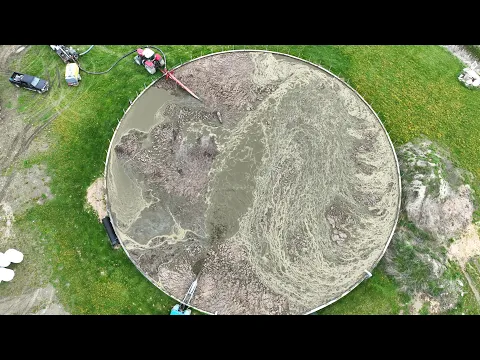
Early in the operation, the video shows that the lagoon of manure was extremely full. The narrator states that it seemed like not even five more gallons could fit in the reservoir, indicating that the intervention needed to start before the stirring mixed all the content.
-
Masked Man Claims to Have Traveled to 2118, Predicts World War Starting with North Korea and Reveals Secret CIA Technology

-
At 54, Brazilian Artisan Turns Textile Waste into a Successful Handbag Brand, Earning Over $6,000 Monthly

-
Brazilian Entrepreneur Sells $50,000 Monthly in Sustainable Luggage Made from Recycled Bottles, Eyes International Market
-
Chinese Man Transforms Home into 10-Story Pyramid Over 8 Years, Defying Authorities Before Demolition



Before stirring the accumulated solids, the team decided to pump part of the effluent to lower the tank level. This care was essential because the proximity of the manure to the edge increased the risk of overflow, especially during the initial movement caused by the lagoon pump.
185-horsepower tractor positioned the pump inside the reservoir
The first equipment to appear in the operation was a Massey Ferguson 6490, pulling a Model 12 lagoon pump. According to the video, the tractor has a 6.6-liter engine and delivers 185 horsepower, being used to position the pump inside the reservoir.
The maneuver required extreme attention. The operator needed to back the set up to the lagoon, with the risk of damaging the tank walls. When the wheels were firm on the bottom, the agitation nozzle was placed in the correct position, preparing the mixture of manure and solids accumulated on the surface.
Main hose shows the hidden cost of the operation
After the first stage, another Massey Ferguson, model 7480, arrived at the site. The video informs that it uses a six-cylinder Perkins engine and 6 liters, with 143 horsepower, participating in setting up the work line to move the manure to the field.
The operation also used an 8-inch main hose. According to the narrator, this line costs approximately $15 per foot, and purchasing two or three miles of hose shows the size of the investment. In practice, before the manure becomes fertilizer, there is an expensive and long infrastructure to transport the material without relying solely on road tanks.
425-horsepower main pump released the flow through the drag line
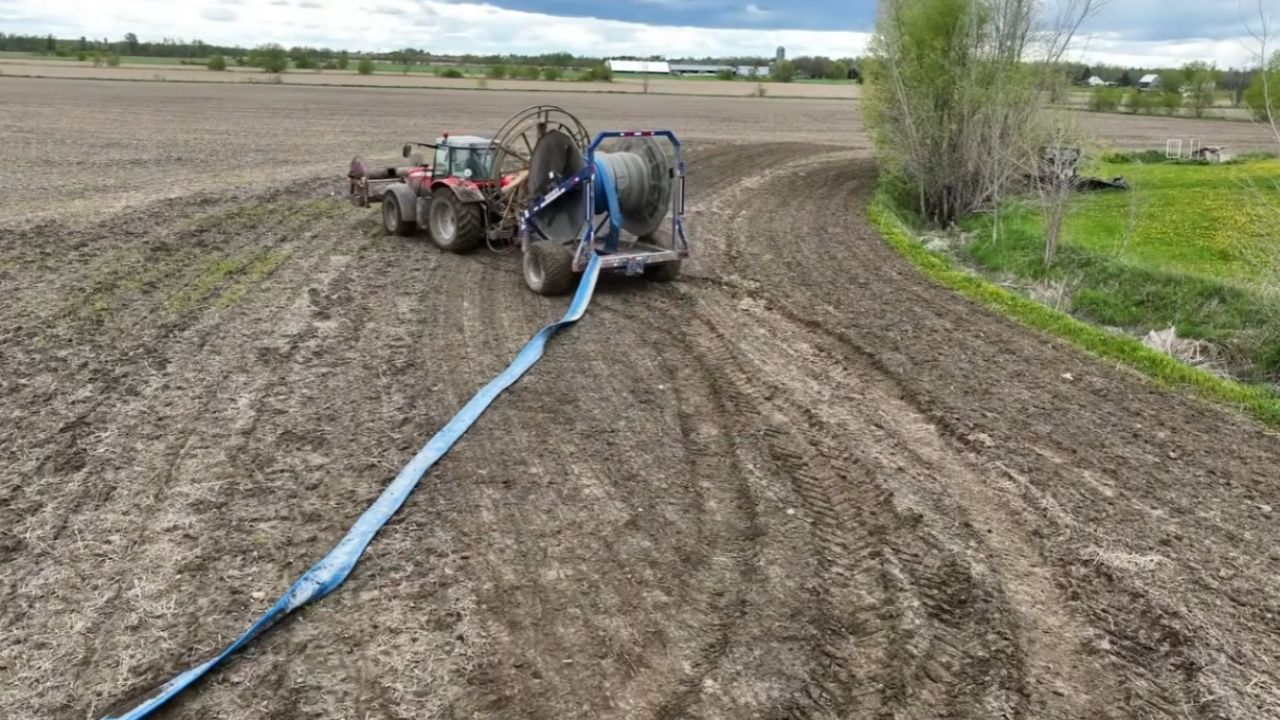
The system also included a main pump, described in the video as the center of the drag line operation. It was powered by a 425-horsepower engine, responsible for pushing the manure through the main line to the application equipment in the field.
The team also installed the feed line between the main pump and the lagoon pump. This type of setup requires checks before releasing the flow because the pressure needs to rise in a controlled manner. When everything was checked in the cabin, the manure began to follow through the main hose and the application could begin.
Compressor came in as support to unclog the line

The video also shows a solution used when the drag line becomes clogged. In these situations, a large sponge ball, comparable to the size of a bowling ball, can be inserted into the pipeline and pushed by highly compressed air.
The equipment mentioned is an Atlas Copco compressor model JD7, with 750 CFM and 150 PSI, powered by a 6.8-liter, 250 horsepower John Deere engine. This detail makes it clear that manure operations do not rely solely on tractors: they also require pressure control, unclogging, and constant mechanical support.
Field application began with a large tractor
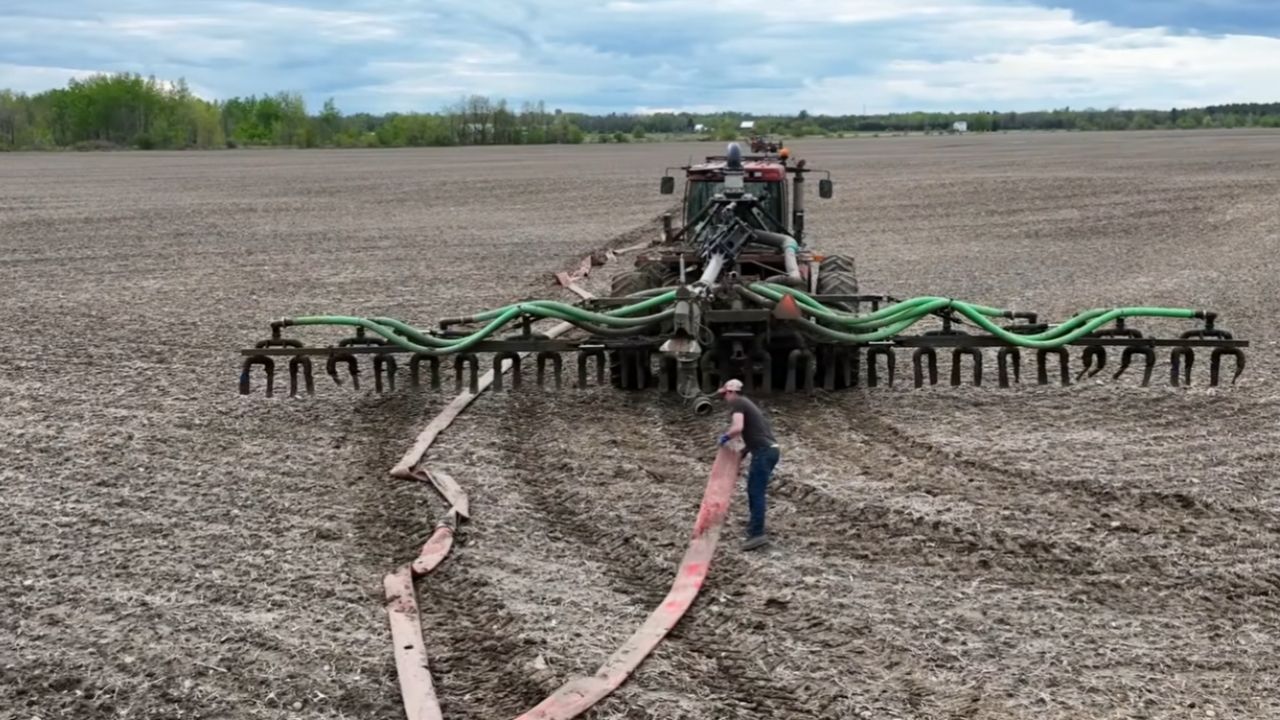
At the final stage of the operation, the manure applicator was connected to a Case IH STX 325, a model that the narrator compares to the New Holland TJ 325. The equipment received the main supply line and began distributing the material in the field.
During the process, a burst fuel line took the STX 325 out of operation. The team then put a Massey Ferguson 8690 into action, equipped with an 8.4-liter, 340 horsepower engine. The quick replacement prevented the operation from coming to a complete halt, showing how backup machines and adaptation are part of the routine in heavy agricultural work.
Agitation dissolved solids and released 100,000 gallons under the barn
With the lagoon level lower, agitation began to make the manure swirl. The video shows that the solids on the surface started to dissolve when the material began to move, allowing for a more uniform mixture before pumping to the field.
Once the lagoon lowered enough, the farm operator was able to pump the 100,000 gallons of manure that were stored under the barn. Once in the tank, this volume could also proceed for application in the agricultural area. What seemed like just accumulated waste became part of the property’s fertilization cycle.
Work took just over 10 hours to complete
The recording shows a long operation with several interconnected stages: positioning the pump, lowering the lagoon level, setting up lines, connecting equipment, releasing pressure, agitating solids, resolving mechanical failure, and applying the manure in the field.
According to the video, the work was completed in just over 10 hours. This time helps to gauge the complexity of the task, which involves high-power machines, operational risk, high hose costs, and the need for synchronization among operators.
Invisible engineering sustains the routine of dairy farming
The operation recorded by Farmer Drone shows a part of the farm that rarely appears when talking about milk production. In addition to animals, feed, and milking, dairy farming also depends on waste management, pumps, tractors, pressurized lines, and planned agricultural application.
Manure, when handled correctly, ceases to be just a storage problem and becomes part of soil management. The scene reinforces how the modern farm operates with a technical mechanism that many people only notice when a lagoon approaches its limit.
What this operation reveals about the modern countryside
The case south of Ottawa shows that dealing with manure in large volumes requires much more than opening a valve and waiting for the reservoir to empty. The operation depends on power, logistics, environmental care, and machines capable of working for hours in sequence.
For you, should this type of rural engineering be more known to the urban public, as it supports part of food production, or does it remain a distant reality for those who only see the final product in the market? Leave your opinion in the comments.