Portuguese
  Spanish


Egg shell lamp created by Joanne Odisho uses crushed waste, biodegradable biopolymer, and blocks that can be reorganized.
Discarded shells from cafes in Melbourne, Australia, have become part of a lighting piece capable of changing shape according to the environment. Created by designer Joanne Odisho, the egg shell lamp Mod-u is made up of movable blocks that can be stacked, rotated, and disassembled by the user.
The project combines the reuse of food waste with a manufacturing process that does not require kiln firing or the application of synthetic dyes. Once crushed and mixed with a biodegradable biopolymer, the shells create a compound with an appearance similar to stone.
The solution earned the creation the Australian Furniture Design Award, recognition linked to the union of sustainability, interaction, and adaptation to compact spaces.
-
Lucy, the 3.2-million-year-old fossil that reshaped our understanding of human origins, makes a rare journey from Ethiopia to Abu Dhabi.

-
Plow Uncovers 50 kg Iron Meteorite in Wisconsin Farm, First of Its Kind in Dane County After 15 Years Hidden

-
Starlink’s Direct-to-Cell Internet Takes Major Step Forward in Brazil with Regulatory Approval, Partnership with Carriers Needed for Antenna-Free Service
-
Brazilian Recycling Company Overcomes $200,000 Debt to Process 360 Tons of Plastic Monthly and Produce 27,000 Items Daily




Egg shell lamp was born from a university challenge
The Mod-u began to be developed in 2022, during Joanne Odisho’s furniture design studies at RMIT University.
In the academic activity, students were tasked with producing an object from food scraps. The proposal led Odisho to analyze materials that were frequently discarded and could receive a different application.
Egg shells stood out for being abundant and typically going straight to the trash after use in the kitchen.
From this choice, the designer began testing a way to transform the waste into a durable, moldable, and visually suitable raw material for decorative objects.
Shells are collected in Melbourne cafes
The raw material used in the Mod-u comes from establishments in the city itself.
Once collected, the shells undergo sterilization and drying. Then, they are ground to a fine powder texture.
This material is combined with a biodegradable biopolymer. The resulting mixture remains moist and has a consistency comparable to wet sand, allowing it to be applied in molds.
The production uses the original shades of the shells, without relying on artificial pigments to define the finish of the piece.
Eggshell lamp naturally dries for a week
After being placed in molds, the mixture needs to remain in natural drying for approximately seven days.
This step replaces industrial processes that would use high temperatures to harden the material. Since there is no kiln firing, the manufacturing avoids a phase of intense energy consumption.
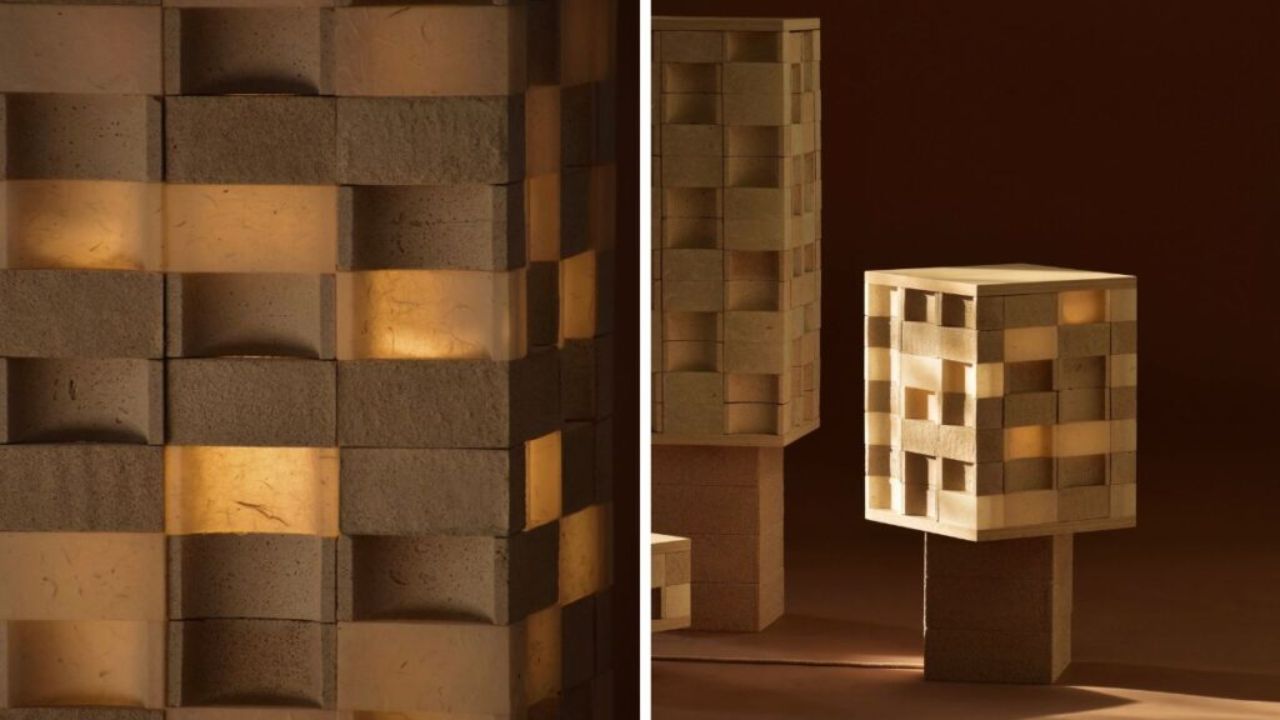
At the end of curing, the compound gains firmness and starts to resemble stone both in appearance and texture.
The small tone variations present in the shells remain visible, making each block have its own characteristics.
How Mod-u’s material is produced
- the shells are collected in cafes;
- the waste goes through cleaning, sterilization, and drying;
- the shells are crushed into powder;
- the powder is mixed with a biodegradable biopolymer;
- the wet compound is placed in molds;
- the pieces naturally dry for about a week;
- the hardened blocks are used in the assembly of the lamp.
Blocks resemble small illuminated apartments
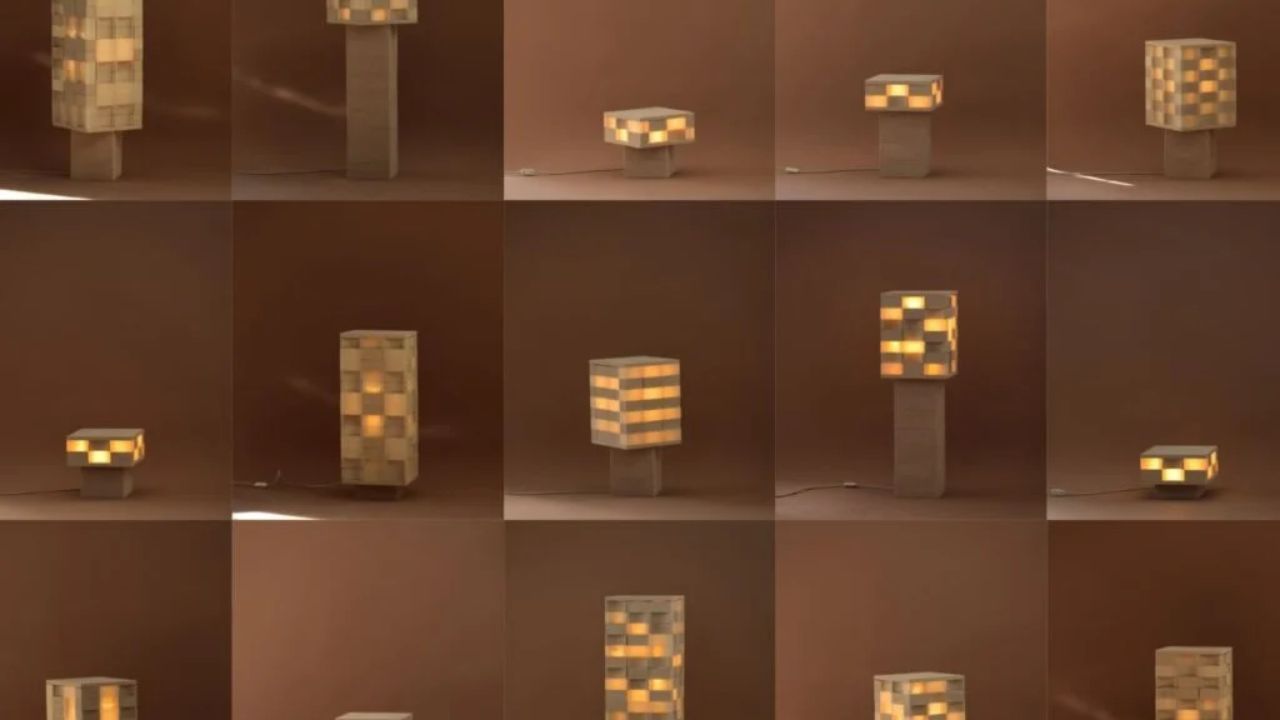
Visually, the Mod-u resembles a miniature construction. The stacked geometric modules resemble the volumes of a building, while the light points give the impression of lit windows.
The architectural appearance, however, does not define a permanent form. The piece can be modified whenever the user desires. Each block functions as an independent unit. By changing its position, it is possible to alter the height, volume, and distribution of light.
The collection consists of dozens of modules that do not need to remain in a fixed configuration. The elements can be moved individually, allowing the eggshell lamp to accompany changes in space, decoration, or personal preference.
Depending on the assembly, the Mod-u can function as:
- table lamp;
- floor lamp;
- lighting object with lower height;
- decorative sculpture;
- custom modular composition.
This flexibility was designed especially for compact interiors, where the same object may need to perform more than one function.
Instead of replacing the piece when the environment changes, the user can reorganize it and create a new configuration.
Award recognized sustainability and adaptation
The choice of shells as raw material was one of the aspects evaluated in the Australian Furniture Design Award, but it was not the only one. The ability to assemble, disassemble, and reinvent the lamp also caught the judges’ attention.
The piece does not just deliver a ready lighting solution. It allows the user to participate in the design, making changes according to the available space or the desired visual effect.
This combination of waste reduction and interactive use helped differentiate Odisho’s work from objects with permanent shapes.
Building games inspired the concept of Mod-u
The designer relates the creation to the playful experiences of childhood. Before contact with formal knowledge of architecture or design, children already experiment with fitting, stacking, and reorganizing pieces to create new structures.
“Long before we learn about design or architecture, we already explore the idea of building, stacking, and reorganizing objects intuitively,” says Joanne Odisho.
According to her, Mod-u recovers this memory and invites people to participate creatively in lighting. The reference to building games appears both in the freedom of combination and in the possibility of dismantling everything and starting over.
The project changes the common perception of eggshells. After processing, the material no longer presents the fragile aspect associated with household waste and becomes solid blocks, suitable for a piece of furniture.
The absence of dyes preserves the identity of the raw material, while the stone-like finish helps to integrate the object into different decoration proposals.
Thus, the egg shell lamp does not try to completely hide the origin of the compound. The repurposed material remains a central part of the piece’s aesthetics and story.
Mod-u combines waste, creativity, and functionality
The creation of Joanne Odisho began with an academic question about the fate of food scraps and resulted in an award-winning design piece.
The shells collected in cafes are no longer discarded, go through a low-energy demand process, and return in the form of sturdy modules.
At the same time, the user can change the lamp without needing to buy a new object for each function or environment.
With blocks that transform into a table lamp, floor lamp, or decorative element, the egg shell lamp shows how an everyday waste can originate an adaptable, interactive, and visually striking product.
With information from Ciclo Vivo