Portuguese
  Spanish


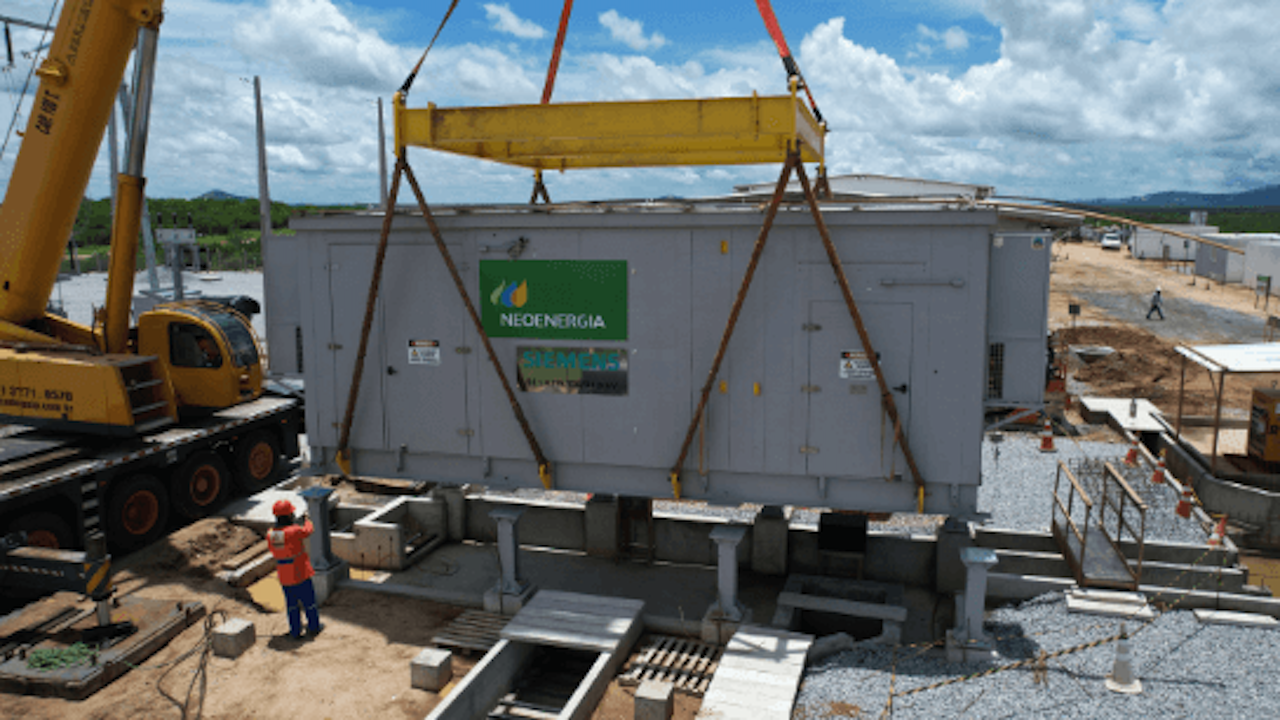

Solar Power Plant Equipment Manufactured by Siemens of 36 kV Features Gas Insulated Panels. The 138/34.5 kV Transformer Delivered by WEG Has a Power of 135 MVA!
The leader in energy in Brazil, Neoenergia, has reached another milestone to advance the construction of the Luzia solar power plant in Paraíba, and many jobs are being maintained and generated in the region! The project marks the company’s debut in centralized photovoltaic generation in the country. The electrocenter and transformer, manufactured by Siemens and WEG (respectively), have been delivered.
Equipment will be installed at the Neoenergia Luzia substation, where the voltage of the generated energy will be adapted to the levels of the transmission grid.
The electrocenter is an electrical room with load distribution centers, electrical panels, climate control, lighting, and integrated control and automation. It is a pre-assembled structure, tailored to the needs of the project, requiring no construction. Additionally, it is tested in the factory, facilitating installation, commissioning, and operation.
-
Brazil’s Offshore Wind Energy Potential Worth $1 Trillion Stalled by Long-Delayed Agreement

-
World’s Largest Engie Solar Plant in Brazil Highlights Billion-Dollar Energy Waste Issue: Company Considers Batteries and Bitcoin Mining to Avoid Wasting Production

-
Air Products Cancels $2.9 Billion Clean Hydrogen Megaproject in Louisiana, Shuts Down Arizona Unit, Highlighting High Costs of U.S. Energy Transition
-
Over 60 Tractors Take to the Streets in Lopera as Solar Parks Compete with Olive Groves, Affecting 13,000 to 100,000 Trees According to Conflicting Reports


Giants Siemens and WEG Deliver Equipment for Neoenergia Luzia Solar Power Plant in Paraíba
The equipment, manufactured by Siemens, has a voltage of 36 kV and features gas insulated panels. “We seek solutions that provide more efficiency, accelerate construction, and reduce costs, demonstrating our commitment to the business plan,” says Neoenergia’s Renewable Projects Manager, William Rodney.
The 138/34.5 kV transformer, with a power of 135 MVA, was also delivered. The equipment was manufactured by WEG, and it is the transformer where the energy generated by the solar modules is converted to the appropriate voltage for the National Interconnected System (SIN).
The connection point of the plant to the SIN – that is, from where the energy is generated to consumers – is the Santa Luzia II substation, also built and operated by Neoenergia. The asset was acquired by the company in lot 6 of the transmission auction held by the National Electric Energy Agency (Aneel) in December 2017.
The substation was delivered in the second half of last year, with 16 months ahead of the contractual deadline set by the regulatory agency, and enabled the start of commercial operations of another company project, the Neoenergia Chafariz Wind Complex, which nearly doubled the installed capacity of the company in wind power, reaching 1 GW.
The Plant Will Have a Capacity of 149.3 MWdc, Enough to Supply Over 150,000 Households
At the solar power plant, the total capacity will be 149.3 MWdc, enough to supply over 150,000 households, and all the energy generated in the project will be directed to the Free Contracting Environment (ACL), with 100% already sold in the free market until 2026. “The Neoenergia Luzia solar power plant is a strategic project for the company, aiming to expand the clean energy generation portfolio and align with the company’s positioning in the liberalization of the Brazilian energy market,” emphasizes William Rodney.
Neoenergia also received, in March, the first solar modules imported for the plant. In total, 228,780 pieces will be installed. The components are more efficient because they are bifacial, meaning they can capture direct solar radiation and also the radiation reflected by the ground on the underside of the module. Additionally, trackers will be installed, which have a tracking system that follows the sun’s position throughout the day, further increasing the capture of solar light.