Portuguese
  Spanish


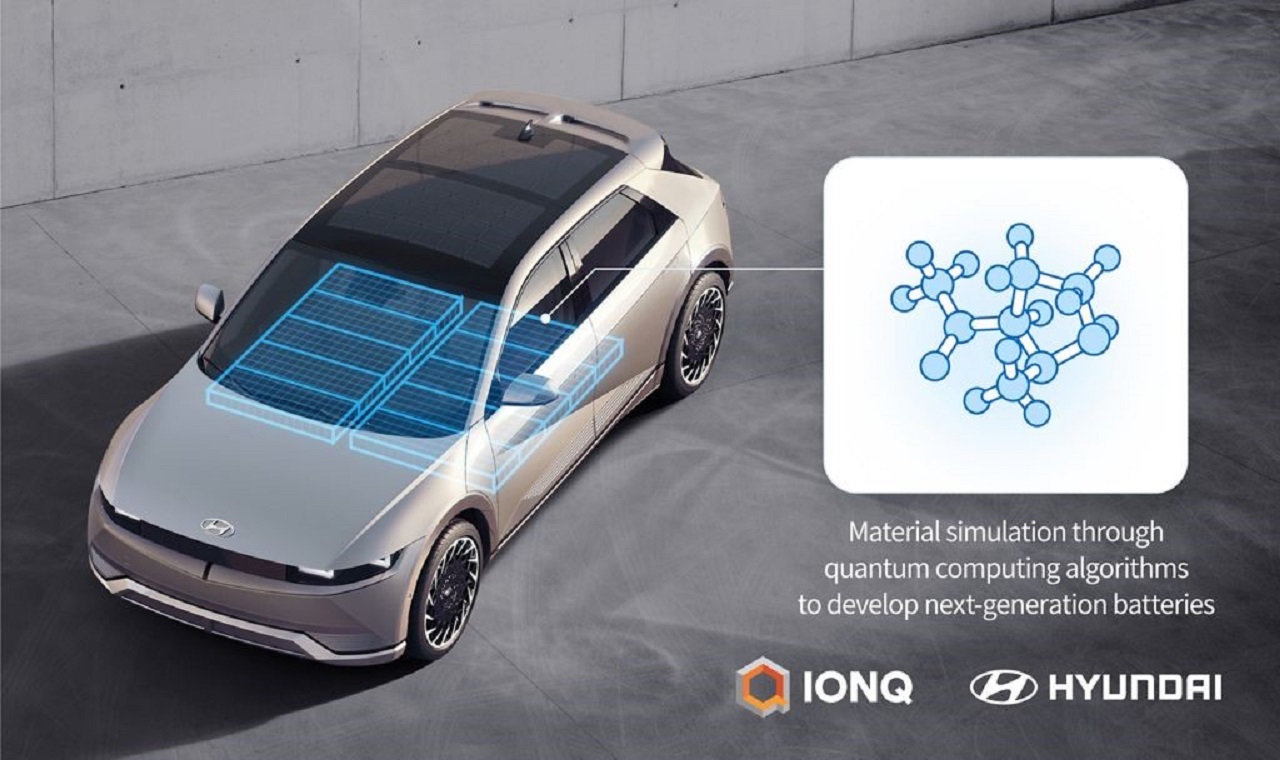

Hyundai Stays Committed to Increasing Its Sales in the Electric Car Market. Recently, the Manufacturer Closed a Partnership with IonQ for the Production of Lithium Batteries Using Quantum Computers
Hyundai has partnered with IonQ, a company focused on quantum computing, with the aim of enhancing its lithium battery technology for its electric car models. In an announcement released on Wednesday (19), the two companies committed to searching for components that improve lithium batteries and their charging and discharging cycles, as well as capacity, durability, and safety. According to Peter Chapman, president and CEO of IonQ, the efficiency of the component is one of the most promising emerging areas where quantum computing can deliver positive results.
Read Other Related News
Hyundai and IonQ Can Simulate Chemical Reactions Without Building Lithium Batteries
Simulating the energy and structure of lithium oxide, the South Korean automaker plans to build, from the partnership with IonQ, the largest lithium battery chemistry model for electric cars on a quantum computer.
-
Automatic, economical, and known for reliability: with a 1.5 engine of up to 110 hp, CVT transmission, seven airbags, and fuel consumption of up to 15.9 km/l, this used hatchback appears as a rational alternative to Polo, HB20, and Onix; meet the Toyota Yaris XLS 2020.

-
He surpassed the Tera, Creta, and Tracker: With a TSI engine of up to 150 hp, 6-speed automatic transmission, and a 373-liter trunk, the Volkswagen T-Cross was the best-selling SUV in June, with 11,753 registrations.

-
It looks factory-made, but it came out of a workshop: a mechanic from Pernambuco builds a handcrafted “mini Toyota,” drives it through the streets, and the video goes viral on social media, leaving residents astonished.
-
Hatch with sedan space and 1.0 car consumption: equipped with a 1.5 engine with 126 hp, CVT transmission with seven simulated gears, and consumption of up to 17.4 km/l, this used Honda delivers technology, comfort, and reliability; meet the 2022 Honda City Hatch Touring.


The premise of the agreement is a research project aimed at exploring new variational quantum algorithms to study lithium compounds and the chemical reactions involved in the components. Thus, Hyundai and IonQ can simulate the chemical reactions occurring inside prototype batteries without the need to build a physical model.
A variational quantum algorithm runs partially on a classical computer and partially on a quantum computer. According to information from IBM, while the classical computer varies experimental parameters that control the preparation of a quantum state, the quantum computer prepares that state and calculates its properties. For now, the companies are working on executing a chemical model to simulate 14 electrons of lithium dioxide in a prototype battery.
Quantum Computing May Bring Benefits Beyond Batteries for Electric Cars
In addition to lithium batteries for electric cars, IonQ’s CEO also claims that quantum computing will bring other benefits to Hyundai in other areas of the automotive sector, such as material durability and fuel cells.
According to the executive, quantum machine learning applications can be used to improve training time for autonomous vehicles and solve basic problems related to storage, predictive maintenance, and much more.
More challenging optimization problems, such as routing and multi-channel logistics, are on the R&D lists of manufacturers. The partnership with IonQ is part of Hyundai’s strategy, which aims to increase the sale of electric vehicles by 2025, as well as enhance management of climate change. The strategy has four focus areas: electric cars, autonomous driving technology, urban air mobility, and hydrogen fuel cells.
Brazilians Discover Way to Improve Lithium-Oxygen Batteries
Brazilian researchers are making progress in creating the catalysts necessary for optimizing lithium-oxygen batteries. Such components stand out for their ability to store more energy than conventional ones, but their cyclability, or the number of recharges the component allows, defining its lifespan, still needs to be improved.
According to Gustavo Doubek, a professor at Unicamp and CINE, the work contributes to the construction of a battery with better cycle efficiency, without the need for high-cost or noble materials.