Portuguese
  Spanish



Multinational Bracell Will Transport Its Pulp Factory Output via MRS Road-Rail System to the Port of Santos (SP)
Bracell’s new factory under construction, one of the largest producers of dissolving pulp and specialty pulp in the world, is partnering with MRS to transport pulp from its factory in Lençóis Paulista to the Port of Santos. To make this entire logistical structure feasible, the companies have made significant investments, such as the construction of an operational base in Pederneiras, with an estimated generation of up to 70 jobs.
Read Also
- Andrade Gutierrez, Artec, UTC Engenharia, and Queiroz Galvão Have Approval from STF to Participate in Bidding
- Raízen of Grupo Shell Will Carry Out One of the Largest IPOs in the History of the Brazilian Market
- Ethanol Price Reacts at Mills and Distributors After Consecutive Drops
Expected to begin operations in the second half of this year, the new production volume from Bracell’s factory will require a complex logistics operation for transporting pulp from Lençóis Paulista to the Port of Santos.
The pulp will be transported by trucks to the Intermodal Terminal in Pederneiras, which will then proceed on the network operated by MRS to the terminals at the Port of Santos. The railway route from Pederneiras to Santos spans 510 km.
-
Giant 3,600-ton Crane Breaks Two World Records by Installing World’s Largest Single-Piece Forged and Welded Hydrogenation Reactor, Weighing 3,037 Tons, in Chinese Petrochemical Plant in Just Six Days

-
$80 Million Bridge in Brazil Cuts Travel Time from 30 Minutes to 1 Minute, but Audit Reveals Major Flaws
-
Man Builds Stone Bed with Granite Rocks and Hand-Sawn Cedar Beams, Home Extension Garners Over 437,000 Views on Bonus Bolts Channel

-
British Factory Transitions from Mechanical Parts to Producing 420,000 Electric Power Units Annually, Supplying 70% of Ford’s Electric Cars Sold in Europe




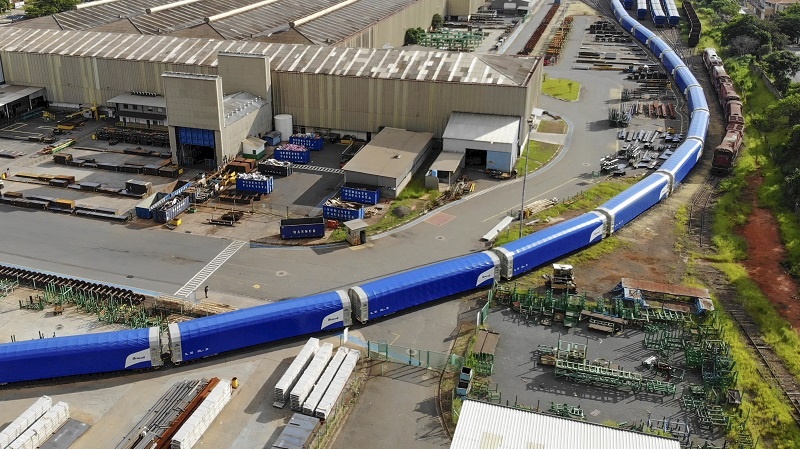
Produced by Greenbrier Maxion, the first hundred wagons have already been delivered and are ready to begin operations, totaling around 463 wagons of the FTT total side-opening model, characterized by the canvas opening along the entire side of the wagon. Equipped with the Motion Control truck that adapts to the operational conditions of Brazilian railways, the FTT offers advantages over older models, such as reduced wagon tare weight, significant increases in loading capacity per train and per wagon, as well as better ergonomics in operation and watertightness, preventing load loss due to water ingress during the rainy season. The compositions will operate 24 hours a day, 365 days a year. Each composition will consist of 60 wagons and transport the equivalent of 113 trucks.
Partnership Between Companies for Pulp Transport Will Generate Jobs in SP
To make this entire logistical structure feasible, Bracell, in partnership with MRS, has made significant investments, such as the construction of an operational base in Pederneiras, with an estimated generation of up to 70 jobs.
For Alberto Pagano, Head of Supply Chain at Bracell SP, the logistics solution adopted by the company, prioritizing the rail modal, brings a range of benefits aligned with environmental sustainability, such as a reduction in the volume of atmospheric emissions during product shipment. “In addition to adhering to Bracell’s sustainability guidelines, the logistics operations will create job opportunities both in the area around the factory and at the Port of Santos. The delivery of the first wagons is an important milestone in the progress of the project that will ensure Bracell’s export capacity,” he commented.