Portuguese
  Spanish


Spanish INNengine’s project drew attention again in 2026 by seeking around R$ 70 million to advance the development of a compact engine, 70% lighter and without a crankshaft, which promises to deliver power equivalent to a 2,000 cc engine.
The new engine developed by the Spanish INNengine has regained attention in the automotive sector after recent updates on tests, patents, and investment search.
The project, known as e-REX, promises to deliver high power in a lighter, more compact, and vibration-free package, but it has not yet reached mass production.
INNengine presents the e-REX as an internal combustion architecture based on the patented “1Stroke” technology.
-
Nissan Versa Offers Surprising Space and Comfort for Under $10,000, Impressing with Japanese Engineering

-
Changan Hunter K50 REEV: New Hybrid Pickup with 1,031 km Range and 4×4 Drive Set to Launch in 2026

-
Brazilian Company Unveils 3.3-Meter Foldable Micro Capsule: Inflates in Under Two Minutes, Fits Small Spaces, and Includes Bed, Table, and Outdoor Shower

-
1.5 Engine Dominates Chinese Cars for Decades with Billion-Dollar Strategy Focused on Tax, Advanced Technology, Over 40% Efficiency, and Aggressive Global Expansion


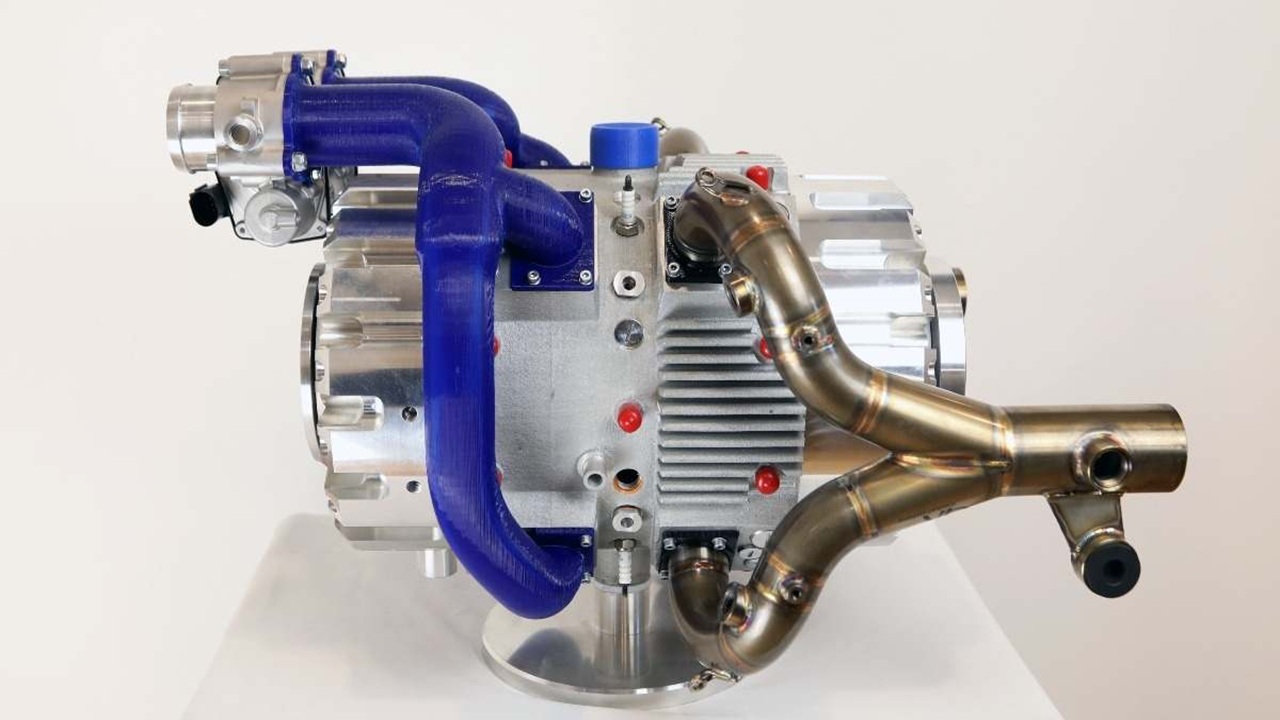
The system retains pistons and cylinders but eliminates traditional components such as the crankshaft, camshaft, valves, and cylinder head.
The proposal is to reduce weight, volume, and vibration, opening up possibilities for applications in hybrid vehicles, generators, drones, light aviation, and maritime systems.
Partnership with Horse Powertrain marks a new phase of the project
In March 2025, according to autoevolution, INNengine announced an agreement with Horse Powertrain, a company linked to Renault, Geely, and Aramco, to evaluate two prototypes of the e-REX at the Polytechnic University of Valencia, Spain.
Technical validation is seen as an important step before any progress towards licensing or mass production.
Horse Powertrain operates with combustion engines, hybrid systems, transmissions, and range extenders.
The approach with a company of this size indicates that the project has moved beyond just an engineering curiosity and is now being observed by companies with industrial capability.
Even so, the agreement still does not represent commercial production. It is a stage of testing and evaluation. If the results are positive, the technology may advance to a licensing phase, but no manufacturing line has been confirmed so far.
Company seeks 12 million euros to complete development
Another relevant update emerged in February 2026. The newspaper eleconomista reported that INNengine started a round to raise 12 million euros, an amount equivalent to about R$ 70 million, depending on the exchange rate. The goal is to finance the final stage of development and bring the e-REX and REX-B engines closer to industrialization.
The company was negotiating with a fund interested in Andalusia for an investment between 5 million and 7 million euros. The mentioned expectation was to conclude the round in the third quarter of 2026, but there is still no public confirmation of the investment closure.
On the official website, INNengine states that it has already developed and tested three prototypes of the e-REX. The most recent one has 500 cc and reached TRL6, a level indicating technology demonstration in a relevant environment. The next planned stage is a 700 cc engine directly coupled to a generator, without a reduction gearbox, aimed at use as a range extender.
New engine promises to be smaller, lighter, and vibration-free
The company claims that the e-REX can be 70% lighter and smaller, as well as more powerful than a two-stroke engine and more efficient and quieter than a four-stroke engine.
INNengine also says that the balanced architecture eliminates vibrations, an important feature for electric vehicles with range extenders, drones, and aerospace applications.
The concept uses eight opposed pistons in four cylinders. The brand argues that its technology generates four times more power events per rotation than a conventional four-stroke engine and twice as much as a two-stroke engine.
This is also the origin of the expression “1-stroke engine,” used by the company. However, technical publications point out that this definition still causes debate among engineers, as the operation can be partially compared to two-stroke architectures with opposed pistons.
REX-B targets drones and aerospace sector
In addition to the e-REX, INNengine is working on the REX-B, a smaller and simplified version of the concept. The company presents the model as a solution for applications where power, simplicity, low weight, and reduced size are decisive factors.
The company’s website states that the 125 cc REX-B has already reached TRL6 and delivers 21.5 hp at 6,000 rpm. INNengine has also directed its lightweight technology towards the drone and UAV market, where greater autonomy and compact energy generation are differentiators.
There is no engine for sale yet
Despite the advances, INNengine’s new engine is still in the development, validation, and fundraising phase. Until June 2026, there is no confirmation of commercial sale, use in production vehicles, or mass manufacturing.
The project remains alive and has gained momentum with the partnership with Horse Powertrain, the investment round, and the advancement of patents. But for now, the promise of revolutionizing combustion engines still depends on independent testing, industrial scale, and validation in the real market.
The partnership with Horse Powertrain was reported by Autoevolution on March 7, 2025. The fundraising of 12 million euros in 2026 was published by El Economista, on February 16, 2026, and by El Confidencial Digital, on February 18, 2026.