Portuguese
  Spanish



President Changed The Names Of The Months, Closed All Hospitals Outside The Capital, And Spent Billions On Marble Amid Extreme Poverty
You may have never heard of Turkmenistan, but few nations in the world combine as much political eccentricity, informational isolation, and authoritarianism as this Central Asian country. Geographically isolated, governed by leaders of almost mythical personality, and marked by unprecedented state decisions, Turkmenistan is an extreme example of how a country can be shaped by individual wills.
From banning dogs and ballets to building a capital made of white marble, to a president who renamed all the months of the year after personal names, Turkmenistan’s recent history reveals an authoritarian experiment that defies the conventional logic of diplomacy, economics, and even culture.
A Country Between The Desert And The Absurd

More than half of Turkmenistan’s territory is made up of desert, and its most famous geological symbol is a burning crater known as the “Gateway to Hell” — a natural gas reserve that has been burning for over 50 years.
-
Earthquake vs. Tsunami: Which Causes More Destruction and Why One Can Be Even More Dangerous

-
Hospital Cook Discovers 1,700-Year-Old Pot of 52,503 Roman Coins Using Metal Detector in Field

-
Salvador’s Acarajé Vendors Turn Used Frying Oil into Income by Selling it for Biodiesel Production
-
Volunteer Revives Dead Lake in Bengaluru Overnight, Doubling Water Capacity and Attracting Kingfishers and Herons



The country has considerable reserves of oil and gas, but most of the population lives in poverty, in contrast to the luxury concentrated around the central government.
Although it became independent only in 1991, the country is home to ancient civilizations and was an important route in Silk Road trade.
But its current prominence comes from internal policies that have transformed Turkmenistan into a singular case of extreme state control allied to personality cults.
Saparmurat: The Dictator Who Renamed The Months

The first president, Saparmurat Niyazov, self-proclaimed himself as life leader and filled the country with statues, coins, mandatory books, and even carpets with his face.
Among his most bizarre measures, he banned dogs, opera, ballet, and circus, and renamed the months of the year based on family members and elements of his personal life.
His book “Ruhnama” became mandatory reading in schools and for public competitions. Access to prominent positions required knowledge of the dictator’s teachings.
After his death, the cult of personality seemed threatened, but the successor would follow an equally authoritarian path.
Closed Hospitals And Mandatory Dogs

With the arrival of Gurbanguly Berdimuhamedov to power, the landscape changed — but only in part.
All hospitals outside the capital were closed, forcing patients to cross deserts to seek medical care.
In compensation, he tore down some statues of his predecessor, annulled the personalized calendar, and began to require dog ownership, which had previously been banned.
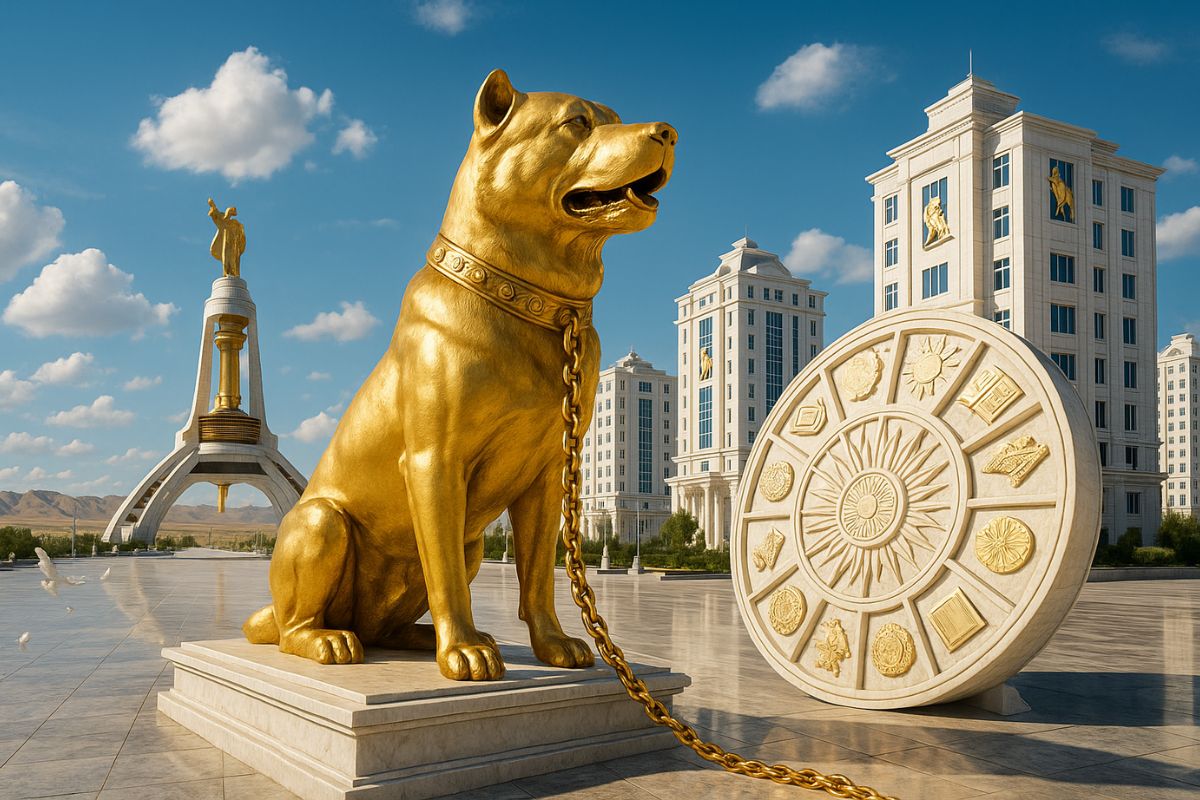
The obsession with dogs took on monumental scale.
Statues of dogs, parades with puppies, and even diplomatic gifts in the form of dogs became a hallmark of the new government.
Vladimir Putin even received a puppy as a symbolic gesture.
Marble, Golden Horses, And Empty Airports
The capital Ashgabat was rebuilt with white marble, earning the title of the city with the most marble buildings in the world.
The aesthetic was complemented with golden Akhal-Teke horses, a national symbol elevated to the status of a political icon.
The country has also spent billions on pharaonic projects: underutilized airports, sports arenas for empty events, and public works without a population to occupy them.
In 2020, Turkmenistan invested over US$ 7 billion in martial arts during the pandemic, while banning journalists and doctors from using the word “coronavirus”.
A Democracy Only In Name
Turkmenistan does not hold free elections, the press is censored, and population data is treated as a state secret.
Despite having 10% of global natural gas reserves, the country faces severe difficulties exporting its resources due to lack of access to the sea and reliance on land routes through unstable countries like Afghanistan and Pakistan.
Currently, 80% of Turkmen gas goes to China, creating an economic dependency with few alternative channels.
India, for example, remains inaccessible by viable routes, which stifles the local economy’s growth and diversification.
A Qatar That Did Not Work Out?
With so many natural resources and a small population, Turkmenistan could have repeated the success of Qatar.
But while the emirate invested in economic openness, port infrastructure, and increasing per capita income, Turkmenistan opted for isolation, censorship, and megalomaniacal symbolic spending.
The population remains impoverished, living under an empty luxury aesthetic and an authoritarian regime that controls even the most intimate habits of civil life.
Do you think regimes like Turkmenistan’s can last a long time or are they doomed to collapse with the advancement of technology and global information? Leave your opinion in the comments!