






 Portuguese
  Spanish


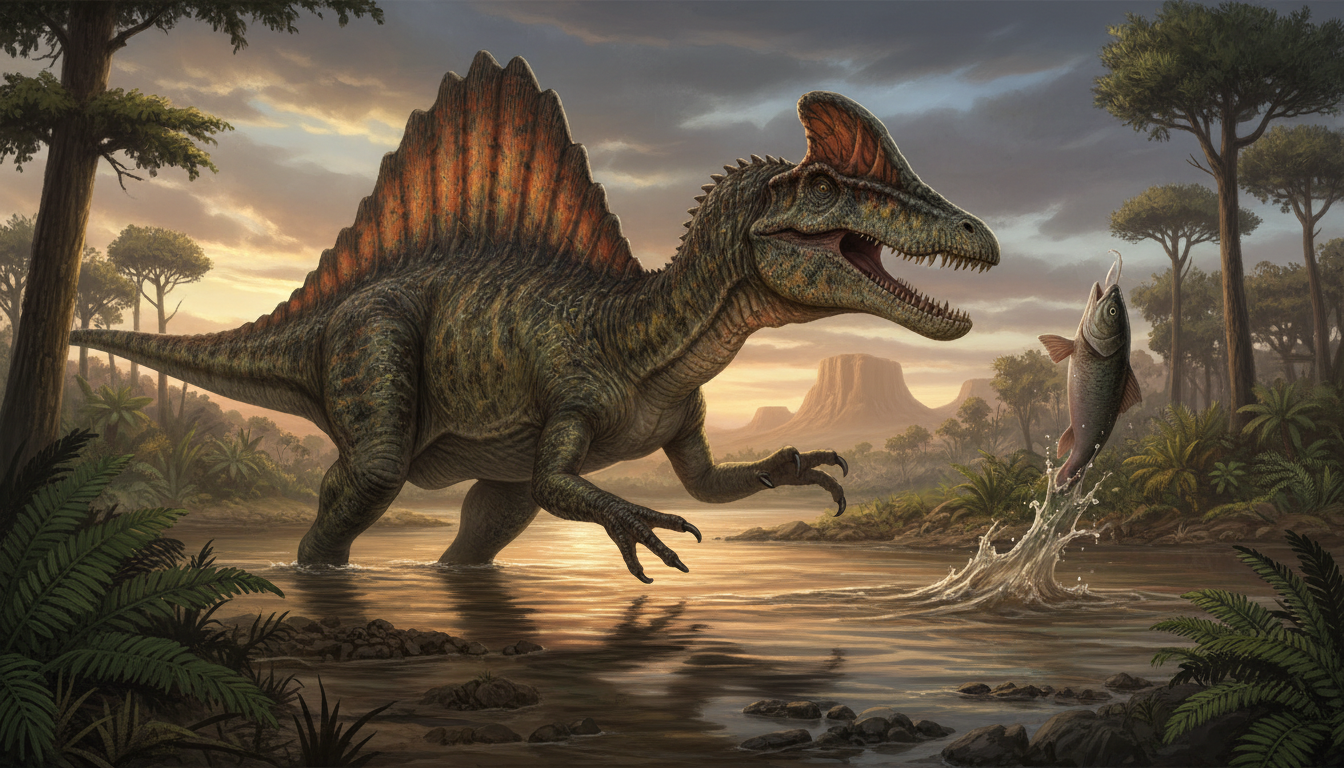

First new Spinosaurus species described since 1915 comes from a skull with crocodile jaws, a saber-shaped crest, and fossils found 1,000 km from the nearest Cretaceous coast.
Paul Sereno and a team of 20 researchers from the University of Chicago described a new dinosaur called Spinosaurus mirabilis, nicknamed “hell heron”.
The article was published on February 19, 2026, in the journal Science, according to a report by CNN.
According to the official UChicago News bulletin, the fossils came from a remote region of the central Sahara, in Niger.
-
Researchers Identify Factor Influencing Dementia Risk Beyond Age and Genetics

-
Iranian Engineers Develop Solar-Powered Mobile Water Purification System for Isolated Regions, Offering Sustainable Solution for Water-Scarce Communities
-
Pedal-Powered Washing Machine Made from Bicycle Parts Cleans Clothes in Three Minutes Without Electricity, Leaves Them 80% Dry.

-
Sixth-grader in Miami wins Lemelson Young Inventor Prize for creating water-absorbing concrete using discarded oyster shells and charcoal.




The excavation yielded a nearly complete skull and jaw bones. According to Sereno, Professor of Anatomy at UChicago, the creature was about 12 meters long and hunted fish in shallow water.
Hence the nickname “hell heron”.
First new Spinosaurus mirabilis in over a century
Indeed, the new creature is the first member of the genus described in over a hundred years. Spinosaurus aegyptiacus, described by Ernst Stromer von Reichenbach in 1915, was the only name cataloged until now.

According to the team, the 110-year gap says more about the rarity of good fossils than about the scarcity of the creature.
Indeed, spinosaurids had thin cranial bones, which tend to fragment before fossilization. Having an entire skull from the group is almost a statistical miracle.
In other words, the find will change the comparative basis for other partial specimens around the world. Consequently, the publication appeared in Science, biology’s most influential journal.
Saber-shaped bone crest and heron-like style
Furthermore, the most surprising feature of the new species is the bone crest on top of the skull.
In an interview published by the Natural History Museum, the team compared the structure to a blade-shaped scimitar.

According to Sereno, “it’s an ostentatious bone crest, similar to Elvis’s pompadour”. The phrase became a hallmark of the scientific dissemination of the find.
In turn, the function of the crest is not yet settled. Active hypotheses include sexual display, thermoregulation, and social signaling among individuals.
According to the team, the creature hunted fish while standing. Supported by robust legs, it entered rivers up to two meters deep. Hence the nickname “hell heron”.
Fossils 1,000 km from the nearest Cretaceous coast
According to the paper, the excavation took place in a remote region of the central Sahara, in present-day Niger.
According to the paper in Science, the site is about 1,000 km from the nearest marine coast of the Cretaceous period.
To understand the scale, this distance is equivalent to traveling from Salvador to Recife within the continent.

Indeed, the predator lived far from the sea. According to Sereno, this data disproves an old hypothesis: the theory that spinosaurids were marine swimmers loses strength when the creature is found in the middle of the continent.
According to ScienceDaily, the species was a predator of inland rivers and lakes.
According to paleobotany, the environment was swampy, with dense vegetation and flood channels. Today, the same stretch is an absolute desert, with temperatures above 45 °C.
The 95-million-year-old Sahara where Spinosaurus mirabilis lived
Spinosaurus mirabilis lived approximately 95 million years ago, in the Middle Cretaceous. According to the paper, it was contemporary with Carcharodontosaurus and Suchomimus, two large predators also from the Sahara.
In comparison, the North American Tyrannosaurus rex appeared about 30 million years later. The new predator therefore represents a much earlier chapter in the evolution of large theropods.
Indeed, it is the peak of spinosaurids. The group diversified into lifestyles, from aquatic hunting to semi-terrestrial predators, all with elongated crocodile-like jaws.
In turn, the end came with the K-Pg extinction, 66 million years ago. Spinosaurids did not reach that geological time boundary.
Who is Paul Sereno and why he matters
Indeed, Paul Sereno is a Professor of Anatomy at UChicago and one of the world’s best-known paleontologists. He has described more than two dozen new dinosaur species in the last 30 years.
According to NBC News, Sereno’s team has been conducting expeditions in Niger since the 1990s.

Consequently, the team possesses local expertise. Logistics in the Sahara are expensive and harsh: temperature, distance, lack of potable water.
Other recent finds followed a similar trajectory. In February, Brazilian paleontologists described a 110-million-year-old digging bug in Cariri, showing the importance of long-term field work.
On the other hand, China has also accelerated discoveries. The recent 125-million-year-old Haolong dongi with hollow spines is a direct example.
Comparison: what the new find changes
- ~12 meters long, tail included
- 95 million years old — Middle Cretaceous of the Sahara
- 2 meters maximum hunting depth in river
- 1,000 km from the Cretaceous marine coast
- 1st new species of the Spinosaurus genus in 110 years
In comparison to its genus sibling, Spinosaurus aegyptiacus weighed about 7 tons. The new predator is smaller, but with a similar body proportion.
According to the paper, future excavations should look for post-cranial remains. The characteristic dorsal sail of the group has not yet been described for the new taxon.
Caveat: the find is still a partial reconstruction
According to the team, the current material covers the skull and part of the jaw. The rest of the skeleton will come in future campaigns.
On the other hand, the exact function of the bone crest remains under debate. Other groups will review the fossils and test hypotheses of display, thermoregulation, or intraspecific combat.
Would Brazil be able to finance two decades of similar expeditions? The Sahara proves that institutional continuity weighs more than archaeological luck.
Nevertheless, Spinosaurus mirabilis has already entered the official evolutionary tree. The group’s revision is expected to occur in a series of papers in the coming years.


