Portuguese
  Spanish


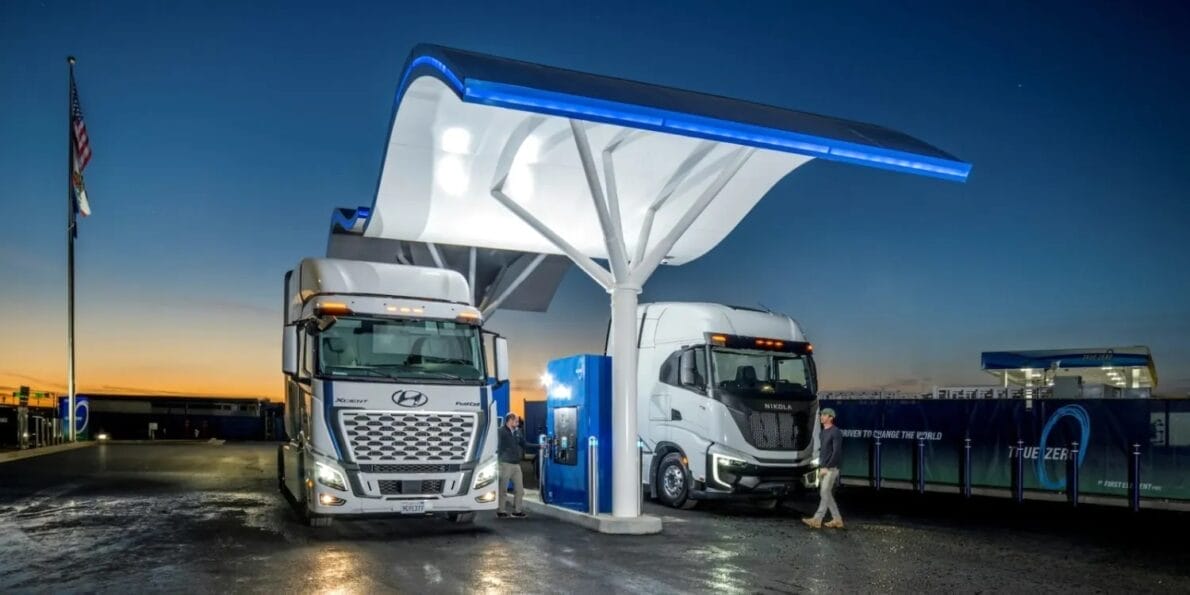

First Hydrogen Station in the World is Operational in the US. Hydrogen Station in the US Can Fuel Up to 200 Vehicles Per Day with the Fuel of the Future.
Hydrogen has long been seen as the fuel of the future. Now, reinforcing that view, First Element Fuels has opened the world’s first large-scale hydrogen refueling station for heavy trucks. Located in Oakland, United States, this innovative project promises to refuel a full tank in just 10 minutes, marking a significant advancement in alternative fuel infrastructure.
Hydrogen Station in the US Can Fuel Up to 200 Vehicles Per Day
The world’s first large-scale hydrogen station, located near the Oakland port, is now operational and attracting trucks from major manufacturers like Hyundai Xcient and Nikola. First Element Fuels, the company responsible for the station, claims that its pumps can fill tanks in just 10 minutes, allowing for refueling of up to 200 vehicles per day. This strategic location serves not only as a refueling hub but also as a demonstration site for the public.
The station’s inauguration took place this week and featured significant figures from the clean transportation and energy sectors in the United States. The project received funding from the California Air Resources Board and the California Energy Commission, highlighting institutional support for using hydrogen as an alternative fuel.
-
Green Hydrogen Projects in Northeastern Brazil Stalled for 18 Months Awaiting Government Decree, Delaying Billions in Investments

-
Brazil Concludes Largest Energy Auction in History, Secures 18.97 GW and Mobilizes $12.8 Billion to Ensure Supply Until 2031
-
How Norway Produces More Energy Than It Consumes with Nearly 1,800 Hydropower Plants and Over 1,100 Reservoirs

-
Axia Energia Invests $280 Million in Q1, Increases Investments by 36%, and Turns Loss into $740 Million Profit


Despite the challenges associated with the necessary infrastructure and production costs, which have delayed its adoption compared to technologies like battery electric vehicles, hydrogen is still seen by some experts as a viable solution for the future of sustainable mobility.
Government Will Invest US$ 8 Billion to Boost the Hydrogen Economy
While these obstacles are real, investments are being made in both areas. California Governor Gavin Newsom’s clean transportation advisor, Tyson Eckerle, who was present during the station’s inauguration, stated that the federal government will distribute US$ 8 billion to boost the hydrogen economy. According to him, this amount is sufficient to build 60 units similar to the hydrogen station in the US by First Element Fuels.
Hydrogen also has another issue: its production process requires methane, a highly polluting gas. According to Electrek, there are also ongoing initiatives to mitigate this drawback, and public opinion regarding this fuel (which previously was not very promising) is beginning to change.
First Element Fuels, owner of the world’s first hydrogen station, claims that its fuel is green, meaning it is over 60% renewable. However, the company purchases hydrogen from Air Liquide in Las Vegas.
The Operation of the Hydrogen Station in the US in Practice

According to First Element, the supplier uses natural gas as the raw material for producing “clean” hydrogen.
The process involves purchasing biogas to mix with natural gas and then create the fuel, making it free of methane. There’s also an addition to the sustainability of the new station’s pumps: it’s a Bosch device that allows refueling in just 10 minutes.
However, this outsourced pump from the world’s first hydrogen station uses cryogenic cooling of the hydrogen, a technology that consumes a lot of energy and electricity (part of which will come from the stored element).
In other words, in the end, the energy efficiency may not be as great as expected, especially in a scenario where the price of the element continues to rise. In Brazil, to give you an idea, only in the state of Piauí, construction related to hydrogen production is expected to generate at least 10,000 jobs in the state by 2027.