Portuguese
  Spanish


Russian project advances to prototype phase and targets the global stealth fighter market with a proposal of lower cost, high speed, long range, and an offer aimed at countries seeking an alternative to the F-35 amid sanctions and technological dispute.
The United Aircraft Corporation, a Russian state-owned company known by the acronym UAC, has begun construction of the first prototype of the Su-75 Checkmate, a fifth-generation single-engine fighter developed by Sukhoi to meet the needs of the Russian Aerospace Forces and potential foreign buyers.
This stage was reported by the company’s general director, Vadim Badekha, in a statement released by the Russian state agency TASS and echoed by defense-specialized media that followed the recent updates of the aeronautical program.
With the start of prototype manufacturing, the program moves from the phase limited to conceptual presentations to an industrial development stage, still without indicating confirmed serial production or operational entry.
-
China to Drill 15 Kilometers into the Earth, Set to Break Russia’s Record for Deepest Man-Made Hole

-
Researchers Use Algae to Enhance 3D-Printed Walls, Boosting Strength by 25% and Speeding Construction by 33%

-
Drill Uncovers Freshwater Rivers Hidden Beneath the Ocean Floor
-
3,000-Ton, 81-Meter Attack Submarine Begins Sea Trials, Equipped with Heavy Torpedoes and Anti-Ship Missiles


Since its public debut at the MAKS air show in Moscow in July 2021, the Checkmate had been mainly displayed through models, engineering concepts, and promotional material from the Russian industry.
According to Badekha, the revival of a modern, single-engine, fifth-generation fighter was treated by UAC as a relevant project for the Russian defense industry.
For decades, the country stopped launching a new single-engine combat platform, after models like the MiG-21 and MiG-23 played an important role in Soviet military aviation and defense exports.
The revival of this segment occurs during a period of pressure on the Russian aerospace industry, affected by Western sanctions, technological restrictions, and high demand for military aircraft already in production.
In addition to the development of the Checkmate, Russian manufacturers need to maintain deliveries and upgrades related to models like Su-30SM, Su-34, Su-35S, and Su-57, which increases the competition for industrial, technical, and financial resources.
Su-75 Checkmate bets on stealth and digital architecture
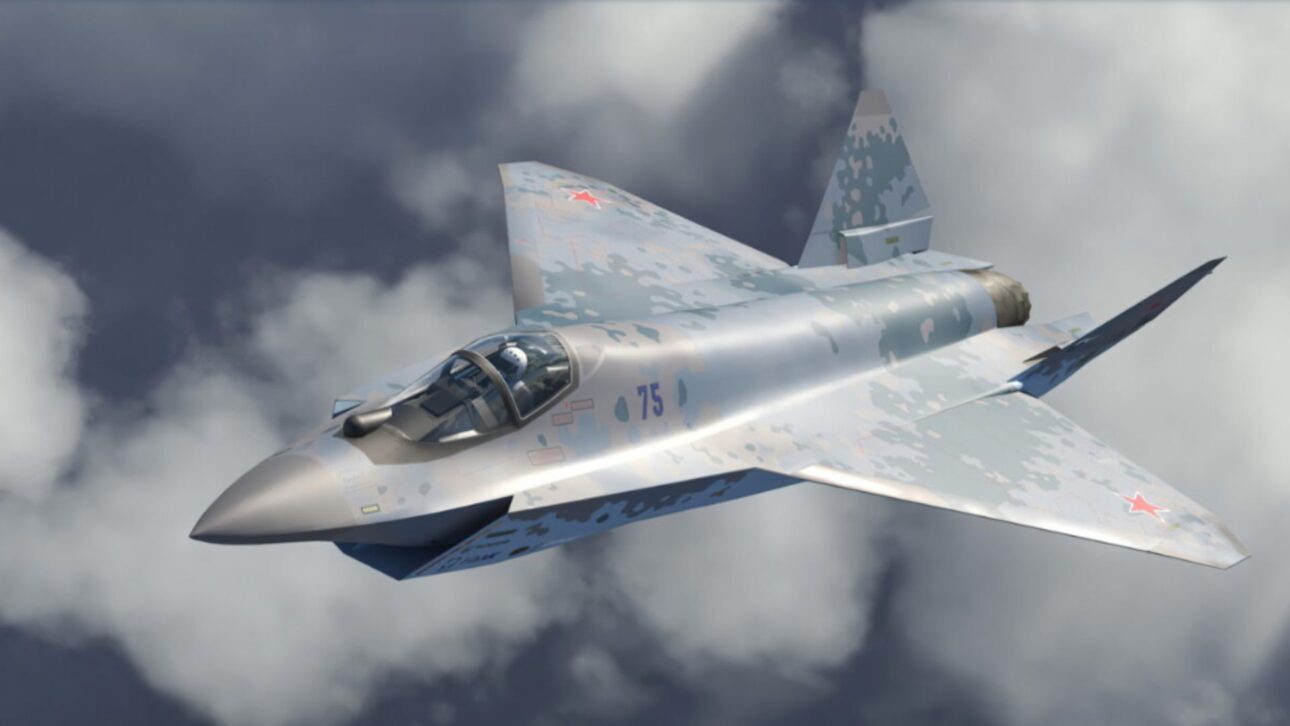
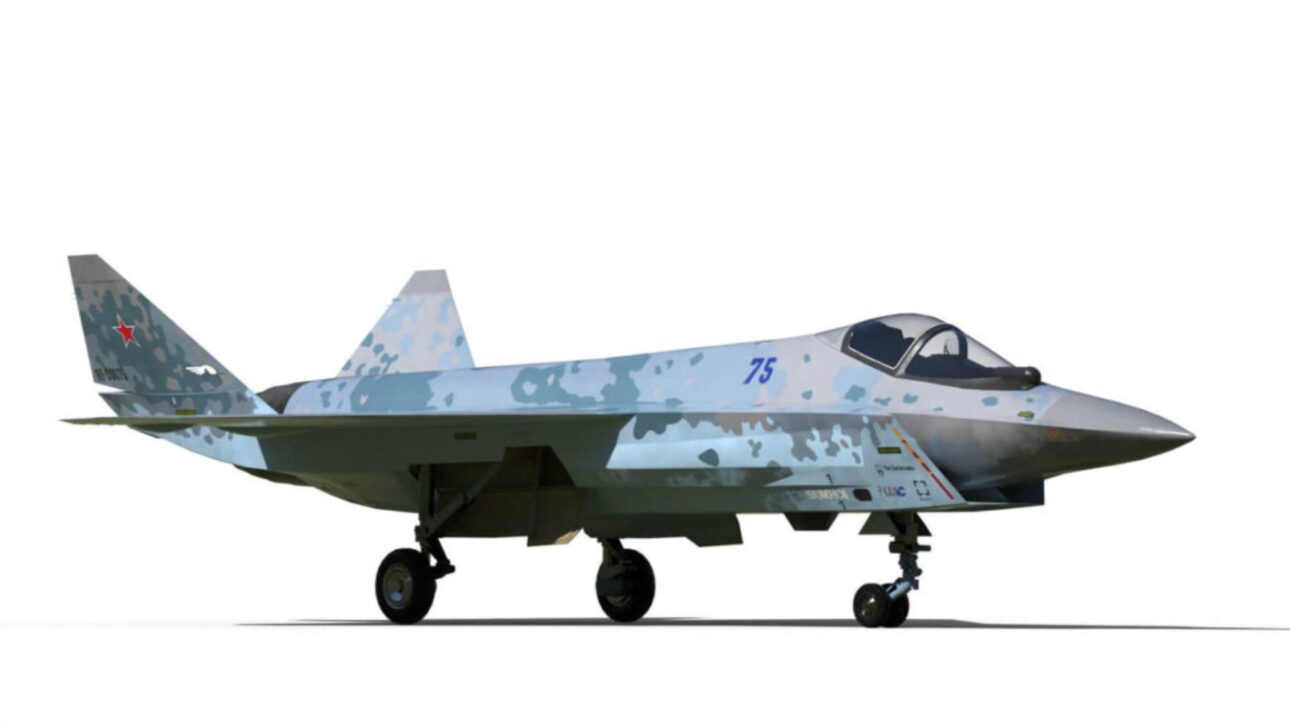
The Su-75 Checkmate was presented by UAC as a fifth-generation light aircraft, with low radar observability, digital architecture, and solutions derived from existing programs in the Russian industry.
According to the manufacturer’s description, the project corresponds to a light, single-engine tactical fighter, developed with the support of supercomputing technologies and pilot assistance systems, focusing on air-to-air and air-to-ground missions.
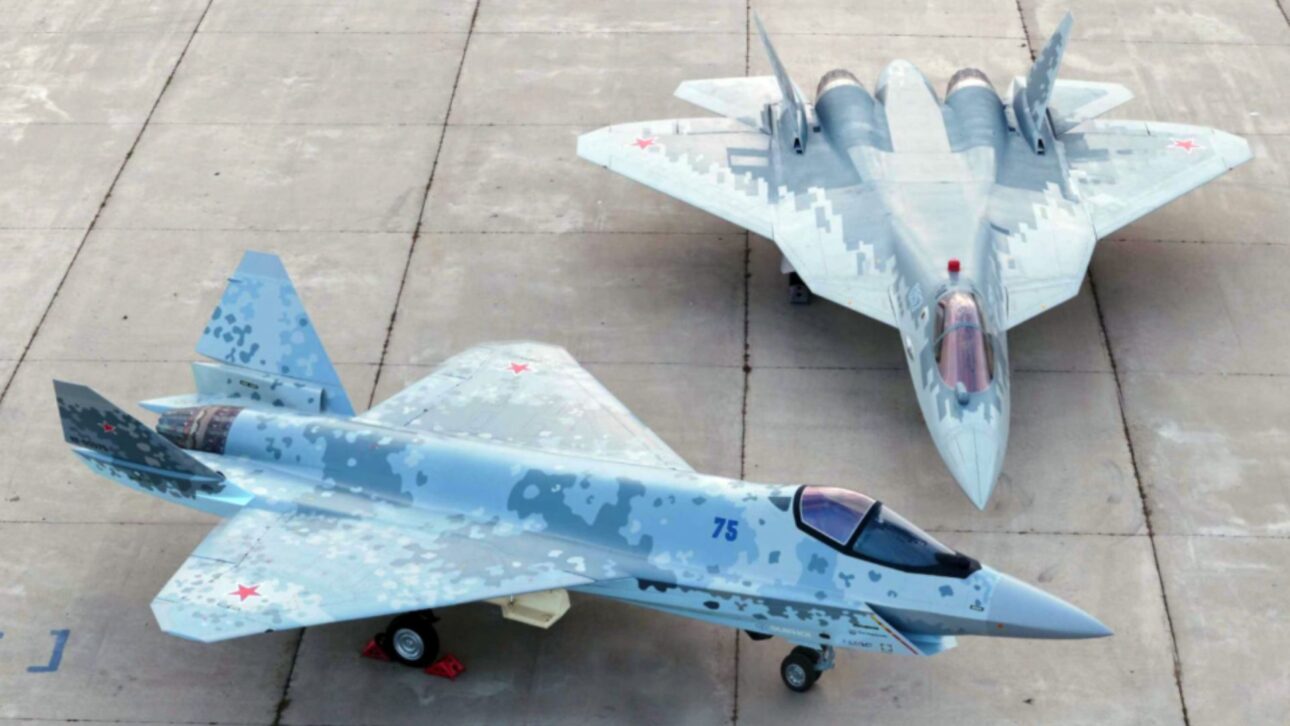
Among the features attributed to the model are the DSI-type ventral air intake, V-tail, internal weapon compartments, and the possibility of operating with different load configurations.
These elements are associated by the Russian industry with the attempt to reduce radar signature without adopting a heavier twin-engine platform, as occurs in larger stealth fighters.
The specifications released by the Russian industry and specialized publications indicate a maximum speed around Mach 1.8, a range close to 2,800 to 3,000 kilometers, and the capacity to carry up to 7.4 tons of weapons and external or internal loads, depending on the configuration.
The comparison with the Concorde is related only to the speed range, as the Franco-British commercial supersonic aircraft reached just above Mach 2 and had a civil purpose, with no operational relation to combat aircraft.
In the case of the Su-75, the performance disclosed by the manufacturer is below the Concorde and refers to a military platform designed to operate in contested air defense environments.
Lower cost is a central part of the Russian bet
UAC seeks to position the Checkmate as a lower-cost alternative to Western fifth-generation fighters, especially the F-35, produced by Lockheed Martin and adopted by various U.S. allied countries.
The proposal presented by the Russian industry envisions a single-engine stealth aircraft, with a simpler design than twin-engine platforms and a declared focus on less complex maintenance throughout the operational cycle.
This argument frequently appears in communications and statements related to the program, in which Rostec, the state conglomerate that controls UAC, associates the project with reduced acquisition and usage costs.
The goal of a lower price than Western competitors has already been mentioned by the Russian industry, but it depends on factors not yet proven on a scale, such as industrial maturity, production volume, and configuration chosen by each client.
Specialized publications reported that the Checkmate was announced with unit cost estimates in the range of US$ 30 million to US$ 35 million, along with promises of a lower cost per flight hour than the F-35.
These numbers remain as industrial publicity targets, not as consolidated values in large-scale production contracts, as there are no public orders capable of validating the final price of the aircraft.
According to Badekha, the Russian Ministry of Defense has also been pressuring the industry for price reductions, making acquisition and maintenance costs one of the central points of the program.
This directive reinforces the attempt to transform the Su-75 into an option aimed at both the domestic market and export, especially for countries that still operate old fleets of Soviet origin.
Competition with the F-35 and search for buyers
The Checkmate was designed to compete in the market for new generation light and medium fighters, a segment in which UAC intends to offer a stealth platform with a cost announced below Western models.
The aircraft targets countries that do not have access to the F-35, do not wish to depend on the United States, or consider the acquisition and operation costs of Western stealth platforms to be high.
Markets in Asia, Africa, the Middle East, and Latin America frequently appear in analyses of potential buyers, although there is no public confirmation of firm orders for the Su-75.
Following the expansion of sanctions against Moscow, the geopolitical environment has imposed additional difficulties on international sales of Russian military systems, including financing, logistics, maintenance, and supply of components.
Financial sanctions, the risk of American retaliation, and logistical restrictions affect Russia’s ability to close international military contracts, especially with countries that maintain significant economic relations with the United States.
For potential buyers, evaluating the program involves not only the initial price of the fighter but also training, weapon integration, parts replacement, technical support, and supply predictability over the years.
As a commercial argument, Moscow also uses the export history of Soviet and Russian military aircraft, which created networks of pilots, mechanics, and infrastructure compatible with equipment produced by the country.
During the Cold War and the following years, models like the MiG-21, MiG-23, MiG-29, and aircraft from the Sukhoi family were sold to different air forces, especially in countries with military ties to Moscow.
Prototype still has to undergo tests
Despite the start of the prototype’s construction, the Su-75 still needs to overcome technical stages before any decision on mass production, export, or adoption in Russian operational units.
The first flight, system tests, sensor and weapon integration, and validation of low observability characteristics will be necessary to verify if the project meets the specifications released since 2021.
The UAC has maintained that the first flight could occur in 2026, according to specialized publications that have followed recent statements from the company and representatives linked to the Russian aeronautical sector.
This schedule, however, still depends on the prototype’s progress, the availability of components, and the Russian industry’s ability to fulfill certification, testing, and integration stages in a more restricted technological environment.
Another sensitive point is access to advanced components, such as semiconductors, high-precision machining equipment, and modern electronic systems, areas considered critical for new generation aeronautical programs.
The sanctions imposed by Western countries make it difficult to import technologies used in different industrial sectors, which can affect deadlines, costs, and supply alternatives for the Russian defense industry.
Alongside the Checkmate, Moscow needs to maintain the production and modernization of aircraft such as Su-30SM, Su-34, Su-35S, and Su-57, which remain linked to the current operational needs of the Russian Aerospace Forces.


This overlap of programs can influence the pace of the Su-75, as complex military projects depend on engineers, facilities, specialized suppliers, and financial resources available over several years.
Return to a Russian tradition of single-engine fighters
The investment in the Su-75 also marks an attempt to revive the Russian and Soviet tradition in single-engine fighters, a category that lost ground in the local industry after the end of the Soviet Union.
Since the 1990s, Russian manufacturers have focused a significant part of their efforts on twin-engine fighters, such as the Su-27, Su-30, Su-35, MiG-29 families, and more recently, the Su-57.
Compared to larger twin-engine aircraft, a single-engine fighter is usually associated with lower fuel consumption, less complex maintenance, and reduced operational cost, although it may have limitations in redundancy, range, and payload.
This balance between cost, performance, and military capability makes up the commercial space that UAC seeks to occupy with the Checkmate, especially among air forces that do not have the budget for more expensive platforms.
The Su-75, therefore, advances as a Russian attempt to compete in the international market for new generation light fighters, but still without operational proof, firm public orders, or announced serial production.
The construction of the first prototype represents an industrial stage of the program, while performance, final price, service entry schedule, and export capability remain dependent on upcoming tests and official decisions.