






 Portuguese
  Spanish
  6 min of reading
  0 comments


Sandisk’s stock jumped 5,636% from February 2025 to a peak of $2,167, according to Exame, surpassing bitcoin’s appreciation in nine years. The race for artificial intelligence increased the demand for SSDs, memory cards, and chips used by cloud and technology on a global scale.
Sandisk became one of the most impressive cases on the American stock exchange after its stock soared 5,636% in 14 months, according to a report by Exame published on June 17, 2026. The appreciation happened on Nasdaq and was linked to the explosion in demand for memory used in artificial intelligence.
The movement gained attention because it surpassed, in the period cited by the report, the appreciation of bitcoin over nine years. While the largest cryptocurrency went through cycles of euphoria and decline since 2018, the memory chip manufacturer rode a more recent wave: the race of cloud and technology companies for SSDs, flash drives, and flash memory cards.
Sandisk emerged from Western Digital’s shadow
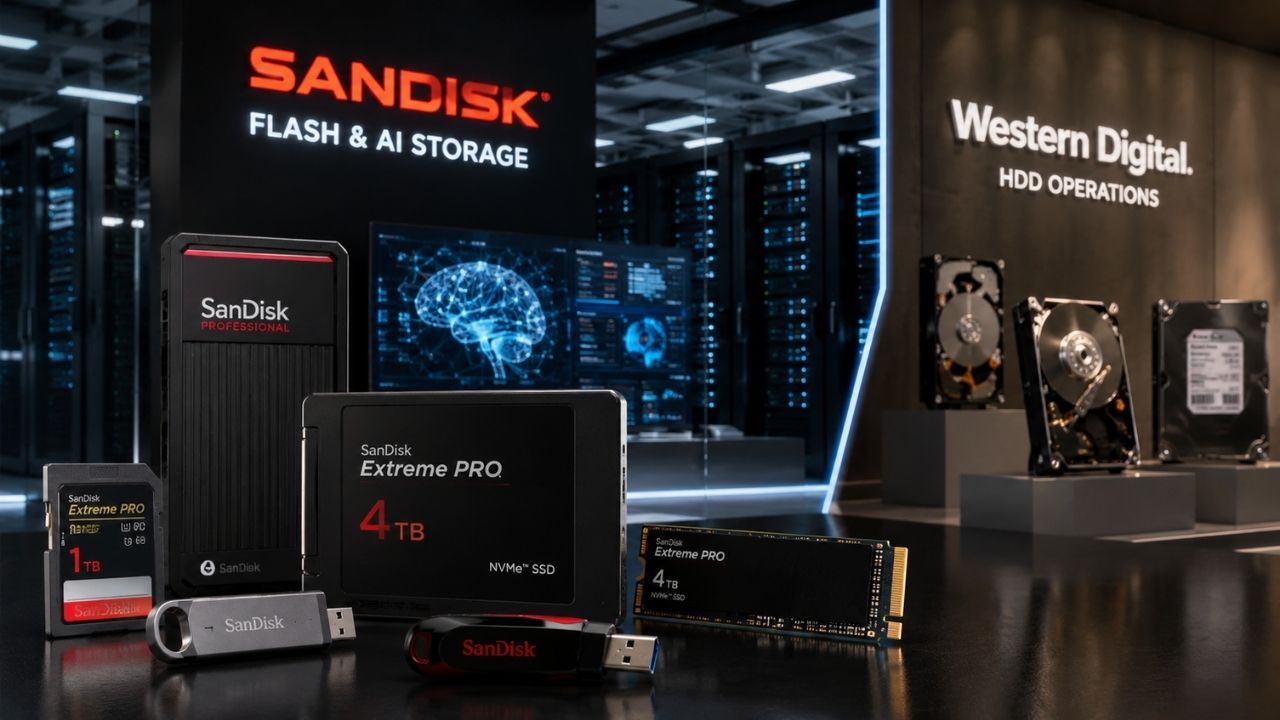
Sandisk was trading between $36 and $40 per share in mid-February 2025, before the separation from Western Digital. The split left the company more focused on SSDs, flash drives, and flash memory cards.
-
The household appliance that consumes the most energy in the Brazilian home is not the air conditioner, it is located in the smallest room of the house, is used daily, and alone can account for up to 25% of the electricity bill, while an alternative in the same outlet can reduce this cost by up to 75%.

-
The country that will host COP31 has lost 186 of its 250 lakes in half a century, saw boats abandoned in dry areas, and now faces advancing desertification, the collapse of migratory birds, and communities leaving regions where water has disappeared.

-
Two Brazilian students created a hospital bed with voice control to help their sick grandmother and won an award in Portugal: the prototype allows patients to adjust height and inclination just by speaking, without cranks, and promises more autonomy for the elderly and people with reduced mobility.
-
Public school students from Sertão de Pernambuco create a $5 filter using sugar-apple peel, transform toxic cassava waste into drinking water, and win 1st place nationally in Samsung’s innovation contest.




Western Digital retained the HDD operation, the traditional hard drives. This division helped the market see Sandisk as a more direct bet on the demand for fast storage linked to artificial intelligence.
Stock reached a historical high of $2,167
According to Exame, Sandisk’s stock reached a historical high of $2,167 this week. Since February 2025, the accumulated increase reached 5,636%, an unusual performance even for technology companies in a phase of euphoria.
In the same report, Exame states that bitcoin has accumulated 5,572% over the last nine years. The comparison draws attention because it places a memory manufacturer above an asset that has become a global symbol of extreme appreciation.
Artificial intelligence changed the demand for memory
The main explanation lies in artificial intelligence. AI models, autonomous agents, data centers, and cloud computing services have come to require much more fast storage to train, operate, and access data on a large scale.
In this scenario, SSDs have gained a strategic role. They are not just components of personal computers; they have become critical pieces for artificial intelligence infrastructure, where speed, latency, and data volume make a difference.
SSDs have become much more expensive than HDs
The report cites a VDURA report according to which SSDs are already 16 times more expensive than traditional hard drives, the HDs. This increase pressures common consumers, especially those who buy parts for computers and games.
On the other hand, the scenario favors companies that sell flash memory. When cloud providers and tech giants absorb a large part of the production, the shortage pushes prices up and improves the perception of manufacturers like Sandisk.
Memory cards have entered the center of AI
For a long time, memory cards and SSDs were seen by the public as retail products, associated with cameras, cell phones, notebooks, and personal use computers. Artificial intelligence changed this perception.
Now, flash memory has become part of the digital infrastructure chain. Sandisk has ceased to be just a brand known for portable storage and has come to be seen as a supplier of an essential input for the new phase of technology.
Cloud giants absorb the production
Cloud computing companies need fast storage to train and operate AI models. This increases the competition for high-capacity SSDs and solutions capable of handling intense data loads.
The consequence appears in the financial market. When corporate demand grows faster than supply, investors begin to reevaluate companies that seemed mature but are now at the center of a new technological race.
Bitcoin has become a benchmark for comparison
The comparison with bitcoin helps to gauge the rise of Sandisk. The cryptocurrency has gone through strong cycles since 2018, including deep drops, historical rallies, and the advancement of financial products linked to the asset.
Even so, in the period cited by Exame, the memory manufacturer’s stock rose more in 14 months than bitcoin did in nine years. The reading does not turn stocks into cryptocurrencies, but shows how artificial intelligence has changed the valuation map in technology.
Rise also carries risk of tension
Such intense appreciation usually attracts attention but also increases the risk of corrections. The report itself points to signs of tension in the market linked to appreciation driven by artificial intelligence.
After the peak, Sandisk fell 1.6% on Nasdaq, to $1,958.80 per share, on the date cited by Exame. This shows that even companies favored by megatrends remain subject to profit-taking, volatility, and changes in expectations.
Memory became a bottleneck in technology
The race for artificial intelligence is often associated with processing chips, GPUs, and data centers. However, Sandisk’s rise shows that infrastructure also depends on storage.
Without fast SSDs and memory at scale, AI models cannot access and process data with the necessary efficiency. The rise in stock reveals that the artificial intelligence chain goes far beyond the most obvious names in the semiconductor sector.
Common consumer feels the effect on prices
The increase in SSDs affects not only billion-dollar companies. In retail, consumers who build computers, upgrade laptops, or buy parts for gaming may feel higher prices.
This is one of the indirect effects of the corporate race for infrastructure. When giants buy huge volumes, products that were once common may become more expensive for the end consumer, creating a silent dispute between data centers and retail.
Sandisk became a thermometer for flash memory
Sandisk has started to function as a thermometer for flash memory amidst the race for AI. Its appreciation shows how the market prices companies that are at strategic points in the technology chain.
The case also reinforces a change in perception. Components that seemed unglamorous, like SSDs and memory cards, have gained prominence because they have become essential for the operation of artificial intelligence.
It’s not just a story of a rising stock
Despite the impact of 5,636%, the story should not be read only as a stock that rose significantly. The most important data lies in the structural change behind the increase.
Artificial intelligence has reorganized priorities within technology. Companies that provide memory, storage, and infrastructure have started to capture part of the attention previously concentrated on software, applications, and cryptocurrencies.
Separation helped highlight the company’s focus
The spin-off of Western Digital also played a significant role. By separating, Sandisk began to focus its market narrative on flash memory, SSDs, and products related to more modern storage.
This focus made it easier for investors to understand. Instead of being mixed with traditional hard drive operations, the company became more associated with the segment that gained strength with the demand for artificial intelligence.
Market watches if rally remains sustainable
The big question now is whether Sandisk’s rally can be sustained. For this, it will be necessary to observe SSD prices, data center demand, production capacity, and the investment pace of technology companies.
There is also the risk of excessive optimism. When a stock rises thousands of percent in a short time, any change in expectations can lead to sharp movements, even if the long-term thesis remains strong.
Has memory become the new gold of AI?
Sandisk demonstrated how the race for artificial intelligence can transform companies outside the traditional spotlight into market protagonists. The stock rose 5,636% in 14 months, surpassed bitcoin in the segment cited by Exame, and exposed the strength of demand for SSDs and memory cards.
The case raises a bigger question about the future of technology: will the next big dispute in artificial intelligence be less about applications and more about who controls memory, storage, and infrastructure? Share your opinion.







Be the first to react!