Portuguese
  Spanish


The new drilling in the Búzios field reached a depth of 5,600 meters and revealed reservoirs below an area already in commercial production. The consortium led by Petrobras, with participation from Chinese companies, continues to analyze the potential of the discovery
Imagine a company that already operates the largest deep-water oil field in the world, producing 1 million barrels of oil per day, and decides to drill even deeper, below the reservoir that is already in full production. This is exactly what Petrobras did in the Búzios field, and what it found reignited the debate about the real limits of Brazilian reserves.
Oil discovered below a field that already produces oil
On February 14, 2025, as confirmed by the Petrobras Agency in an official relevant fact, the Brazilian state company announced the presence of oil in well 9-BUZ-99D-RJS, located in the western region of the Búzios field, in the pre-salt of the Santos Basin. The discovery was not in a virgin area: it is a new accumulation in a zone below the main reservoir, that is, oil found below a field that is already in commercial operation.
According to the Petrobras Agency, tests were conducted from a depth of 5,600 meters, with electrical profiles generated by a probe introduced in new drilling. The material collected is still under analysis in the state company’s laboratories to determine the potential and characteristics of the oil found.
-
OPEC+ Boosts Oil Supply by 188,000 Barrels per Day in July 2026, Leading to Price Drop from $112 to $89 per Barrel in Under Two Months

-
TotalEnergies Signs 20-Year Deal to Purchase 2 Million Tons of LNG from Alaska, Boosting Project Viability
-
Turkey Deploys Çağrı Bey Drilling Ship to Explore New Oil Frontier Off Somalia’s Coast
-
Golden Pass LNG Ships First Liquefied Gas Cargo from the U.S., Completing $10 Billion QatarEnergy and ExxonMobil Investment

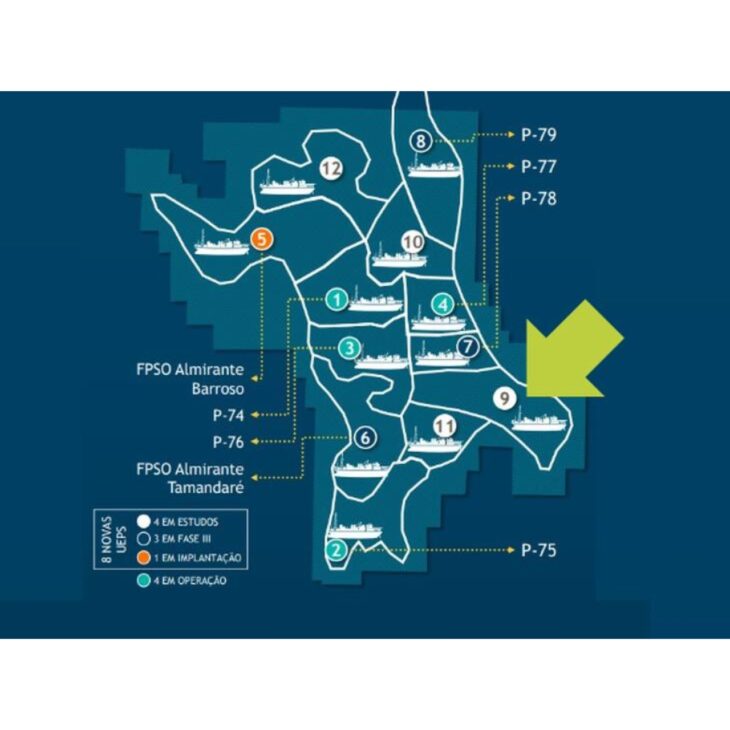
The field that was already giant became even larger
The Búzios field already held, before this discovery, the title of largest ultra-deepwater oil-producing field in the world. Located 189 kilometers off the coast of Rio de Janeiro, with a water depth of 1,940 meters, the field has a reservoir with a thickness of up to 480 meters and covers an area of 852 km², equivalent to 115,000 football fields, as described by Petrobras.
In October 2025, according to Petrobras, the FPSO Almirante Tamandaré platform produced alone 270,000 barrels per day, helping Búzios to break the record of 1 million barrels daily of production, the first time a Brazilian field has reached this level.
What makes this discovery different from all previous ones
Most oil discoveries occur in new, unexplored areas. What Petrobras did in Búzios is different: the company found oil in a deeper layer, below a reservoir that has been in commercial production for years. This means that the infrastructure of platforms, wells, and pipelines is already installed in the region, which can reduce some of the future development costs.
The drilling was carried out in an environment of high technical complexity: 1,940 meters of water column even before starting to drill the rock, reaching more than 5,600 meters deep underground. For comparison, according to PPSA, the federal agency managing the sharing contracts, the total depth of the pre-salt can reach up to 7,000 meters from the sea surface.
The real numbers of extraction costs in the pre-salt
A fact that explains why Petrobras invests in increasingly deeper drilling is found in the company’s own financial reports. According to the official Petrobras documents filed with the American SEC (United States capital market regulator), the lifting cost of the pre-salt in 2025 was US$ 4.19 per barrel without leasing, or US$ 6.87 per barrel including the chartering of platforms.
These numbers make the Brazilian pre-salt one of the most competitive operations in the world. For comparison, the onshore extraction cost in Brazil, according to the same reports, reached US$ 17 per barrel in the same period. The deeper and more productive the well, the more the fixed costs are diluted.
The consortium behind the discovery
The exploration of Búzios is not exclusive to Petrobras. As informed by the state company in an official note, the Búzios Shared Deposit Consortium is composed of Petrobras as the operator, with 88.98% participation, the Chinese CNOOC with 7.34%, and the also Chinese CNPC with 3.67%. The management of the sharing contract is carried out by Pré-Sal Petróleo S.A. (PPSA), a federal public company.
The analysis of the results of the new accumulation is still ongoing by the consortium, which has not yet released estimates of recoverable volume for the new zone.
The pre-salt still has much to reveal
In July 2025, according to data from the National Petroleum Agency (ANP) compiled by Petrobras, the pre-salt accounted for 79% of all national oil and gas production. Petrobras’ total production grew 11% in 2025 compared to the previous year, reaching 2.40 million barrels per day.
Furthermore, as highlighted by Petrobras, the oil extracted from the pre-salt emits up to 70% less greenhouse gases per barrel than the global average, an increasingly relevant argument in a market that demands climate transparency from energy companies.
The new accumulation discovered below the Búzios field is still a question mark regarding its size and commercial viability. But the fact that there is oil below the oil that is already being produced raises a question that the sector still cannot answer: how many other layers are yet to be found in the Brazilian subsoil?