Portuguese
  Spanish



University Student Invests in Mechanism Capable of Transforming Sludge into Cooking Gas. His Project Aims to Reuse Water Used at Home, Both for Watering Plants and for Transforming into Gas
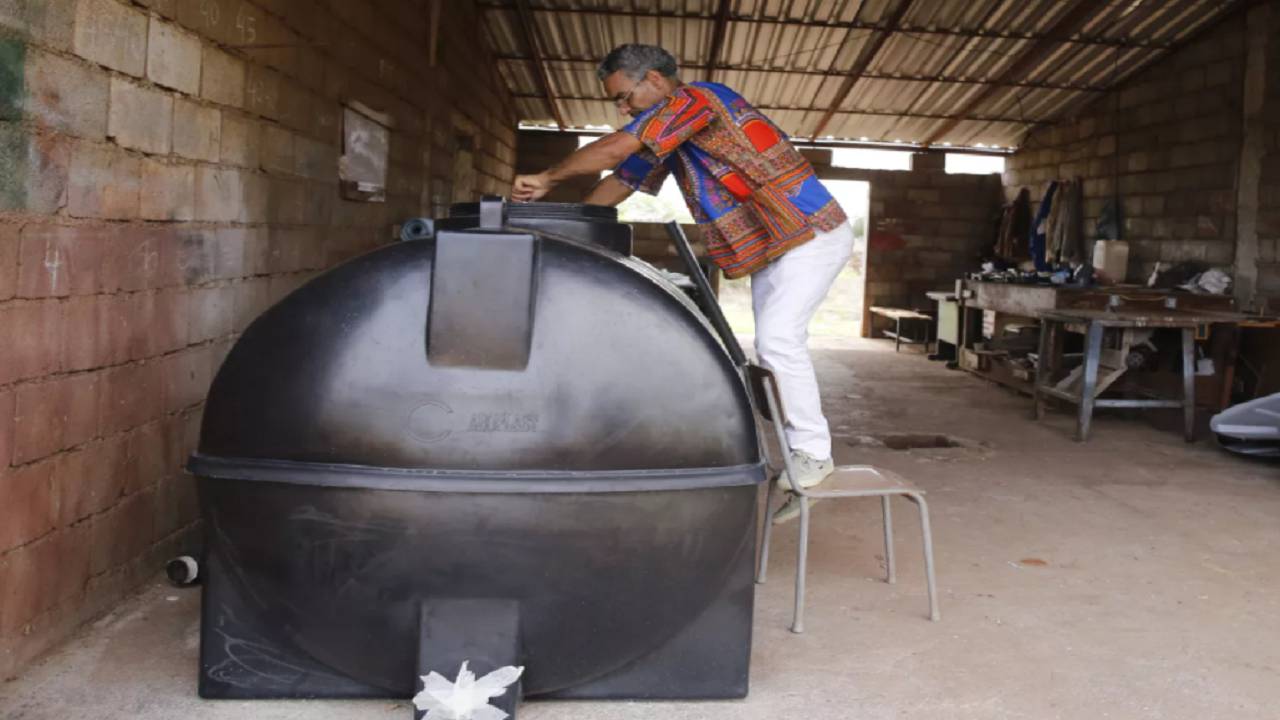
The Cape Verdean university student Patrick Gomes, who is in the 4th year of the Architecture course at Jean Piaget University of Cabo Verde, developed an incredible project that aims to transform sludge into cooking gas and liquid for watering plants. The idea is to reuse as much water as possible in a sustainable way. Gomes explains that his project was born out of the needs of rural life in Cabo Verde, which at the time was facing a terrible drought. Understanding that water rationing and reuse were more than necessary gave rise to the idea for this project.
Read Also
Project That Transforms Sludge into Cooking Gas Could Revolutionize the Market and Gas
When the university student began to realize that people were complaining about the lack of water, but didn’t know how to use the little they had consciously, he decided he had to help people with this issue.
Thus, Recycle Be was born, a mechanism capable of filtering water and redirecting it directly for irrigation. The university student reported that all the used water goes to the Recycle Be tank in his storage, where it then undergoes a filtration process to separate the waste.
-
Oil production grows in Rio, but reserve replacement raises a warning sign

-
Petrobras is expected to complete the drilling of the Morpho well in the Foz do Amazonas in August 2026, the first well in the Equatorial Margin, an oil frontier that the ANP estimates at more than 30 billion barrels and could redraw the map of Brazil.

-
Oil returns to the center of concerns with tension between the US and Iran

-
IEA reduces forecast for global oil demand in 2026 after impacts of the Middle East crisis



The water then goes to the watering of the plants, and the waste, mostly sludge, has been processed to become cooking gas. According to Gomes, this project is 80% complete.
Official Implementation of the Project
Once the project is finally completed, it is expected that the mechanism will be operational between the end of August and the beginning of September, in the Ribeira da Cidadela region, where the university student will choose a family to assist during the studies, making observations that could help with improvements and adjustments to the project.
This will be necessary mainly to assess how much cooking gas is produced from sludge, as the exact quantity of cooking gas has not yet been defined. The university student believes that the amount of gas produced will depend on the amount of sludge obtained in the process of separating water from waste in the sewage tank.
It is clear that, for the university student, it is very important for this project to succeed, not only to contribute to the recovery of the environment but also as a way to help his people with the problems of water scarcity, in addition to a bonus of having sustainable cooking gas that is practically free.
The Importance of This Project to the Cape Verdean Community
A project as innovative as this is undoubtedly essential for the regeneration of the environment, especially when we consider the daily challenges that have been extremely aggravated by the global pandemic we face.
It is remarkable the effort that university student Patrick has made on behalf of a nation that suffers from drought and, most of the time, also from lack of resources. While conducting his studies, the university student understands that it is still early to say whether his project will meet the needs of a large portion of the population that requires this economy, not only in water but also in cooking gas.