Portuguese
  Spanish



Railway corridor between China and Iran advances as a land route in Eurasia, amid trade disputes, international sanctions, and efforts to reduce dependence on traditional maritime routes controlled or monitored by Western powers.
The expansion of railway connections between China, Central Asia, and Iran has begun to be monitored by international analysts for reducing dependence on maritime routes and bringing Beijing closer to Tehran amid United States sanctions.
The corridor passes through Kazakhstan and Turkmenistan before reaching Iranian territory, but there is no confirmed information that it is a single, entirely new railway, stretching 10,400 km.
The structure relies on existing lines, cargo terminals, modernization of railway yards, and transit agreements between Eurasian countries, indicating a gradual logistical integration, rather than just an isolated project.
-
Salvador’s Acarajé Vendors Turn Used Frying Oil into Income by Selling it for Biodiesel Production

-
Volunteer Revives Dead Lake in Bengaluru Overnight, Doubling Water Capacity and Attracting Kingfishers and Herons
-
1909 Train Car Once Destined for Abandonment Transformed into Luxury Accommodation in the U.S. After $3,000 Restoration

-
86-Year-Old Brazilian Man Starts Homemade Bread Business After Learning from TV Recipe


For China, the land route expands alternatives within the Belt and Road Initiative, while Iran gains another connection to Asian markets during a period of financial, energy, and maritime restrictions.
US$ 400 billion agreement brings China and Iran closer
The Sino-Iranian rapprochement gained momentum in March 2021, when the two countries signed a 25-year cooperation program in Tehran, presented by the governments as a broad economic partnership agenda.
The amount of US$ 400 billion is cited in international reports and analyses as an estimate of the planned investments, but the official details of the agreement have not been fully disclosed by the involved governments.
The significance of the corridor is not limited to the tracks, according to international trade experts, because railway transport offers Beijing a complementary alternative to maritime routes passing through the Indian Ocean and the Persian Gulf.
These maritime paths include points subject to military crises, blockades, inspections, and diplomatic pressure, factors that help explain China’s interest in diversifying cargo routes between Asia and the Middle East.
In the Iranian case, analysts point out that the land connection has additional importance because United States sanctions have for years affected sectors such as oil, banking, insurance, and commercial navigation.
In this context, any land trade alternative can function as a complementary logistical channel for Tehran, although its effectiveness depends on financing, regional stability, and operational agreements between the involved countries.
Kazakhstan and Turkmenistan enter the route axis
The route also increases the participation of Kazakhstan and Turkmenistan in trade connections between China and the Middle East, as both are located at transit points between the Chinese market and Iranian territory.
These countries begin to act as transit hubs in an international railway network, with the possibility of collecting tariffs, receiving infrastructure investments, and expanding their bargaining power with regional and global partners.
From a technical standpoint, the corridor crosses arid areas, steppes, desert regions, and border zones with different railway standards, requiring coordination between national networks with their own operational characteristics.
In practice, integration depends on transshipment terminals, truck exchanges, gauge adaptation, and dispatch systems capable of reducing delays in cargo that crosses several countries before reaching its destination.
China uses a standard gauge of 1,435 mm, while networks inherited from the former Soviet sphere, such as those in Kazakhstan and Turkmenistan, mainly operate with 1,520 mm.
Since Iran also uses 1,435 mm, border points need specific solutions to allow the continuity of transport, whether through equipment exchange, cargo transshipment, or adapted railway operations.
Desert, gauges, and customs challenge the railway
In addition to the gauge difference, the corridor faces administrative and operational obstacles, as each country maintains its own customs rules, signaling systems, inspection requirements, and procedures for international cargo.
For this reason, modernization depends as much on engineering works as on political and administrative agreements, capable of standardizing processes and reducing bottlenecks at border sections and cargo terminals.
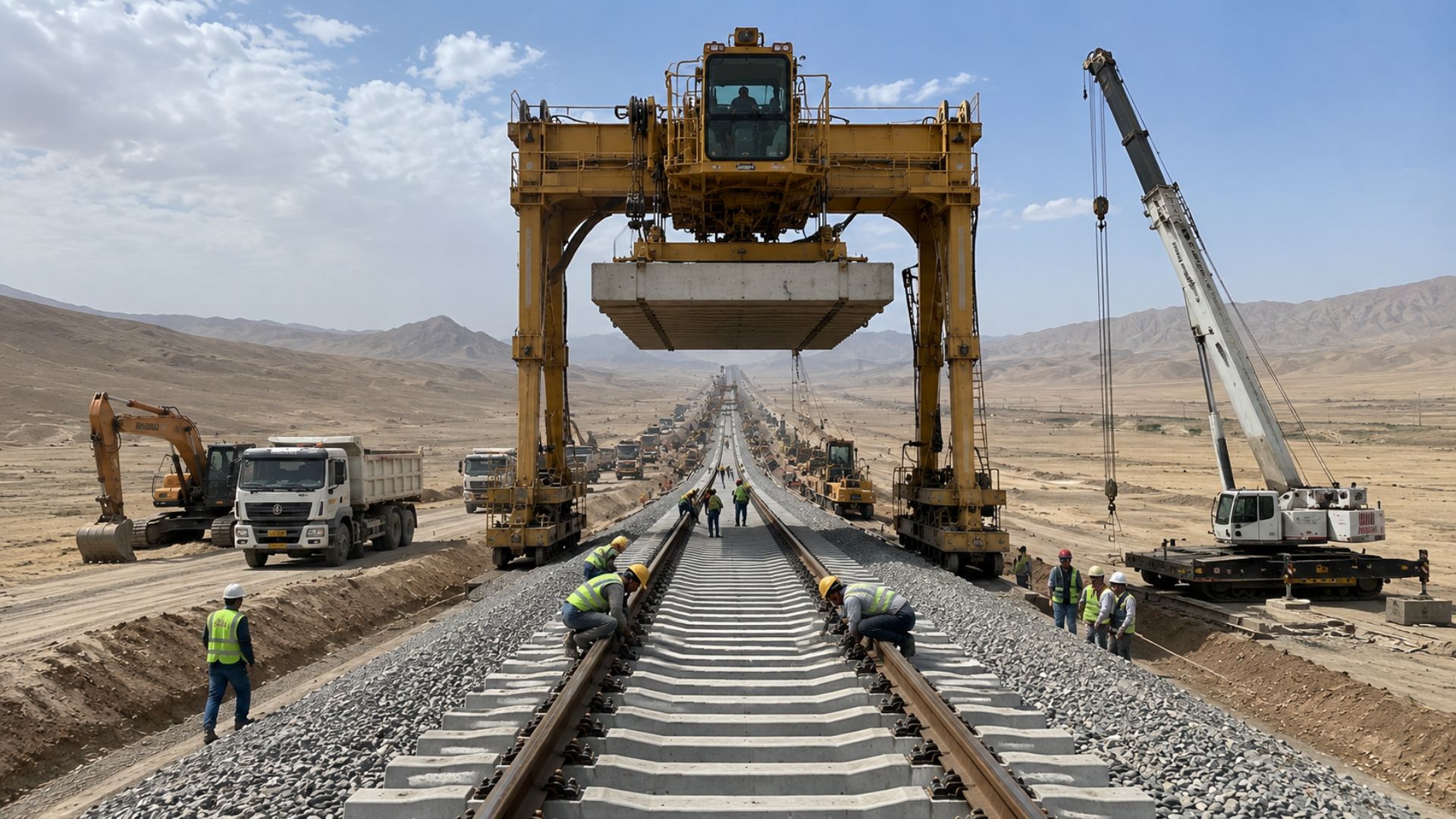
In the most sensitive sections, railway construction and adaptation require subgrade reinforcement, soil compaction, installation of resistant ballast, and drainage systems suitable for dry climate regions.
In desert areas, factors such as extreme heat, sand, and thermal variation accelerate rail wear and increase the need for maintenance, especially on routes used by heavy freight trains.
Bridges and tunnels are also part of the network planning, as rivers, valleys, highways, and mountainous terrain require structures with sufficient stability for the transport of containers, machinery, industrial products, and energy inputs.
These works need to reduce vibrations and maintain operational safety along sections with high traffic, especially when the railway is used by long compositions and heavy loads.
Logistics centers support the land route


Daily operations depend on large-scale logistics centers, including container yards, bonded warehouses, dry ports, railway branches, and maintenance workshops distributed along the route.
These structures are necessary for the connection to function as an integrated international corridor, and not just as a sequence of tracks connected between different national networks and administrative borders.
In recent years, regular container train services between China and Iran have been resumed or expanded in different formats, according to records from regional railway organizations and logistics operators.
These entities claim that railway flows reduce delivery times and strengthen commercial integration between the two countries, although the economic reach depends on the regularity of services and the capacity of the terminals.
Even so, experts warn that the economic implementation of the China-Iran pact has been less than announced in initial estimates, especially when compared to other Chinese investments in the Middle East.
A Reuters report pointed out that effective Chinese investments in Iran remain limited compared to those made by Beijing in other regional partners, which puts the real size of the cooperation into perspective.
Railway route reduces dependence on maritime transport
The interest of the United States is related to the cumulative effect of these connections, according to analysts, because a more efficient land link can reduce part of Iran’s dependence on maritime routes subject to monitoring and sanctions.
A more integrated network between China, Central Asia, and Iran can also expand Beijing’s commercial options towards the Middle East, without completely replacing maritime transport, which remains central in global trade.
The railway should be understood as an expanding network, formed by existing lines, modernization works, cargo terminals, and transit agreements between countries with different economic and political interests.
Its impact will depend on regional stability, financing capacity, international sanctions, and coordination between governments that control essential sections of this railway link through Eurasia.