






 Portuguese
  Spanish


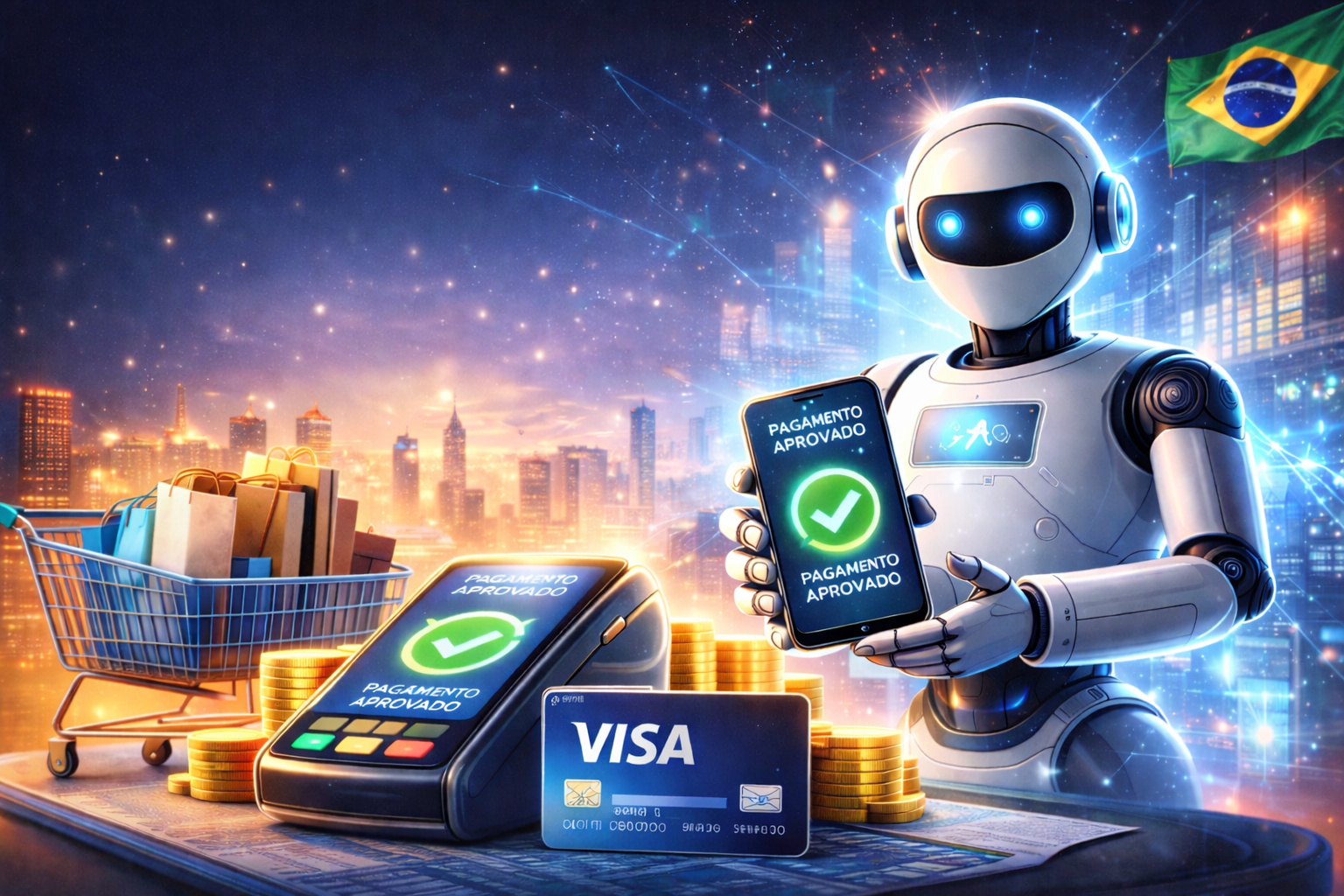

Visa Accelerates Use of Artificial Intelligence, Automates Banking Transactions and Prepares New Era of Digital Consumption in Brazil in 2026.
Visa announced this Monday (29) that it has already completed hundreds of banking transactions in e-commerce through Artificial Intelligence. The company carried out the operations in partnership with technology companies and digital platforms.
The advancement occurred throughout 2024, in controlled environments, and indicates that mass adoption is expected to begin in 2026. As a result, Visa forecasts a profound change in the digital economy, including in Brazil.
According to the company, 2025 is likely to mark the end of the traditional online shopping model. By then, consumers are still browsing alone, manually comparing prices, and completing payments on their own.
-
The ‘tsunami’ of investments directed at Artificial Intelligence (AI) and semiconductor companies, which prioritize security and more predictable profits, has been a determining factor in the declining trajectory of Bitcoin.

-
Samsung eyes strategic chip factory in South Korea and could shake up the global AI landscape with advancements in HBM memories and advanced packaging.

-
Nvidia makes agreements in South Korea for AI factories and takes data centers, advanced chips, and global cloud to another level by 2027
-
ChatGPT reveals which human job it would choose if it could really work


In the next stage, Artificial Intelligence agents will take over this process. They will seek products, analyze prices, and execute purchases according to user preferences.
Artificial Intelligence Begins to Execute Banking Transactions
Visa refers to this new model of “agent-based payments”. In this format, Artificial Intelligence-based robots act on behalf of the consumer. The user sets rules, limits, and goals. Then, the system executes the entire purchasing operation.
According to the company, these payments are expected to quickly move out of the testing phase. Visa states that the technology is already demonstrating practical viability. Therefore, the company sees Artificial Intelligence as the next natural step in the evolution of digital banking transactions.
Visa Expands Partnerships to Accelerate Mass Adoption
To make this transformation possible, Visa is working with more than 100 partners in its global network. These partnerships involve fintechs, technology companies, e-commerce platforms, and card issuers.
According to the official statement, “these collaborations have already produced hundreds of real transactions controlled and initiated by agents, proving the viability of AI-driven shopping.” Thus, the company emphasizes that the model already works outside the theoretical environment.
Executives Project Structural Change in Consumption
Visa also highlighted the strategic impact of Artificial Intelligence on the future of commerce. “We have seen impressive progress in how AI will transform commerce,” says Rubail Birwadker, Senior Vice President and Head of Growth Products and Partnerships at Visa.
According to the executive, the technology will no longer just support decisions. “By 2026, AI agents will not only assist in the purchasing process but will complete it.” In this way, Visa projects a structural change in how consumers interact with digital payments.
Consumers Already Adopting AI in Purchase Decisions
Research conducted by Visa shows that consumer behavior is already aligned with this trend. In Latin America, more than 70% of consumers use Artificial Intelligence to assist in online shopping.
These users turn to the technology to compare prices, seek recommendations, and evaluate options. In the United States, the movement is also growing. Almost half of consumers use AI tools at least once in the purchasing process.
Direct Impacts on the Economy and in Brazil
In Brazil, experts evaluate that the adoption of payments with Artificial Intelligence could further accelerate the digitization of the economy. The country already registers a high volume of digital banking transactions, driven by cards and e-commerce.
With AI agents, the process is expected to become faster and more personalized. Furthermore, the technology could reduce errors, increase efficiency, and enhance consumer experience. Thus, companies gain scale and competitiveness.
Next Steps and Challenges of the Technology
Despite the progress, Visa acknowledges significant challenges. The company remains focused on security, data privacy, and authorization control. Therefore, it will continue testing the model throughout 2025.
Nonetheless, the scenario points to a definitive shift. As Artificial Intelligence takes over banking transactions, digital commerce enters a new phase. This movement is expected to impact the economy, consumption, and the financial market in Brazil and worldwide.


