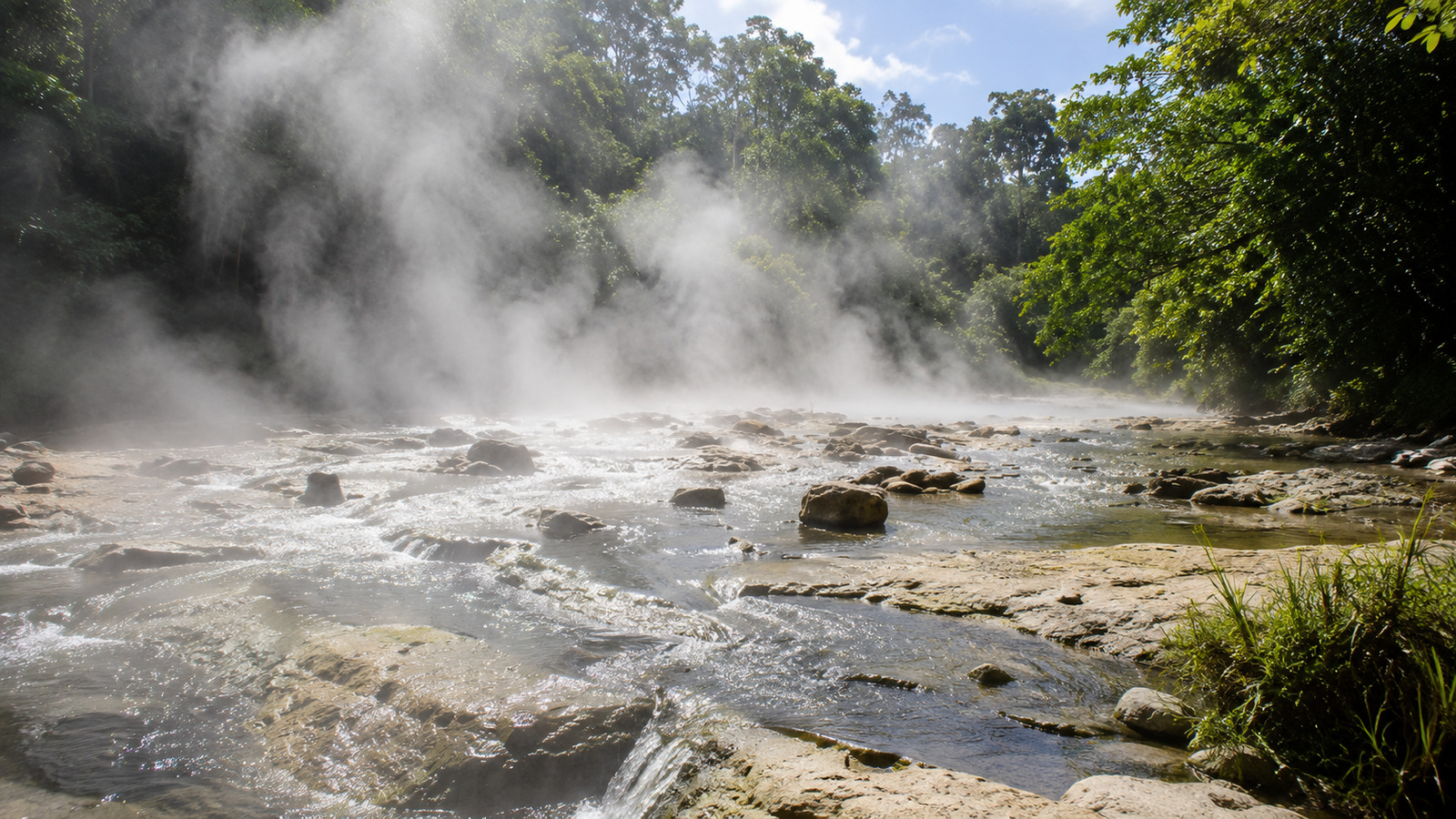

In the Peruvian Amazon rainforest, the Shanay-timpishka records sections above 90°C, causes severe burns, alters nearby vegetation, and has become a natural laboratory for researchers to understand the effects of extreme heat
The Shanay-timpishka, a river located in the Peruvian Amazon, draws researchers’ attention for recording sections with water above 90°C and nearing 100°C. The phenomenon, associated with geological faults and the emergence of hot underground water, is concerning for causing severe burns, affecting animals, and altering the surrounding vegetation. The data for this article is from an article by UOL.


Shanay-timpishka does not boil because of the sun
The river is located in the middle of the Amazon rainforest, in Peru, and is known for having points where the water appears to boil.
The name Shanay-timpishka means “boiled by the heat of the sun” in an indigenous language, but researchers state that this is not the scientific explanation.
-
Scientists Develop Needle-Free Insulin That Penetrates Skin, Reduces Glucose in Animals Within an Hour, Paving the Way for Diabetes Patches and Creams for Humans

-
After 40 Years of Research, Powdered Coconut Water to Be Produced in Brazilian Biorefinery, Aiming to Revolutionize Health for Children, Elderly, and Hospital Patients
-
Queen Guitarist Brian May Collaborates with ESA Scientists to Study Asteroids Bennu and Ryugu Using 3D Simulations
-
Largest Known Single-Piece Meteorite, Weighing 60 Tons, Puzzles Scientists with Its Intact Fall and Lack of Visible Crater


Experts assess that geological faults allow the circulation of heated underground water at great depths.
When this water emerges along the river’s course, the temperature rises intensely in different sections.
Peruvian geoscientist Andrés Ruzo claims to have measured temperatures close to the boiling point. In recent research, he recorded parts of the river above 90°C and points where the water was boiling.

Hot water poses an immediate risk
Direct contact with the water of the Shanay-timpishka can cause severe burns in just a few seconds.
Ruzo told The Sun portal that placing a hand in the river can quickly cause second or third-degree burns.
The heat also threatens animals that fall into the watercourse. According to the geoscientist, they cannot escape the extreme temperatures and end up dying because of the heat.
Sensors recorded temperature contrast
In 2024, a team of scientists from the United States and Peru installed 13 sensors along the Shanay-timpishka.
The monitoring lasted a year and aimed to measure the air temperature at different points near the river.
The data showed a great contrast between cooler areas and hotter points. In the milder parts, the average was 24°C. In the hotter regions near the river, the sensors recorded nearly 45°C.
Vegetation changes near the hottest sections
The analysis of forest plots near the river indicated that plant diversity decreases as the temperature increases.
Some species disappear, while others, more adapted to the heat, become more common.
Researcher Alyssa Kullberg, from the Federal Institute of Technology in Lausanne, told the BBC that even with the region’s humidity, the vegetation seemed drier in the higher temperature areas.
Scientists treat the Shanay-timpishka as a natural laboratory to study the effects of global warming. Rodolfo Nóbrega, from the University of Bristol, told the BBC that the increase in temperature can reduce the photosynthesis of plants even when there is water nearby.
The researchers cite differences between species. Trees like the Ceiba can withstand, while the Guarea grandifolia suffers more from the high temperatures.
For Chris Boulton, from the University of Exeter, the loss of the forest can release carbon into the atmosphere and affect the climate on a global scale.
This article was prepared based on information from The Sun and BBC, with data, numbers, and statements preserved as per the consulted material.