Portuguese
  Spanish


Nicknamed Heavenly Sword, the Taiwania cryptomerioides of 84.1 meters was measured in 2023 in the Sheshan mountain range, after a survey that combined aerial laser, online volunteers, and expeditions in cloud forests threatened by extreme climate and illegal deforestation.
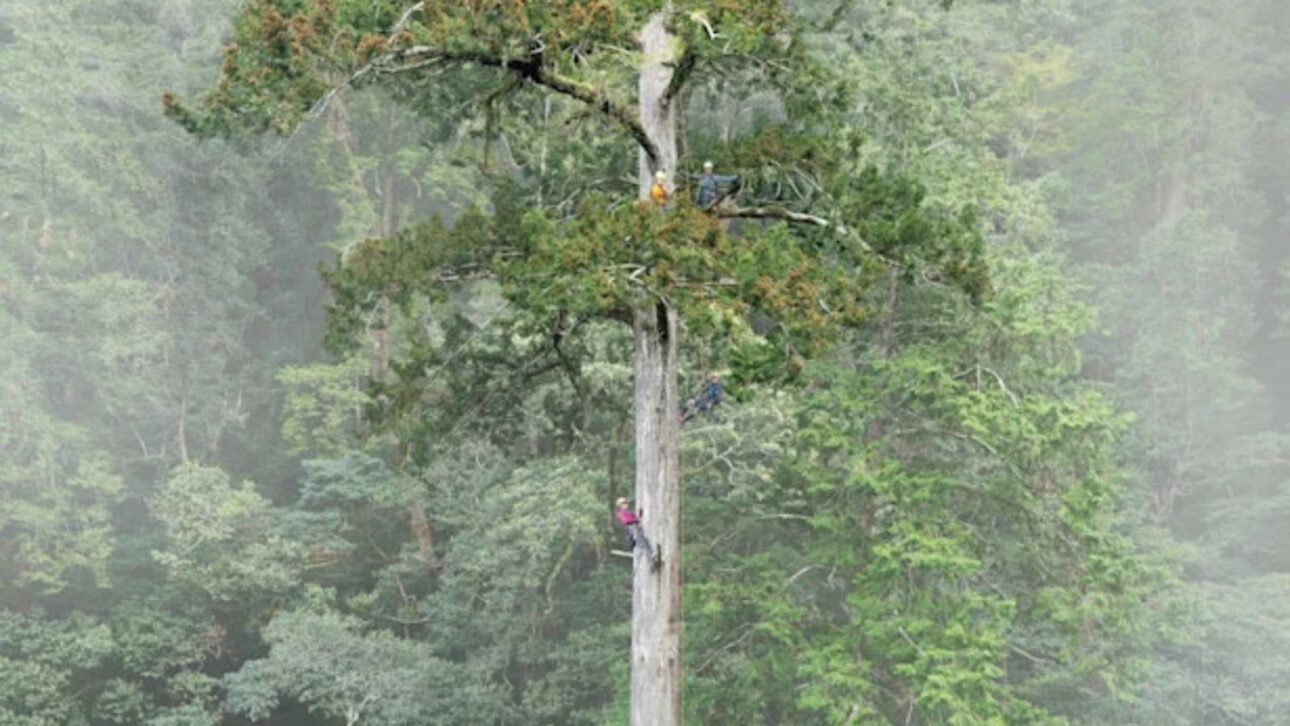
The tallest known tree in East Asia was confirmed in the mountains of Taiwan: a Taiwania cryptomerioides of 84.1 meters, nicknamed Heavenly Sword, located in the Sheshan mountain range and measured in 2023.
Heavenly Sword leads survey in Taiwan
The confirmation occurred during the work of the Taiwan Tree Seekers, a group that brings together climbers, ecologists, geologists, and remote sensing specialists. The team has been active since 2014 to locate and document giant trees.
The Heavenly Sword belongs to the species Taiwania cryptomerioides, a conifer from the Cupressaceae family. Its ancestors date back 100 million years, and the indigenous Rukai people call these giant firs “the tree that reaches the Moon.”
-
Drill Uncovers Freshwater Rivers Hidden Beneath the Ocean Floor

-
3,000-Ton, 81-Meter Attack Submarine Begins Sea Trials, Equipped with Heavy Torpedoes and Anti-Ship Missiles

-
Boat Made from 10 Tons of Plastic and 30,000 Discarded Flip-Flops Sails Along African Coast, Serving as a Floating Classroom on Ocean Pollution
-
Welder Discovers 16th-Century Diamond Ring in England After 7 Hours with Metal Detector; Gold Jewel Linked to Edward I Pattern Auctioned for £17,000




The decisive measurement was made in 2023, when a climber scaled the trunk and dropped a measuring tape from the canopy. The procedure confirmed the 84.1 meters, a mark considered the tallest known in East Asia.
National map revealed thousands of candidates
Before the expeditions, researchers built a national map of vegetation cover with laser scanning data. The initial tracking identified 57,065 candidate trees.
The process required careful filtering. Steep cliffs generated false positives, such as a tree only 25 meters tall recorded as 90 meters because it was on top of a steep slope.
To speed up the analysis, the team turned to public participation. In total, 372 volunteers examined images obtained by laser and reduced the list to 4,736 candidates.
This screening eliminated 92% of the manual verification work that would be done by experts. The final survey identified 941 giant trees in Taiwan, all over 65 meters.
These specimens appear grouped in cloud forests of the mountains, between 1,500 and 2,500 meters of altitude. Among the ten tallest trees, nine exceeded 70 meters, and all were Taiwania cryptomerioides.
Largest tree exposes strength and fragility of forests
The discovery of the largest tree in East Asia reinforces the ecological importance of these ancient individuals. Large trees store carbon, provide critical habitats, alter microclimates, and support forest biodiversity.
Despite their size, these giants are vulnerable. Climate change is raising the cloud base in Taiwan’s mountains, reducing the humidity of the cloud forests on which these trees depend.
Another risk comes from typhoons. The intensity of events hitting the island has increased by 35% in the last four decades, heightening threats of floods and landslides in steep river valleys.
The expeditions also revealed illegal logging of primary forests, even in protected areas. More than 95% of the identified giant trees are under official protection, but the remote location makes monitoring difficult.
The study was published in the journal Frontiers in Forests and Global Change. According to the authors, formal protection needs to be accompanied by broader community surveillance, capable of preventing further losses in remote areas.
What do you think of this discovery in Taiwan: is it more impressive for the size of the Celestial Sword, the technology used to locate hundreds of giant trees, or the warning that even protected forests remain exposed to extreme weather and illegal extraction?