Portuguese
  Spanish


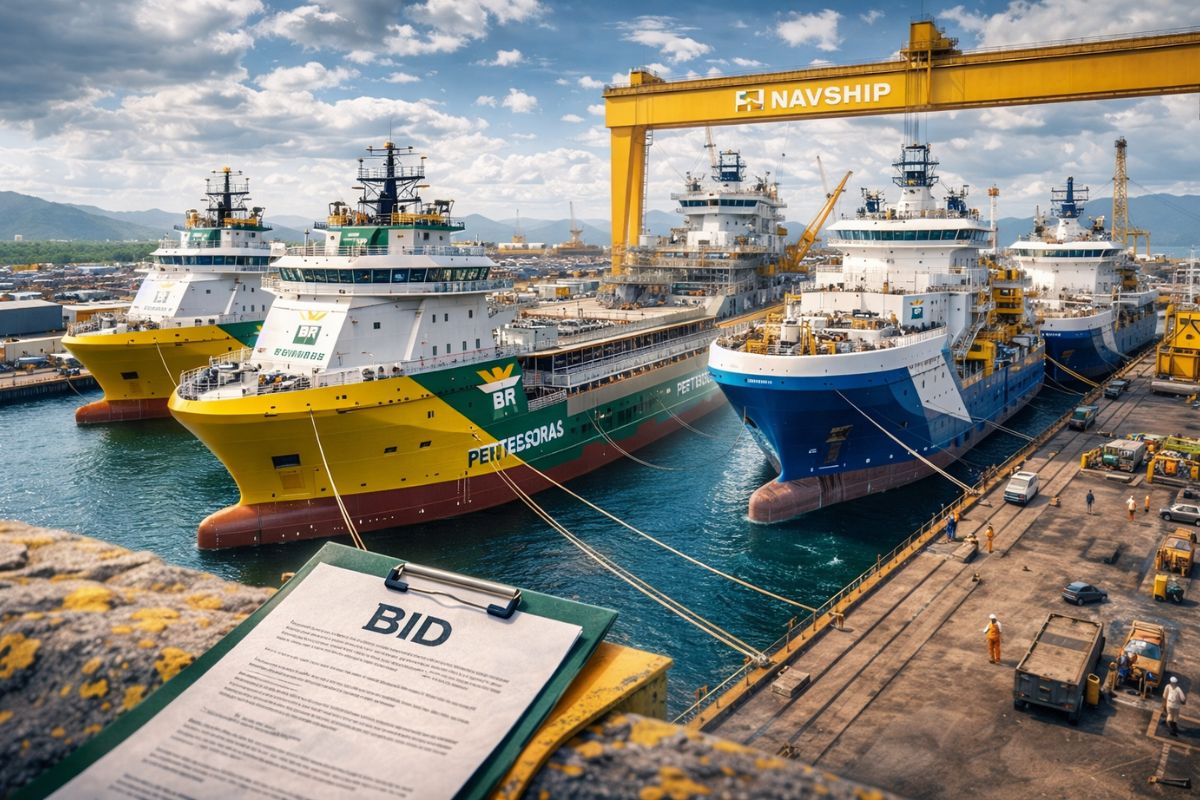

After the announcement of US$ 2 billion for six PSVs, the city of SC may receive four more RSV ships, with BID published and Navship indicated as the winner, but still awaiting release of resources
Petrobras is expected to take the next step in the offshore ordering cycle in Santa Catarina with plans to build four RSV ships in Navegantes, as reported by Mayor Ricardo Muniz in an interview with ND Mais on the 14th. The new point is that the contract has already appeared in BID with Navship as the winner, although it still depends on the release of resources to be signed.
This movement comes right after the announcement made at the beginning of the year when the state-owned company signaled an investment of US$ 2 billion for six PSV ships. Now, the local expectation is that the entry of RSV ships will take the city to a more complex stage of operation at sea, with a direct impact on jobs and the naval supply chain.
What changes with the RSV ships in relation to the PSVs
PSV ships are offshore support vessels aimed at transporting supplies, a kind of “supply line” for operations. RSVs, on the other hand, enter a more technical service level, focused on underwater work.
-
The U.S. Navy Conducts Submarine Tests in Idaho Lake to Detect Underwater Noises Hidden by the Ocean

-
Nuclear Submarine USS Alexandria Retired After 35 Years, Having Completed Over 1 Million Miles in Missions

-
MODEC Introduces New Hull Design for FPSO Gato do Mato to Produce Up to 120,000 Barrels of Oil Per Day in Brazil’s Pre-Salt Region
-
This Massive 12-Meter, 21-Ton Underwater Drone Can Operate Autonomously for Up to Five Days


In practice, it is the difference between carrying cargo and supporting operations that require technology to deal with the seabed, where inspections and repairs need specialized equipment and remote control.
Why RSV ships have become key pieces in operations at 4,000 meters
RSV ships are described as vessels equipped with advanced technology, such as mechanical arms, lights, and lenses, for handling and assembling underwater equipment. The base also points out that they operate with ROVs, underwater robots capable of working at depths of up to 4,000 meters.
This transforms the ship into a work base for tasks that would be impossible with direct human presence, such as inspections and repairs on pipelines and other structures on the seabed.
BID published, Navship cited as winner and the stage that is still missing
The mayor stated that the new contract for the four RSV ships has already been published in BID, with Navship indicated as the winning company. The shipyard in Navegantes would be responsible for building all the vessels.
At the same time, he emphasized that the contract has not yet been signed. The reason is simple: it depends on the release of resources, a stage that usually defines when the forecast turns into a work schedule and permanent hiring.
Who should operate the vessels and the link with Bram Offshore
According to the mayor, the operation of the vessels should be carried out by Bram Offshore, a subsidiary of the same parent company as Navship, the Edison Chouest Offshore Group, based in the United States.
This arrangement suggests a package that goes beyond just construction: it connects shipbuilding and operation within the same group, which tends to drive demand for professionals across different fronts, from the factory floor to logistics and technical support.
The city is already feeling the effect: job fair of 500 vacancies and pressure for labor

Even before the contract is signed, the sector is already showing signs of heating up. The mayor mentioned that Navship held a job fair with 500 jobs in the São Paulo neighborhood, indicating that the search for qualified labor is increasing.
When the offshore sector enters a cycle of orders, the impact quickly appears in job vacancies, training, and movement in the local economy, because the shipbuilding industry usually requires a large volume of people and long production stages.
How this movement reinforces the “naval vocation” of Navegantes
In the mayor’s assessment, the package of six PSV has already guaranteed a “lifeline” of about a decade for the shipyards in the region, within an investment cited at around R$ 2 billion. With the RSV ships, the interpretation is one of continuity and technological advancement in the project portfolio.
For Navegantes, the message is that the municipality is not just receiving orders, but consolidating a role in the construction of vessels linked to oil and gas, in a sector described as strategic and with global know-how.
In your opinion, is this possible new wave of RSV ships the type of project that consolidates a long-term naval hub or does it still leave the region too dependent on a few large contracts?