Portuguese
  Spanish


In the Jarfel Saara broadcast, founder Francisco Aguilar demonstrates the ideal soil, the holes that become columns and conduits, the thousand-count calculation, and the 50 square meter house built in up to 10 days
A simple machine, lever-operated, that transforms earth and cement into an interlocking brick every few seconds: this is the heart of the ecological brickworks. According to Jarfel Saara, in a broadcast published on August 29, 2020, the manual press demonstrated by founder Francisco Aguilar is portable enough to fit in the trunk of a small car, and the company from Mogi das Cruzes has been manufacturing the equipment since 1972, when the first units were produced.
The presentation has the tone of someone who has seen the trend emerge twice. The unburnt brick, pressed and cured with water, became a trend decades after the factory created the machines, and today the system operates in Brazil and other countries, as Jarfel Saara states. The video is practically a course: soil, mix, operation, curing, and even the house construction.
From 1972 to the current trend: half a century of ecological brickworks
The longevity of the system is the first argument of the broadcast. The factory has spanned decades when the pressed brick was a curiosity at construction fairs, saw traditional brickworks close one by one, and reached the era of sustainability with the right product on the shelf: a brick that doesn’t burn trees, doesn’t emit smoke, and cures with water.
-
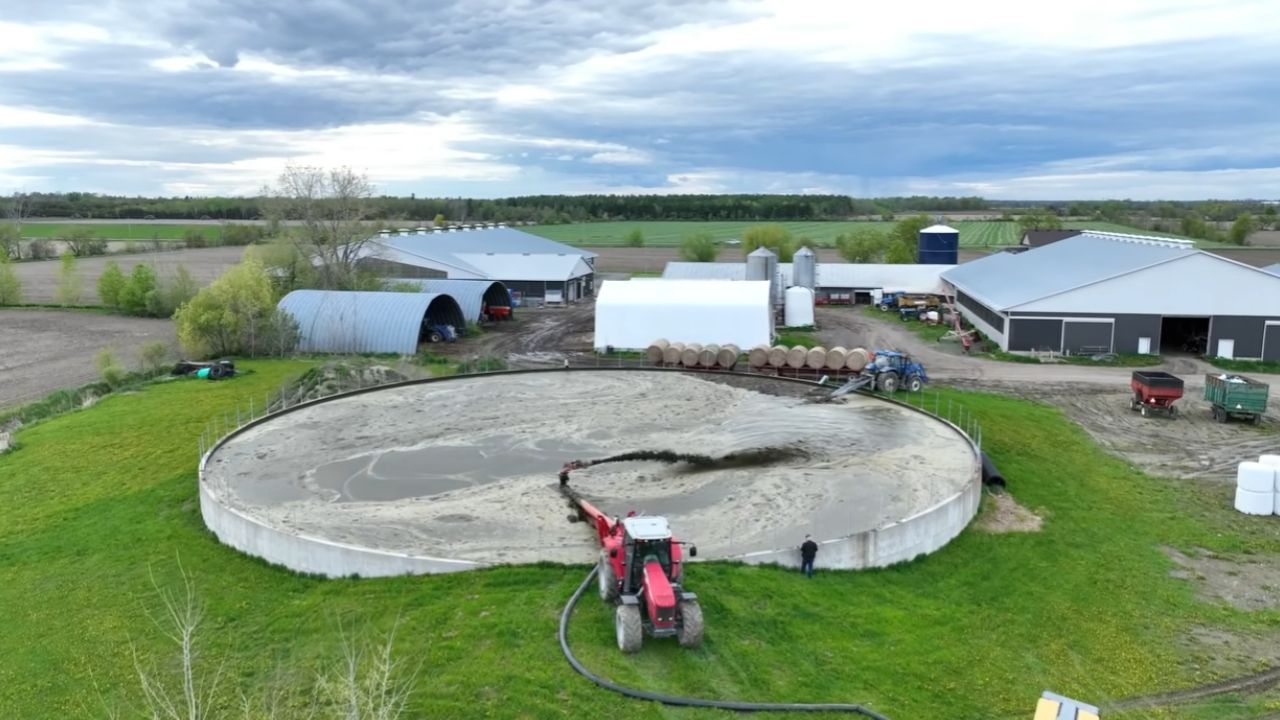
Dairy Farm Prevents Manure Lagoon Overflow with High-Powered Tractors and Industrial Pumps, Turning 100,000 Gallons of Waste into Fertilizer

-
Masked Man Claims to Have Traveled to 2118, Predicts World War Starting with North Korea and Reveals Secret CIA Technology

-
At 54, Brazilian Artisan Turns Textile Waste into a Successful Handbag Brand, Earning Over $6,000 Monthly

-
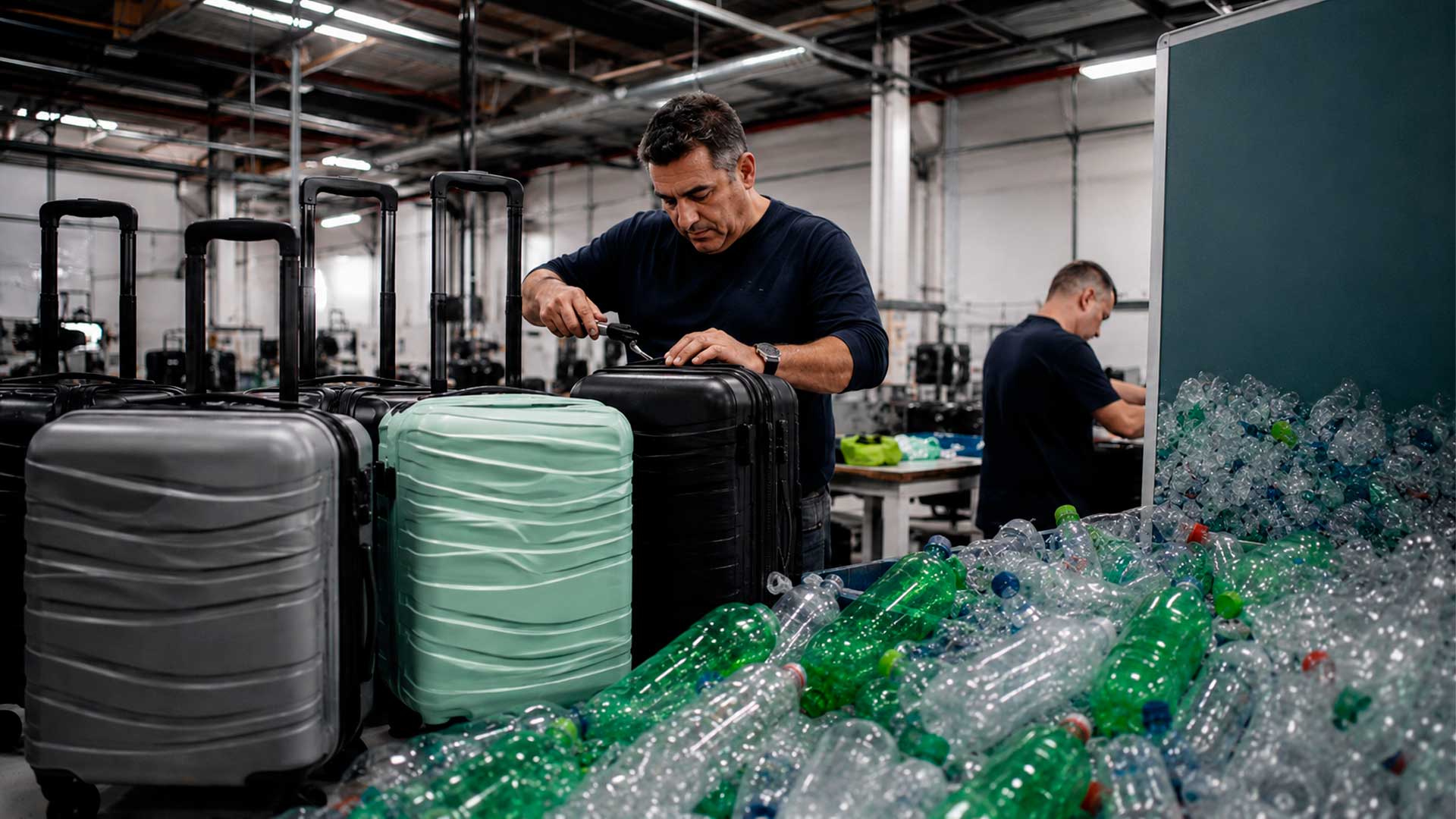
Brazilian Entrepreneur Sells $50,000 Monthly in Sustainable Luggage Made from Recycled Bottles, Eyes International Market


The founder uses the history to dispel the skepticism of newcomers. The technology is not a new bet; it is a system with half a century of adjustments, used by clients throughout the country and exported, as the Jarfel Saara channel on YouTube records in its broadcasts. The novelty, the presentation ironically notes, is that the world has finally caught up with the idea.
How the manual press works: lever, drawer, and body weight
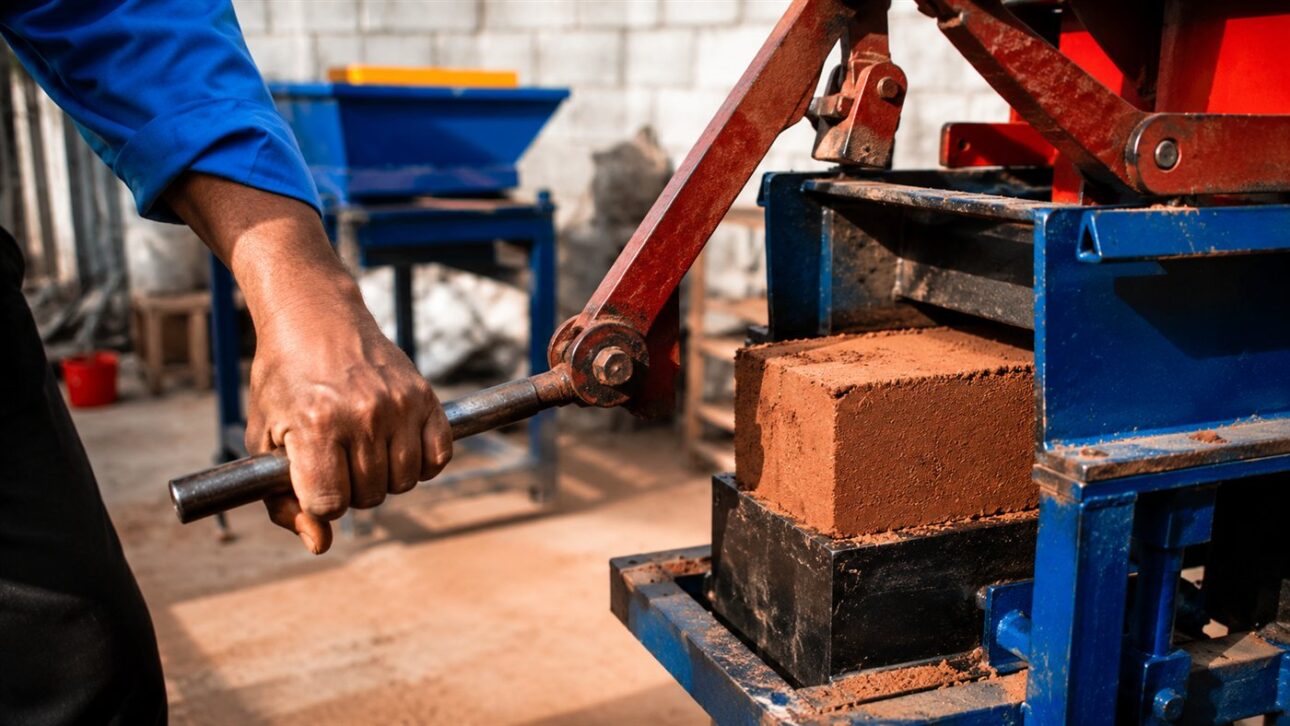
The engineering of the machine is a collection of simple solutions. According to Jarfel Saara, the mixture of soil and cement descends by gravity from the silo to the chamber, a drawer controls the exact dose of material, a back screw regulates the thickness, and the movable lever multiplies the force: the operator’s effort is basically to support the body’s weight, around 30 kilograms.
The detail that ensures the standard is in the stopper. Every time the piston touches the limit, the brick comes out with the same thickness, whether it’s the first or the ten-thousandth, as Jarfel Saara demonstrates. The press returns to the soil the compaction it had on the slope, expelling the air from the excavated soil, and the cement does the rest: the result, in the words of the founder, is a brick up to 3 times stronger than the traditional one, depending on the cement dose.
The holes in the brick: column, conduit, and breathing wall
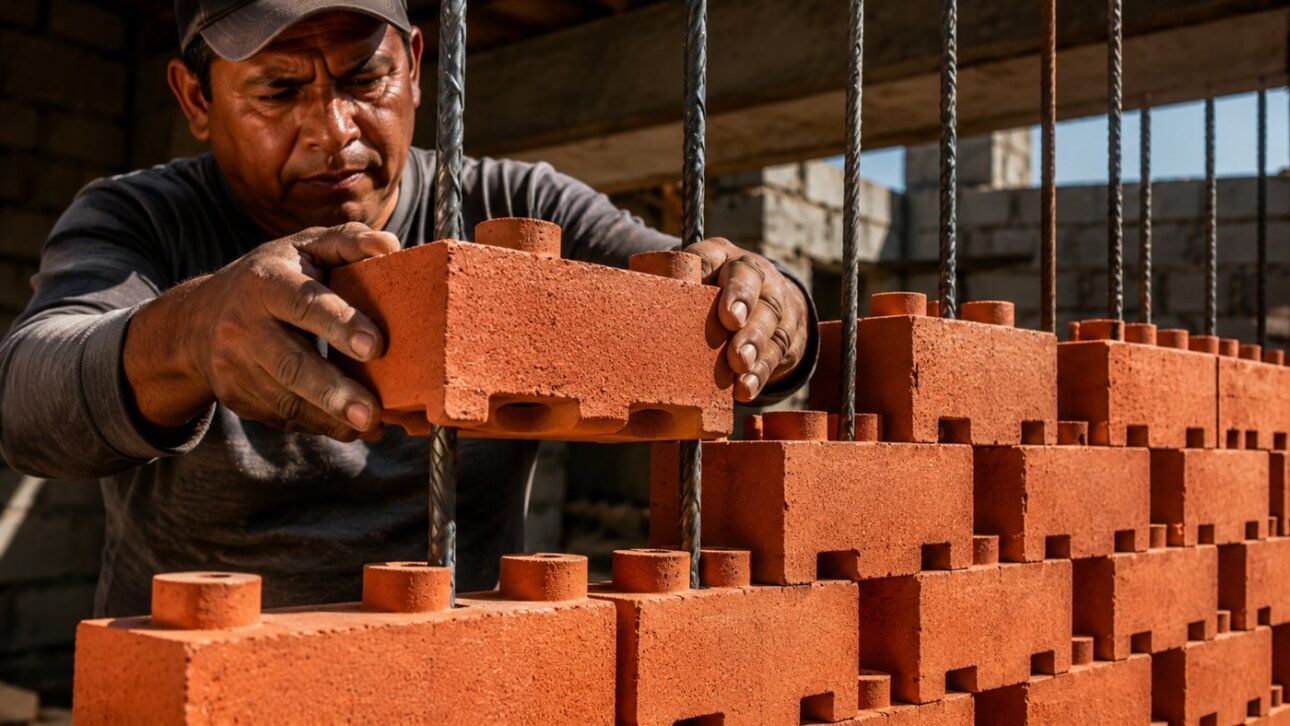
The two holes in the modular brick are the most underestimated trick of the system. According to Jarfel Saara, besides saving material and weight, the aligned holes form vertical channels that receive a rebar and concrete, creating a microcolumn every meter of wall, without woodwork, without formwork, and without a carpenter.
The other functions come as a bonus. The same hole serves as a fireproof ceramic conduit for electrical wiring, which works ventilated and heats less, and the air column that rises from the foundation to the slab carries moisture out of the wall, as Jarfel Saara explains. A dry wall does not create mold, fungi, or mites, and the founder turns this into a health argument: a well-ventilated house makes its inhabitants less sick.
50 square meter house in 20 days, or 10 for those who know
The labor cost is the field where the system excels. According to Jarfel Saara, a standard team of a bricklayer at R$ 150 per day and two helpers at R$ 75 each costs R$ 300 daily, and a 50 square meter house, with two bedrooms, takes about 100 days with the conventional method: R$ 30,000 just for labor.
In the modular system, the schedule collapses. The same team delivers the house in 20 days, for R$ 6,000, and in practice, it can be done in 10 days if you know how to work, according to Jarfel Saara, based on the training that comes with the machine. The secret is the block-type interlock, combined with the embedded structure: a small rebar every meter and a channel forming a belt every meter of height, creating a monoblock that, in the words of the founder, may crack in a shake, but does not fall.
The thousand-brick account opened in the broadcast
The video opens the production spreadsheet with numbers from the factory itself. According to Jarfel Saara, 1,000 bricks consume 2 to 2.5 cubic meters of soil; in the founder’s example, a licensed truckload of soil brought from 100 km costs R$ 2,000 and yields 10 thousand bricks, meaning R$ 200 of soil per thousand bricks; the 8 bags of cement, one extra to ensure quality, cost R$ 240; and the labor of 3 helpers at R$ 70 producing 2,000 pieces per day adds R$ 105.
The total aligns with the market price at the time. The thousand bricks cost about R$ 545 to produce and were sold at the national average of R$ 1,000, a margin close to 100%, as calculated by Jarfel Saara, noting that a 50 square meter house consumes around 10,000 bricks. The values are from 2020 and serve as a reasoning structure, not as a current quote.
No good soil? Sand, stone dust, and phyllite
The ideal soil rule is the same that the company has taught for decades: 70% sand for strength, 30% clay for bonding, with simple corrections when the proportion is off. According to Jarfel Saara, soil with too much clay receives fine sand in the mix, soil with too little bonding receives crushed clay, and the company analyzes the soil sample sent by the client to the headquarters on the Mogi-Bertioga highway for free.
For those who don’t have suitable soil, there is the mineral plan B. Fine sand or stone dust gain bonding with phyllite, in a mix of 7 parts sand, 3 parts phyllite, and 1 part cement, which also saves cement compared to the soil mix, as demonstrated by Jarfel Saara in tests recorded in the factory’s own laboratory. Phyllite, presented as a direct substitute for lime, cost around R$ 4 to R$ 5 per bag, and consumption is about 40 bags per thousand bricks.
The factory on site: the case of the engineer from Anápolis
The portability of the press changes the entire construction site’s logistics. According to Jarfel Saara, engineer Rodrigo Braga, a client of the company in Anápolis, set up production within the site itself, under a mobile tent that follows the construction: one person does the pre-mixing, one operates the machine, and one stacks the bricks already near the rooms where they will be used.
The gains appear in two columns. Without freight and with daily quality monitoring, the brick costs less than half the price of the traditional market, with samples sent to a laboratory for breakage testing, as shown by Jarfel Saara in the recorded testimony at the site. Even the moisture of the mix has a veteran’s trick: a can covering the pile so the mass does not dry between pressings.
The hydraulic sister: the machine that moves with a finger
For those who want scale, the factory presents the motorized version. According to Jarfel Saara, the HM hydraulic press moves on casters with the push of a finger, works with an electric motor and joystick, compacts more than the manual one, and accepts a converter to operate on a single-phase network for an additional R$ 500.
The necessary space remains domestic. A garage that fits 3 cars is enough to house the factory, and the molds that come with the machine produce dozens of models of parts, as Jarfel Saara lists: whole brick, half brick, solid, continuous and interrupted channels, and the blocks that create lateral outlets for electrical and plumbing. Training at the headquarters accompanies the purchase, and the founder treats it as an obligation: those who refuse the course sign a term assuming the risks of improvisation.
The care that separates the good brick from the problem
The broadcast dedicates an entire block to the mistakes that ruin production. According to Jarfel Saara, the manual press needs cleaning every 5 to 10 bricks, with a soft brush or air gun; the freshly pressed brick cannot be wetted in the first 24 hours; and the curing stack must be covered with plastic, because wind is the number one enemy of curing, taking away the moisture that cement needs.
The handling of the piece also has etiquette. Bricks are picked up by the ends, without squeezing, and broken pieces go back to the pile, are crushed, and reused immediately, without waste, as Jarfel Saara teaches in the tests. The founder’s final rule serves as a summary of the system: there is no bad soil, there is poorly prepared soil, and there is no weak brick, there is a wrong mix.
Watch the complete demonstration
The broadcast shows the manual press in operation, the tests with sand, stone dust, and phyllite, the count of the thousand, and the factory’s line of machines.


The manual press from the Mogi das Cruzes factory is proof that construction technology doesn’t need a screen or software: it needs a well-calculated lever, the right mix, and half a century of fine-tuning. Tell us in the comments: have you ever seen an ecological brick press working up close?