Portuguese
  Spanish


Drones, robots, and intelligent machines change the routine of reforestation in the Mu Us desert, where China tests new ways to contain dunes, transport seedlings, and accelerate actions against desertification.
Drones used to transport seedlings and intelligent machines capable of planting trees in a few seconds have become part of reforestation actions on the edge of the Mu Us desert in northern China.
The initiative takes place in the Inner Mongolia Autonomous Region, in an area considered strategic for China’s efforts to control desertification and reduce sandstorms.
The work combines aerial transportation of seedlings, mechanical opening of furrows, and automated planting in sandy terrains.
-
Researchers Use Algae to Enhance 3D-Printed Walls, Boosting Strength by 25% and Speeding Construction by 33%

-
Drill Uncovers Freshwater Rivers Hidden Beneath the Ocean Floor

-
3,000-Ton, 81-Meter Attack Submarine Begins Sea Trials, Equipped with Heavy Torpedoes and Anti-Ship Missiles

-
Boat Made from 10 Tons of Plastic and 30,000 Discarded Flip-Flops Sails Along African Coast, Serving as a Floating Classroom on Ocean Pollution



According to Gao Fei, an employee of Jintaiming Technology Group, a company based in Inner Mongolia, “it takes only five seconds for these robots to plant a seedling in the desert.”
The technology was employed in Otog Banner, one of the areas included in the Three-North Shelter Forest Program, an initiative launched by China in 1978 to curb desertification in regions of the north, northeast, and northwest of the country.
The program is internationally known as the “Chinese Green Great Wall”.
The Mu Us region has environmental and economic importance due to its proximity to the irrigated areas of the Hetao section on the Yellow River.
The river, the second longest in China, runs over 840 kilometers through Inner Mongolia and supports agricultural activities in areas vulnerable to the advance of sand.
How the robots that plant trees in the desert work
The machines used in the project are second-generation intelligent equipment developed to perform successive stages of planting.
They drill and loosen the soil with spiral drills, insert the seedling, irrigate the roots, cover the base with sand, and compact the terrain around the plant.
This process automates tasks that, in conventional planting, require sequential manual work.
In desert or semi-desert areas, performing these steps is often hindered by wind, heat, unstable soil, and large distances between planting points.
According to Gao Fei, four machines were used in the testing phase in the program area.
Mass production of the equipment had not yet been fully initiated when the project was announced.
The company claims to hold intellectual property rights over the technology.
The equipment combines spiral soil drilling, unmanned operation, and artificial intelligence features.
According to the company, the goal is to enable large-scale planting with less reliance on direct human labor in dune areas.
The company also reported that it is developing other intelligent machines for different planting scenarios.
The adaptation of the equipment is relevant because degraded areas can present variations in soil, slope, moisture, and type of vegetation suitable for recovery.
Drones transport seedlings in hard-to-reach areas
In addition to the robots responsible for planting, the program uses drones to transport seedlings over large stretches of sand.
In the Otog Banner area, 20 drones were employed in this stage of the operation.
The use of aerial equipment aims to reduce ground travel in areas where vehicle access may be limited.
In dunes and loose sand terrains, the transport of seedlings and other supplies usually requires more time and logistical planning.
With the drones, the seedlings can be taken to planting points distributed over wide areas.
The machines then open the furrows and place the plants in the soil.
This division of tasks creates a workflow where transport and planting occur with the support of automated equipment.
According to Gao Fei, an intelligent machine can perform in one day a volume of work equivalent to ten workers.
He also stated that the operational cost of the equipment is about 30% of the cost of human labor, according to company estimates.
These figures were presented by the company responsible for the technology and do not replace independent evaluations of cost, productivity, or performance under different environmental conditions.
Why the Mu Us Desert concerns Chinese authorities
Inner Mongolia has identified about 15 million hectares of desertified land distributed across areas managed by seven cities.
These regions are pointed out by local authorities as sources and routes of sandstorms that can reach the Beijing-Tianjin-Hebei axis.
The containment of desertification, in this context, is linked to the protection of agricultural areas, food security, and the preservation of the Yellow River basin.
The advance of sand can affect crops, infrastructure, and air quality in regions far from the dunes themselves.
In Otog Banner, the target announced for the program stage is to plant trees in 3,333 hectares of sandy lands.
According to Yan Wei, local director of the Three-North Shelter Forest Program in Ordos, about 60% of the work must rely on support from different types of machines.
Mechanization does not eliminate the need for environmental planning.
Projects of this type depend on the choice of suitable species, soil preparation, water availability, and monitoring of seedlings after planting.
Resistant species are used in the recovery of arid areas
One of the species mentioned in the project is a drought-resistant willow identified in Chinese sources as salix mongolia.
According to Gao Fei, the seedlings planted by machines showed a higher survival rate than those planted manually.
The exact survival rate, however, was not provided in the consulted sources.
For this reason, the data should be attributed to the company and treated as a statement from the technical manager, not as an independently available public measurement.
The choice of resistant species is one of the central points in arid area restoration programs.
Planting in regions with low water availability requires plants adapted to strong winds, soil poor in organic matter, and intense temperature variations.
In actions against desertification, the survival of seedlings depends on factors beyond the moment of planting.
Correct depth, protection against sand displacement, initial irrigation, and land maintenance influence the outcome over time.
China’s Green Great Wall against desertification
The Three-North Shelter Forest Program was created to establish vegetative barriers in regions affected by desertification.
The initiative began in 1978 and is expected to continue until 2050, according to institutional records and international organizations monitoring the issue.
Over the past decades, the program has mobilized techniques for dune stabilization, tree and shrub planting, degraded area management, and community actions.
One of the most used techniques is the installation of grids made with wheat straw on the sand.
These grids reduce the direct action of the wind on the soil and help stabilize the surface before planting.
With the sand less mobile, seedlings and shrubs have better initial conditions to root.
In recent years, automated equipment has started to appear in new stages of the program.
The presence of drones and robots in Mu Us indicates the incorporation of transportation, navigation, and planting technologies in areas previously served mainly by manual labor and conventional machinery.
Renewable Energy and Environmental Control in Desert Regions
Ma Qiang, deputy director of the regional administration of forests and grasslands of Inner Mongolia, stated that the prevention and control of desertification need to go beyond administrative boundaries.
According to him, these actions should be integrated with energy initiatives, such as wind and solar projects in desert regions.
The statement reflects a guideline adopted by local authorities, who seek to combine environmental recovery and economic use of arid areas.
In regions with high incidence of sun and wind, renewable energy projects can share space with soil protection measures, provided they undergo environmental planning.
Experts in ecological restoration often point out that reforestation projects in arid zones require prolonged monitoring.
Among the evaluated points are plant survival, water consumption, species suitability, and the real effect on sand displacement.
In the case of Mu Us, the disclosed data indicate a stage of technological application within a broader program to combat desertification.
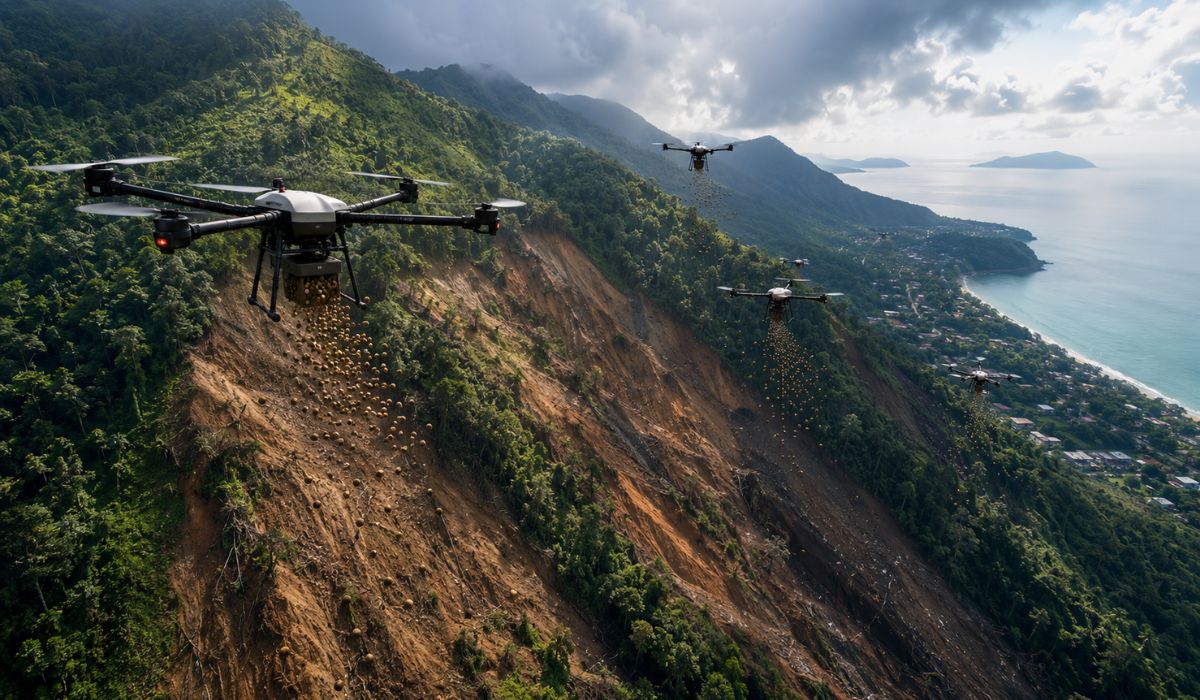
Robots do the planting, drones transport seedlings, and technical teams monitor the operation.
Automation, in this scenario, appears as a tool to expand the scale of work in hard-to-reach areas.
Environmental effectiveness, however, depends on results measured over time, especially regarding seedling survival and soil stabilization.