Portuguese
  Spanish


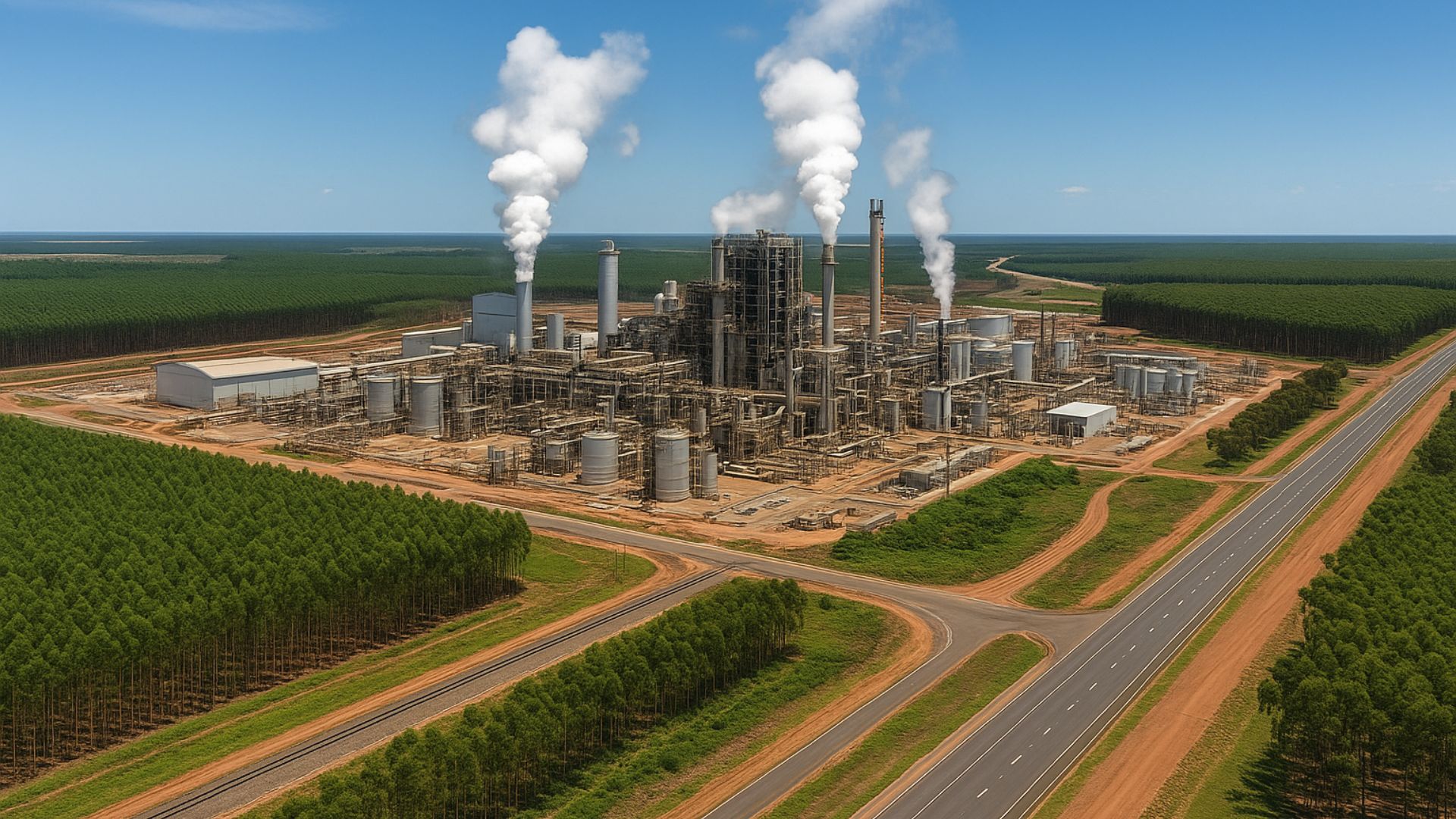

Billion-Dollar Megafactory Transforms Small Town into Global Hub for Pulp and Renewable Energy, Accelerates Regional Economy, and Redefines Brazilian Industrial Production.
Ribas do Rio Pardo, in Mato Grosso do Sul, has quickly transformed from a discreet town on the Brazilian map to a strategic point for the global pulp industry.
With approximately 24,152 residents, the municipality is now home to a megafactory operated by Suzano, resulting from a total investment exceeding R$ 22 billion and designed to produce 2.55 million tons of pulp per year on a single industrial line, a level already effectively reached in less than a year of full operation.
Economic Expansion and Job Creation
The facility is part of the Cerrado Project, considered the largest undertaking in Suzano’s history and one of the largest recent private initiatives in the country.
-
Brazilian Startup Turns Coffee Grounds into Plant-Based Leather, Cutting Water Use by Over 50 Times for High-Impact Sustainable Fashion

-
Eco Invest Auction Aims to Unlock $10 Billion in Investments, Focusing on Green Fertilizers, Critical Minerals, Batteries, and AI for Clean Industry in Brazil

-
Half of Brazilians Prefer Lower Taxes with Private Health and Education, While 44% Opt for Higher Taxes for State-Provided Services, Datafolha Survey Reveals

-
Brazil’s Most Expensive Toll Rises to R$ 40.60 on Route from São Paulo to the Coast, Nearly Matching Bus Fare to Santos




With the factory’s launch, the company’s market pulp production capacity increased by about 20%, rising to approximately 13.5 million tons annually, further consolidating the company’s position among the leading global players in the sector.
The advancement is not limited to industrial scale.

The municipality has experienced an unprecedented economic leap since the announcement of the factory’s installation in 2021.
The construction required around 30 months of work and, at its peak, mobilized over 10,000 workers, including direct employees and contractors.
During this period, the influx of people and resources boosted commerce, stimulated the opening of new businesses, and propelled the local real estate market.
With the start of industrial operations, the workforce stabilized at approximately 3,000 jobs directly related to the forest, industrial, and logistics activities of the facility.
These formal jobs, along with the supply chain and services that revolve around the factory, now sustain a significant portion of the recent economic activity in the city and region.
Industrial Technology and Innovation in Production
The industrial complex operates with technology provided by ANDRITZ, responsible for supplying the main process islands, from wood preparation to chemical recovery.
The plant features gasification systems, chemical recovery, high-capacity fiber lines, pulp drying, and power boilers designed to operate with high energy efficiency.
The operation is supported by advanced layers of automation, intensive data use, and robotics in specific stages, reducing operational variables and enhancing process stability.
Among the technological differentiators is the SulfoLoop sulfuric acid plant, which allows the factory to be self-sufficient in this critical input.

The unit produces commercially-grade acid from concentrated odorous gases and elemental sulfur, closing the sulfur cycle within the plant itself.
This arrangement reduces the need for road transport of hazardous products, lowers logistics costs associated with the input, and contributes to stricter control of atmospheric emissions linked to the process.
Optimized Logistics and Strategic Forest Base
The forest base supplying the unit was designed to reduce distances and transport emissions.
The project operates with an average radius of about 65 kilometers between eucalyptus plantations and the industry, the shortest among the company’s factories.
This effectively shortens the truck routes for wood, lowers fuel consumption, optimizes the refuelling time for the production line, and helps diminish the environmental impact associated with logistics.
Renewable Energy and National Impact
Another pillar of operations in Ribas do Rio Pardo is energy.
The factory was designed to be self-sufficient in renewable generation, utilizing biomass and waste from the industrial process.
The surplus of approximately 180 megawatts (MW) average is directed to the national electricity grid and, in terms of scale, would be sufficient to supply a city with over 2 million residents.
This volume of clean energy enhances the project’s significance in the Brazilian renewable matrix and creates an additional revenue source for the complex.
Global Influence and Changes in the Municipality

The combination of greater forest productivity, shortened logistics, advanced chemical recovery, and digital integration of equipment was designed to maintain production costs at a competitive level compared to other major global pulp producers.
The speed with which the unit reached its nominal capacity, in less than a year after the ramp-up phase, has begun to be cited by industry entities and the technology provider itself as a new performance benchmark for plants of this scale.
Locally, the effects are visible in the pace of urbanization in the municipality.
The influx of new residents in search of work, the expansion of services, and the establishment of companies supporting the pulp chain have changed the daily life of a city previously focused on smaller-scale activities.
State and municipal authorities view the project as a landmark in consolidating Mato Grosso do Sul as a pulp hub, in a movement that includes other industrial units in the state and reinforces the region’s image as a corridor for exporting forest products.
From the perspective of the international market, the megafactory places Ribas do Rio Pardo on a direct route to major pulp-consuming centers abroad.
Production is primarily targeted at the external market, integrating global chains of paper, packaging, and other bioproducts derived from eucalyptus.
With the new facility operating at maximum capacity, the municipality has begun to frequently appear in reports, corporate communications, and analyses by consultancies that monitor global supply and prices of the raw material.