Portuguese
  Spanish




Egg Consumption in Brazil Is Expected to Reach 288 Units per Inhabitant in 2025, Placing the Country Among the Largest Consumers in the World. Check ABPA’s Data and See How Domestic Production Is Going.
The egg consumption in Brazil has never been higher. According to estimates from the Brazilian Animal Protein Association (ABPA), each Brazilian is expected to consume an average of 288 units in 2025.
This result represents a growth of 7.1% compared to the previous year and, for the first time, places the country in the group of the 10 largest egg consumers in the world.

For Ricardo Santin, president of ABPA, this trend shows the strength of the product as a food security item.
-
In Rural Brazil, José Sirval Operates a Water-Powered Mill Grinding 125 Kilograms of Corn Daily Using His Great-Grandfather’s Century-Old Monjolo

-
From Market Stall to Agribusiness: Patagonian Fruit Grower Owns 550 Hectares and Processes 18 Million Kilos of Pears and Apples Annually, Exporting Directly to Brazil
-
At 93, Brazilian Farmer Restores 56 Hectares of Forest and Revives Spring in the Amazon, Installs First Climate Tower in the Region
-
Brazilian Cheesemaker Wins European Award for Ant-Infused Cheese with Nutty Flavor Inspired by Indigenous Tradition


He believes that the pace of growth is expected to continue in 2026, further reinforcing the presence of protein on the Brazilian table.
Global Egg Consumption Ranking
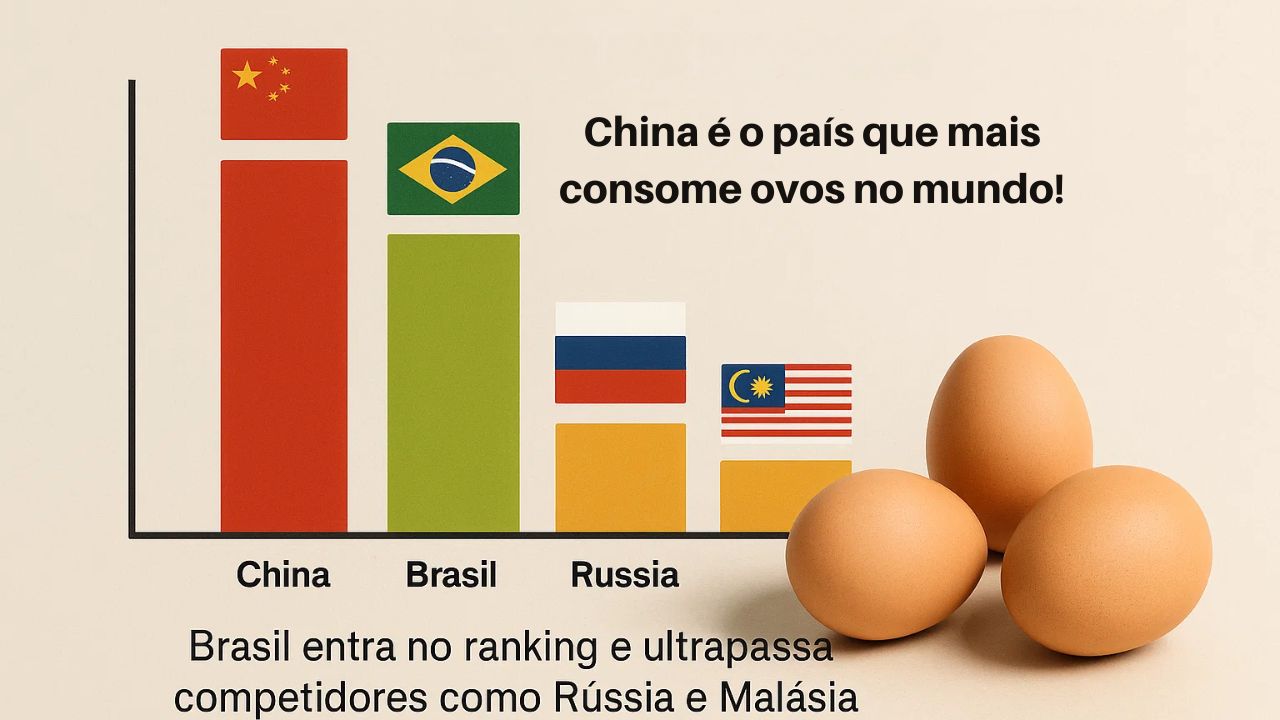
With the significant increase, Brazil is expected to reach the seventh position in the global ranking. China leads with an average of 385 units per inhabitant per year.
Next are Mexico, with 363, and Indonesia, with 340. Japan occupies the fourth position, followed by Argentina and Paraguay. Brazil ranks ahead of Russia, Malaysia, and Ukraine.
Projection for 2025 according to ABPA, regarding units per inhabitant:
- China – 385 units per inhabitant
- Mexico – 363 units
- Indonesia – 340 units
- Japan – 337 units
- Argentina – 332 units
- Paraguay – 298 units
- Brazil – 288 units
- Russia – 288 units
- Malaysia – 281 units
- Ukraine – 260 units
Progress Compared to Recent Years
Brazilian consumption has not always been so significant. Between 2014 and 2017, the per capita average did not exceed 190 units per year.
The growth gained momentum starting in 2018, when the number surpassed 200 units and continued to rise steadily to reach the current level.
Domestic Production Keeps Up with Demand
In addition to the rise in consumption, egg production is also noteworthy.
In 2025, the expectation is for 62 billion units, which corresponds to an impressive average of 2,000 eggs produced per second.
The anticipated growth for this year is 7.5%, and the trend is expected to continue into 2026, when production should reach 65 billion, an increase of 4.8%.