Portuguese
  Spanish



Vale Will Begin Operation of Ship Equipped with Modern Rotating Sails. The Idea Is to Save and Also Help the Environment
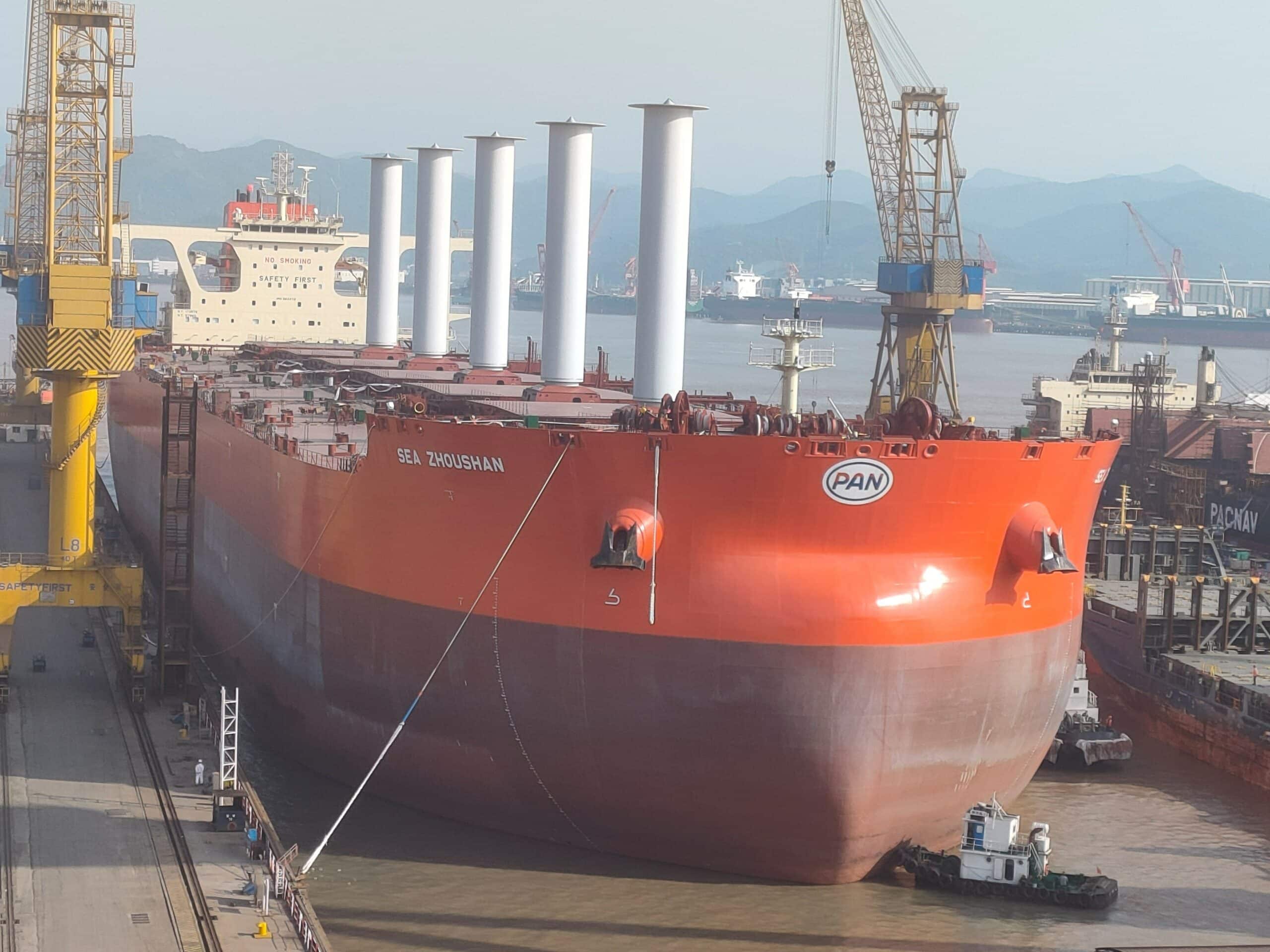
Vale has an exciting news in the maritime sector. The company announced that the first ship Guaibamax, which is equipped with a system of rotating sails, the famous rotor sails, will begin its operations soon. The project aims to increase the efficiency of its fleet and help the environment by contributing to lower carbon emissions.
The company announced that the ship VLOC (Very Large Ore Carrier) is a Guaibamax, which has a capacity of 325,000 tons. The vessel seeks more efficiency and, consequently, has a total of five sails installed along the ship. This will enable an efficiency gain of up to 8%, as well as a reduction of 3.4 tons of CO2 in the atmosphere over the course of a year of operation.
What Are Rotating Sails?
The rotating sails used on Vale’s ship are cylindrical rotors, with a diameter of 4 meters and 24 meters in height. The rotors spin at different speeds when in operation. This creates a pressure difference to move the ship.
-
Eni Acquires 25% Stake in Chilean Lithium Project, Plans to Invest Up to $225 Million in Eco-Friendly Extraction Method

-
French Brand Transforms 6 Million Brazilian PET Bottles into Sustainable Sneakers for Global Fashion Market
-
Abandoned Factory in Rio’s North Zone Becomes Urban Hazard with Standing Water and Debris

-
The U.S. Navy Conducts Submarine Tests in Idaho Lake to Detect Underwater Noises Hidden by the Ocean


The installation of the technology, which was supplied by Finnish manufacturer Norsepower, is a major project for Vale, in partnership with the Korean shipowner Pan Corean. Watch the video below explaining the concept:


“Our naval engineering team has been studying the use of wind propulsion technology for our business since 2016. With the Ecoshipping program, we developed several cooperative partnerships with ITV (Instituto Tecnológico Vale), universities, and laboratories in Brazil and Europe,” emphasizes Rodrigo Bermelho, Vale’s naval engineering manager.
Vale Seeks More Efficiency
Additionally, Vale has been working to increasingly adopt the use of alternative fuels to enhance its efficiency and reduce environmental impacts. Dozens of second-generation VLOCs have been designed for the future installation of a liquefied natural gas system.
The start of operations of the first ship equipped with rotating sails is part of Vale’s program called Ecoshipping. The program aims to reduce carbon emissions. Last year, Vale announced a $2 billion investment to achieve a 33% reduction in its carbon emissions by 2030.