Portuguese
  Spanish


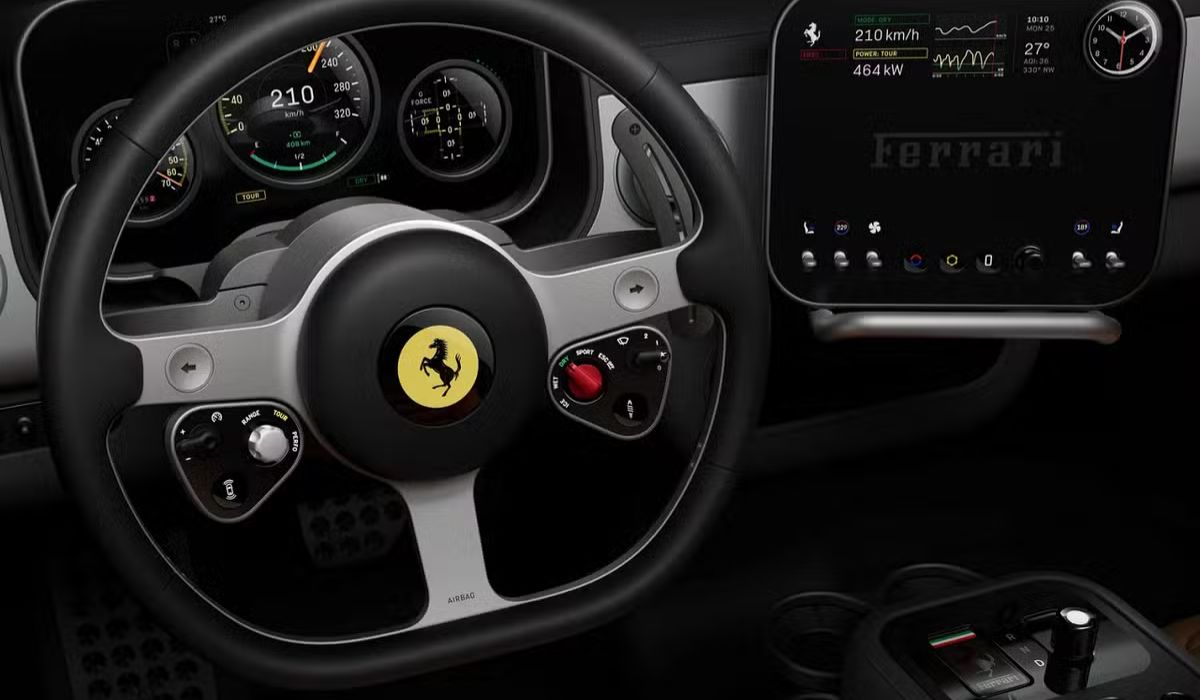


Ferrari Reveals Name of First Electric Car, Previews Interior and Reinforces Technical Data of the Model that Marks a New Phase for the Brand, Maintaining Focus on Performance, Identity, and In-House Production While Delaying Complete Presentation of the Exterior Design.
Ferrari has confirmed that its first fully electric car will be called Luce.
The brand has released new teasers featuring snippets of the interior, along with reinforcing technical information already presented previously.
The model marks the Italian manufacturer’s debut in the 100% electric vehicle segment.
-
Sales of Brazil’s Cheapest Electric Car Halted Before First Deliveries: E-Motors Suspends Emova Easy Due to Import Tax Increase and Rising Freight Costs

-
Nissan Discontinues Qashqai SUV Amid Cost-Cutting, Chinese Competition, and Product Line Review

-
BYD Patents Revolutionary System Using Computer Vision to Detect Animals Under Cars Before Starting, Preventing Tragedies

-
Study Reveals Why Cars Are More Expensive to Produce and Buy in Brazil Compared to Mexico, Highlighting Taxes, Logistics, and Industrial Costs as Key Factors.


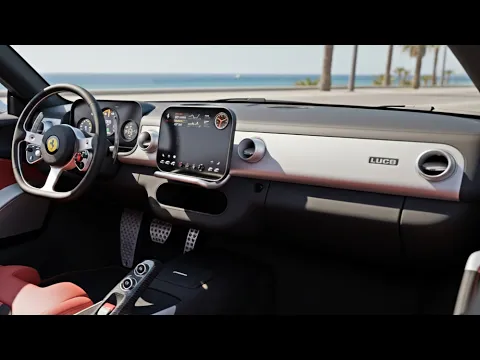
The name was revealed alongside the first official images of the cabin.
The complete exterior design remains under wraps for a future presentation.
The name change puts an end, at least for now, to the use of the name “Elettrica,” which had been associated with the project since the first announcements.
According to Ferrari itself, the Luce will feature a sound system developed to amplify real vibrations from the electric powertrain, rather than relying solely on artificial sounds.
The strategy, according to the company, aims to preserve sensory characteristics associated with driving its sports cars, even in a battery-powered vehicle.
Ferrari Luce Name and Brand Electrification Strategy
According to information from the portal Autoesporte, the name Luce, which means “light” in Italian, was announced alongside the first visual package of the car, focused on seats, steering wheel, instruments, and controls.
At the same time, Ferrari stated that the exterior will be revealed only at a later stage, expected to take place at a specific event later this year.
Until then, the brand keeps the final lines of the bodywork under wraps.
While presenting its first pure electric car, Ferrari has reiterated that it does not intend to abandon combustion engines and hybrid systems in the short term.

In recent communications, the company indicated that its strategy for the coming years envisions the coexistence of different technologies.
The share of electric vehicles will be lower than originally projected in plans released at the beginning of the decade.
Interior of the Ferrari Luce and Collaboration with LoveFrom
The interior of the Luce was developed in collaboration with LoveFrom, the creative collective founded by Jony Ive and Marc Newson.
This information was confirmed by Ferrari in the teaser releases.
Ive is known for his design work at Apple.
His involvement in the project is associated with a cabin that prioritizes visual simplicity and the use of physical controls, according to the brand’s official description.
Instead of centralizing all functions on large touchscreens, the stated proposal for the Luce is to maintain a more direct interaction between driver and vehicle.
Materials such as recycled aluminum and special glasses were highlighted by Ferrari as part of the interior’s composition.
The intention is to reinforce durability and tactile sensation of the controls.
The disclosed information also mentions the presence of three displays on board.
The set includes the driver’s instrument panel, integrated into the steering column, with overlapping OLED screens.
There are also additional control modules.
A glass key with E-Ink technology was cited as part of the vehicle activation process and the user experience proposed for the model.
Internal Production and Development of the Electric Platform
In the industrial field, Ferrari has emphasized that components considered central to the Luce were developed and produced internally.
The company mentioned the structure known as “e-building” as the basis for this process.
The space combines the manufacture of high-voltage batteries, inverters, and electric axles under the direct responsibility of the brand.
This positioning aligns with Ferrari’s strategy of presenting the Luce not just as a transitional product.
The model is described as having its own identity within the portfolio.
In previous communications, the manufacturer stated that the electric car was designed to offer performance levels consistent with the historical standards of the company.
This happens despite the completely different architecture from combustion models.
Four Electric Motors and Over 1,000 HP
The mechanical architecture of the Luce consists of four permanent magnet electric motors, two on each axle.
Ferrari stated that the setup has a technical relation to solutions developed for Formula 1.
The combined power exceeds 1,000 hp, a number disclosed by the brand in institutional presentations.
According to data circulated by the specialized press, the model is expected to accelerate from 0 to 100 km/h in approximately 2.5 seconds.
The top speed exceeds 310 km/h. The power distribution favors the rear axle.
This axle accounts for most of the total force. The front motors act as a complement.
There is a possibility of decoupling under certain usage conditions.
The package also includes advanced torque management and dynamic control systems, with individual wheel power distribution.

Ferrari associates these solutions with the quest for stability and predictability of behavior.
These characteristics are deemed essential for a high-performance GT within the Luce’s concept.
Ferrari Luce Battery, Fast Charging, and Range
The Luce uses a battery integrated into the vehicle’s floor.
According to the manufacturer, this solution helps to lower the center of gravity by about 80 millimeters compared to a combustion-equivalent model.
The stated capacity is 122 kWh.
The energy density is close to 195 Wh/kg.
The disclosed specifications also indicate support for fast charging in direct current of up to 350 kW.
This is made possible by a high-voltage electrical architecture.
The estimated range exceeds 530 kilometers, according to projections presented by Ferrari itself.
The data has not yet been certified by official consumption cycles.
Sound System and Acoustic Identity of the Electric Car
Besides performance, Ferrari has highlighted the development of a specific sound system for the Luce.
Instead of artificially simulating the noise of combustion engines, the company states that the car will amplify real vibrations from the electric setup.
The solution has been described as a way to create a distinctive acoustic signature.
According to institutional statements, it seeks to maintain compatibility with the historical identity of the brand.
With the name defined, the partially revealed interior, and the main technical specifications already known, the Luce continues to await the complete presentation of its exterior design.
When Ferrari showcases the bodywork, the public will be able to assess how the brand’s first electric car aligns with the visual legacy of Maranello and meets the demands of a new technological phase.